children into Northern Ireland, a top human rights academic said last night.
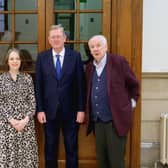
Dr Tomoya Obokata, assistant director of the Human Rights Centre at Queen's University in Belfast, said it was impossible to say how many youngsters were involved because
the true extent was masked by "private fostering".
Dr Obokata said people-trafficking into the Province was "becoming a big problem" with recently published reports indicating that this involved children.
"But this can be hard to prove because children arrive into the UK to be privately fostered," he said.
"The law can be lapse with regards to this and it is hard to detect as these children are quite hidden.
"How do you prove they are being trafficked when they are met at airports by so-called aunts and uncles.
"There is also a lack of resources on the part of PSNI and immigration."
Dr Obokata said he had noticed a huge increase in the number of Romanians, including children, arriving in the Province.
"I have seen the incredible numbers of Romanian people flooding into Northern Ireland and selling the Big Issue," he said.
"I noticed the big numbers coming over at the end of last summer. I know Romania is now part of the EU, but the numbers coming over had to be organised."
Dr Obokata was speaking out on the day of the Human Rights and Human Trafficking conference at Queen's University.
Statistics suggest that 600,000-800,000 men, women and children are trafficked across international borders each year.
Some 80 per cent are women and girls, and 50 per cent are children.
Alliance MLA Anna Lo has estimated that at least 2 ,000 women from China's mainland are working illegally in Ulster.
But Dr Obokata said the nature and extent of trafficking in Northern Ireland "is hard to grasp because of its secretive nature".
He said: "Anna Lo spoke of some 2,000 women, illegal Chinese migrants working here. She said she suspected that many of these people have been trafficked.

"I think that is true. But I think her estimation is way too low. Official statistics even by the US government are of 600,000 to 800,000 people being trafficked worldwide.


"I could not estimate the number for Northern Ireland at the moment but the statistics from the Home Office say that at least 4,000 women are trafficked into the UK for sexual exploitation.
"Again I think the figure of 4,000 people trafficked is way too low as people are trafficked into the UK for other purposes including factories, agriculture and catering.
"Statistics are difficult in Northern Ireland, particularly because of the geography. There are people brought up from the south and also from the mainland UK.
"People are either coerced or deceived. But people can be kidnapped, in particular children. Children would be the easiest to kidnap or abduct.
"People can also be deceived that they are being promised a good job in the country or a good job in London. They have to pay their way.
"Repaying the debt is very difficult. Some have to repay as much as £1,000 a month. Victims do not come forward because they are afraid of retaliation. This is a huge problem."
Dr Obokata said Chinese triads and west African groups were involved in trafficking in Northern Ireland and across Britain generally.
"But once the migrants reach their destination they go into the hands of local groups. This can be either be individual organisations like paramilitaries or triads."