
Auction in Dublin on Tuesday to celebrate the acclaimed Belfast artist Deborah Brown’s ground-breaking works


Belfast in the late 1950s might seem an unexpected place to see some of the most progressive contemporary art in the UK.
But within a few years of the appointment in 1957 of Anne Crookshank as Keeper of Art at the Belfast Museum and Art Gallery (which became the Ulster Museum in 1962), she had begun to use her contacts, expertise and independence of judgement to enable acquisitions for the collection of works by artists who are now regarded as some of the leading figures in international twentieth century art, such as Helen Frankenthaler, Jean Dubuffet, Antoni Tàpies and Morris Louis.
At the same time, in her studio in Cathedral Buildings, the artist Deborah Brown was painting and constructing the most progressive and challenging art being made in Ireland.
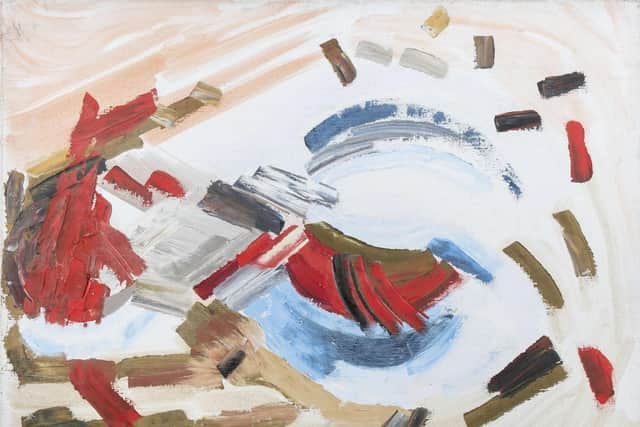
In 1958 she started painting gestural abstract works that were close to the American abstract expressionists, at a time when artists like Jackson Pollock and Mark Rothko were only just becoming well-known in the UK.
This work is a far cry from her early upbringing and artistic inspirations.
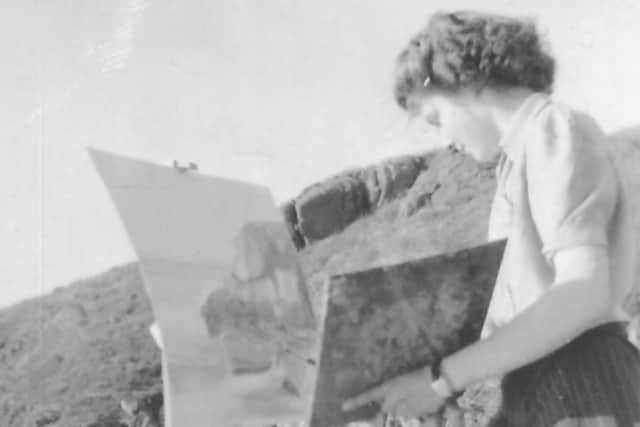
Deborah Brown was born into a prosperous Belfast family in 1927, but spent much of her childhood at Cushendun, where she received her first informal art lessons from the popular landscape painter James Humbert Craig, who was a family friend.
Her early work reflected his influence and it was only when she spent some months in Paris in 1950 that an awareness in European modernism began to transform her work.
Deborah Brown held a number of successful solo exhibitions in the early 1950s, at prestigious venues in Belfast, and Glasgow, as well as showing work in London and Dublin. John Hewitt, the poet and then Keeper of Art at the Belfast Museum and Art Gallery, was an early admirer of her work.
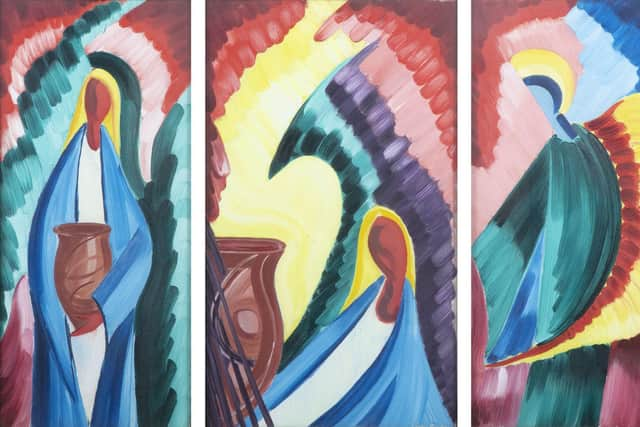
In the mid-1950s she became increasingly drawn to a more abstract manner of painting, partly influenced by the experience of making stage designs for Mary O’Malley’s Lyric Theatre.
Her large-scale abstract paintings of the late 1950s and early 1960s began to bring Irish art closer to the international avant-garde of the time, and in 1961 Brown began to cut through the canvas, adding everyday materials usually far removed from art, such as nails, thread or papier mâché to paintings, prefiguring the Italian Arte Povera movement that became prominent in the mid-1960s.
In 1964 she began to shape fibreglass and add it to her paintings, eventually making freestanding fibreglass sculptures.
Even today this work is extremely challenging.
With limited opportunities to exhibit in Ireland when it was first made, Brown showed with galleries further afield. But gradually, in the late 1960s, this began to change, and she won a series of awards and was included in many touring exhibitions of leading Irish artists (her old school in Belfast, Richmond Lodge, now Victoria College, even acquired a fibreglass work).
Having pushed artistic boundaries in Belfast, Deborah Brown made another striking shift in the early 1980s, when her empathy for people and her interest in animals began to be expressed in sculpture.
In 1991 she made arguably her best-known work, Sheep on the Road, which is now situated outside the Waterfront Hall in Belfast. In 2002 she donated a bronze sculpture of a goat, Johann, to Cushendun, and another popular later work was Suzie the City Cat, a bronze sculpture commissioned in 2004 for Belfast’s Donegall Road.
2005 saw the launch of a book about Deborah Brown, and an exhibition of her work at the Ava Gallery, Clandeboye Estate, while the F.E. McWilliam Gallery in Banbridge held a major retrospective exhibition in 2012-13.
Yet the extraordinary ambition and courage of her earlier work was often overlooked, and it was the discovery of a large number of early paintings that had been in storage for, in some cases, as long as seven decades, that initiated discussions with museums and other institutions about how to present this remarkable and hitherto unknown work.
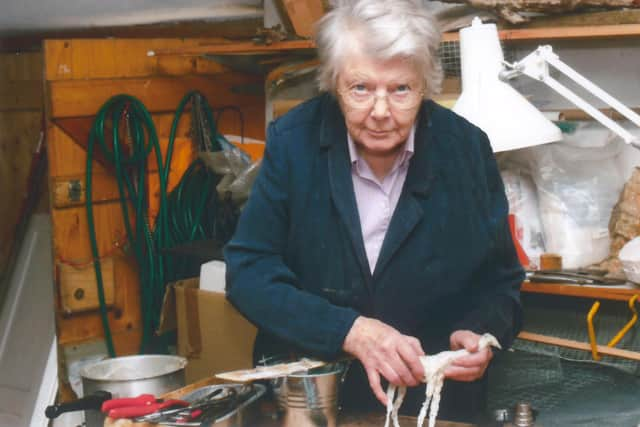
Deborah Brown died in April 2023, in Ramelton, where she had moved two decades earlier after many years living in south Belfast. She was a warm and extremely kind person remembered fondly by everyone who had known her.
She was always keen for her art to reach a new audience, and the first stage of this will be an auction at Adam’s in Dublin (www.adams.ie) on Tuesday, October 1, of works from all periods of her career, alongside her own collection of works by her friends.
It is hoped that this will be followed by institutional exhibitions that will begin a much-deserved re-assessment of her true place in the history of Irish art.
In the late 1950s and 1960s, there was arguably no other artist in Ireland making work as ground-breaking and radical as Deborah Brown.
Just as many of the artists Anne Crookshank identified as so significant in the late 1950s are now recognised as among the leading, and most collectable artists of their time, the significance of Deborah Brown’s work in Irish art history is now beginning to be appreciated.
The auction at Adam’s provides an opportunity for art lovers to begin to know her work better and to enjoy it in a way of which we hope she would have approved.