
Join Dan Snow on an adventure in Rome as he traces the true history of the gladiators

Last Friday, one of the most eagerly anticipated films of the year was released in cinemas.
Ridley Scott’s Gladiator II, the sequel to the director’s 2000 blockbuster, follows Lucius (Paul Mescal), the former heir to the Roman Empire and son of Russell Crowe’s Maximus and Lucilla (Connie Nielsen), who becomes a gladiator after his home is invaded by the Roman army led by Marcus Acacius (Pedro Pascal).
Lucius seeks revenge against Acacius and fights as a gladiator for Macrinus (Denzel Washington), a former slave who plots to overthrow the emperors Caracalla (Fred Hechinger) and Geta (Joseph Quinn).
At the centre of Gladiator II (and its predecessor) is an iconic building that, to this day, remains one of the most recognisable in the world.
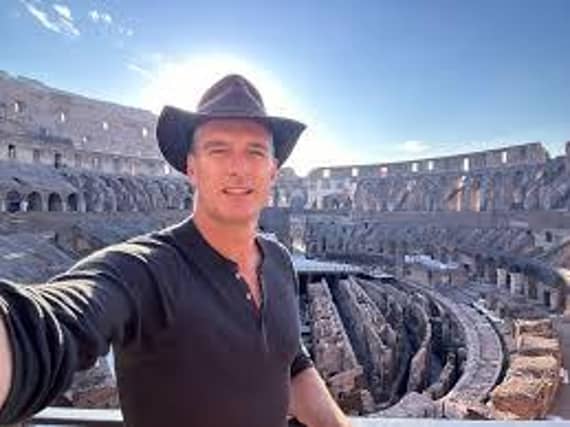
Built 2,000 years ago, Rome’s Colosseum is a must-see sight if you’re visiting the Eternal City.
One of the New Seven Wonders of the World, the Flavian Amphitheatre was built in the 1st century CE at the behest of the emperors of the Flavian dynasty, and was used to stage animal hunts and gladiatorial games.
A symbol of the splendour of the empire, the Colosseum has changed its appearance and its function over the centuries, and today it is a monument to Roman art and ingenuity.
In this timely two-part special, Dan Snow investigates the real story of the Colosseum.
As he separates fact from fiction, the historian discovers which Emperor ordered it, how the Romans built it in just 10 years, and the high price paid by those forced to work on the project.
He begins in 69AD, with the city of Rome in a mess after the disastrous rule of Emperor Nero. But, out of the fires, a huge building rose unlike any across the entire Empire.
This new super stadium would sit right at the heart of Rome, so the new emperor, Vespasian, needed the very best builders to make it.
Dan ventures deep into the caverns beneath Rome that were hollowed out as slaves quarried the vast quantities of rock needed to build the Colosseum.
This included a powder that could be turned into a key ingredient – Roman concrete.
To further explore the design of the Colosseum, Dan joins fans at a modern football match at Rome’s Stadio Olimpico.
This state-of-the-art stadium is remarkably similar to the Colosseum, from the uninterrupted views of the action to the wide entrances that literally ‘vomit’ the crowd in and out of the ground.
Next, the presenter discovers the truth about the famous warriors who fought in the arena, much like Lucius and Maximus in the Gladiator films.
While the Colosseum was rising, the fighters were honing their craft, and Dan visits one of their training centres, the Ludus Magnus, where the gladiators, who were also mostly slaves, perfected their violent skills.
Despite all the preparations, the opening games were almost a disaster – Emperor Vespasian died, leaving his son, Titus, to complete the controversial project.
Dan explores the opening games and the fight that started it all: two of Rome’s most famous gladiators slugging it out for hours before the baying crowds. Exhausted, they turned to the emperor to decide their fate.
Were the gladiators, and the brand-new arena, given the thumbs up or thumbs down?