
Professor Alice Roberts: Why I dig into the past and what NI has taught me
She started out as a junior NHS doctor working in a busy hospital in South Wales before moving into academia.
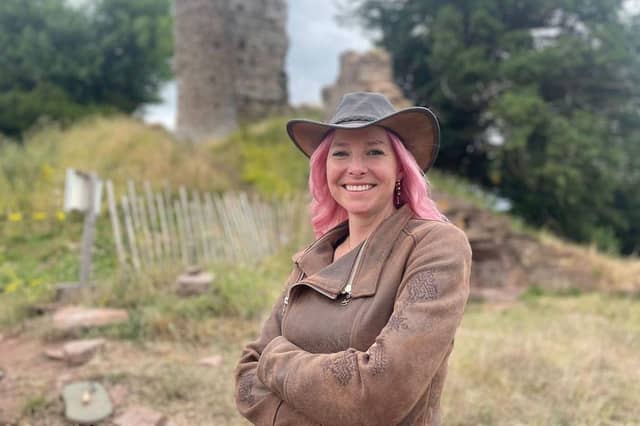

Today, professor Alice Roberts is a prominent anatomist, anthropologist, and author who has hosted over a hundred documentaries, including the BBC series Digging for Britain and Channel Four’s series Britain’s Most Historic Towns.
Professor Roberts is no stranger to Northern Ireland. Some of our most famed landmarks including Cave Hill, Dunluce Castle and the Neolithic sites in Londonderry, have come under her historic microscope.
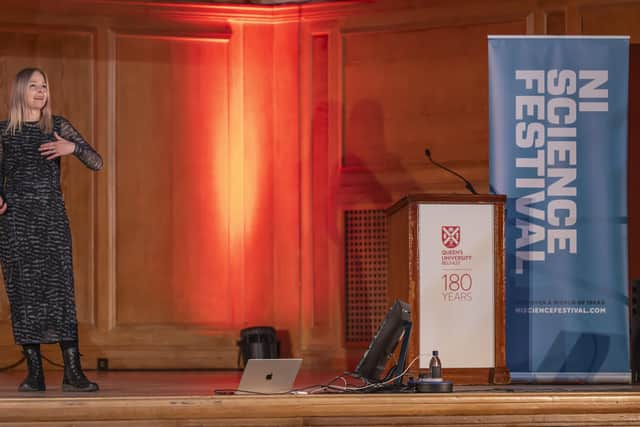
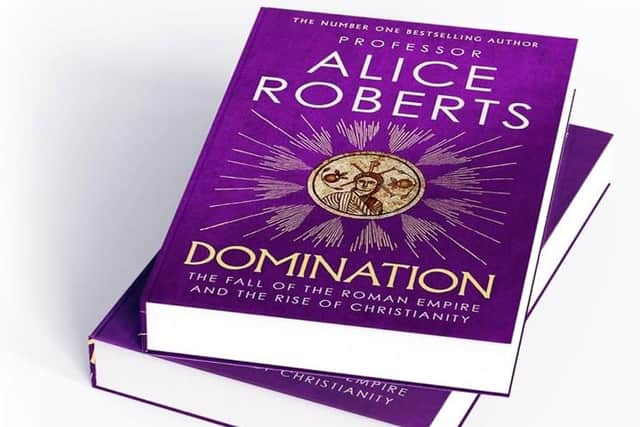
As part of her UK tour, she was among the speakers at this year’s Northern Ireland Science Festival, where, audiences were treated to a spectacular show and were given a flavour of her latest book, ‘Domination - The Rise and Fall of an Empire’.
Speaking via phone from her home in England, professor Roberts shared her passion for unearthing the past and explained how DNA is changing our view of the past.
Question: What is archaeology?
Answer: People often assume that archaeology is only about finding pretty objects. But it isn’t that at all.
Yes, the objects unearthed are often beautiful and fascinating but for archaeologists, they are part of the bigger picture. We want to learn about our ancestors, how people lived, how they interacted with their landscape, their culture and how populations moved around the world.

As an archaeologist, I’m interested in all those social aspects but as a biological anthropologist, I’m equally interested in what we can learn from ancient bones.
Now that we have DNA, we have a fantastic insight into the lives of our ancestors.
When we put all the information together, we learn things we’d never known before, not only about their cultures, but population movement and even the kind of diseases they suffered.
In 2021, along with the Digging for Britain team you visited a significant Neolithic site at Clooney Road in Londonderry where evidence was discovered of two large rectangular houses dating back to 3800BC. What else was found?

The discovery of the Neolithic era settlement helped shed new light on how people lived around the shores of Lough Foyle. We found a lot of lovely pottery etc but there’s a phrase in archaeology that says ‘pots are not people’ meaning we can’t tell about a culture simply by looking at pots!
Before DNA, archaeologists only had theories. We didn’t know how many people were coming to Ireland/Britain, contributing their ideas and cultures to our own.
In broad brush strokes, DNA points to a 90% population replacement in the early Bronze Age, ie, 4500 years ago. Back then a lot of new people were crossing the North Sea, the Channel and the Irish Sea bringing their cultures with them.
There is also wonderful information about the Neolithic burial chambers. We didn’t know if the people in them were related or randomly allocated a space. Thanks to DNA we know they shared a kinship.
There are amazing examples of that in these Irish Neolithic tombs where kin are buried together and even share DNA with other tombs across the landscape.
Have there been any other major discoveries?
Absolutely! In the past twenty years one of the biggest discoveries is the fact that modern humans aka, ‘homosapien’ interbred with Neanderthals.
Thanks to our ability to extract DNA from ancient bones, the evidence is incontrovertible. It’s incredible to think that we all have a little bit of Neanderthal in our DNA, simply because, our modern human ancestors were hooking up with Neanderthals. That was mind blowing!
In centuries to come, what will archaeological digs reveal about us?
It’s interesting to consider which elements of our culture will survive. I’m worried that our great writings will be lost due to everything being stored on the internet.
Are we as a species still evolving?
Yes of course. Evolution is part of biological phenomena. In developed countries, evolution will be at a slower rate than in the past, mostly because we have blunted the Grim Reaper’s scythe by massively reducing infant mortality.
Do you enjoy your visits to Northern Ireland?
Oh yes, it’s a great place! My wonderful friend Julia, from school days, has settled there and I can see why she loves it so much. I take every opportunity to visit her and the family anytime I’m over.
I’ve spoken at the NI Science Festival on several occasions and always enjoyed it. It’s such as fantastic event and I’m always impressed by the breadth of what’s on offer.
Compared to similar events, which tend to be quite narrow, Northern Ireland covers a wide range of subjects including art and music. It embodies my belief that science is very much a part of our culture and not separate from it. My work sits in that interesting area where science meets history.
How long did it take to write Domination?
It’s hard to answer that. Back in the early Noughties, I’d been looking at an ancient Christian cemetery in West Wales and it prompted me to ask questions about the spread of Christianity.
I wondered how it moved from its inception on the far side of Europe to the shores of Wales. I began mulling over ideas which eventually led me to write the book.
As a humanist, some have questioned your interest in Christianity. What’s your view on that?
People have queried my interest in the spread of Christianity, but I don’t see the problem.
As a humanist I treat Christianity as a part of culture. I wanted to trace its spread in the same way I traced other subjects.
I think I’ve treated Christianity as a species, asking how it became so successful.
Can I just add that, as a humanist, I’m delighted by the news that my friend Janet Ellis and former Blue Peter presenter, is the new president for Humanists UK.
l Domination by Alice Roberts is published by Simon & Schuster (£22)