
Simon Schama’s Story of Us: Simon Schama looks at artists who’ve explored why the landscape matters to people's sense of who they are.
Wednesday: Simon Schama’s Story of Us (BBC Two, 9pm)
How has post-war culture shaped who we are?
That’s been the major question behind Simon Schama’s new series over the past fortnight, as he has taken viewers on a tour of loosely connected artistic happenings that, in his view, have not only established Britain as a land of contrasts but also bound us together.
Story of Us began in 1945 – the year in which a new, modern nation emerged from the devastation of the Second World War, and when Schama himself was born.
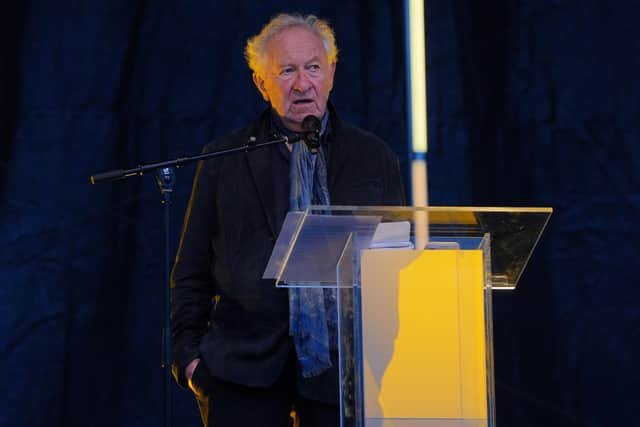

During his lifetime, Britain has been moulded by social and sexual revolutions, secularisation and globalisation, a collapsing empire and boom in migration.
But more than this flux and upheaval, what Schama, in his role as a cultural historian, is interested in are the ideas that have endured and the divisions, disillusionments and doubts.
In the first episode, he looked at the post-war years optimism, meeting Cliff Richard, Jarvis Cocker, Ali Smith and Frank Cottrell-Boyce.
He then examined how mass immigration changed the face of the country, considering the work of James Bond creator Ian Fleming and two-tone band The Specials.
In tonight’s final episode, Our Contested Land, he explains that it is no accident that when people talk about where they are from, they use a word drawn from nature: roots.
But while our love of the countryside is thought to be the one thing that unites us all, the landscape is in fact a theatre of enormous conflict.
Schama looks at the work of writer Philip Larkin, in particular his extraordinary poem Going, Going, and the rapid transformation of Britain’s landscapes and our struggle to keep up with the rising population in overcrowded towns and cities.
Moving onto the early 1970s, Britain and the world slowly became more concerned with the environment, and in the years that followed, period dramas harked back to the days of the ‘green and pleasant land’.
But artists such as Joanna Coates have depicted the countryside not as a rural theme park but an anti-idyll being eroded by those purchasing second homes.
Simon also visits the Scottish Highlands, a land of enchantment that has seduced wealthy adventurers and artists alike.
But behind the stunning landscapes there is a dark side of grief and tragedy.
Using agitprop play The Cheviot, The Stag and the Black Black Oil as an example, Simon tells the story of visionary artists who made us stop and think about our relationship with the land we live on.
From there, Simon heads to Northern Ireland and considers the work of Seamus Heaney.
He speaks to U2 frontman Bono, who explains how Heaney’s poetry as well as his band’s music were linked to the peace process and Good Friday Agreement.
“Culture is always upstream of politics,” Bono says.
Derek Jarman was the centre of the 1980s queer culture in London and his provocative 1986 film Caravaggio was an exercise in kicking down boundaries.
Simon visits Jarman’s extraordinary garden in Dungeness, created as he was dying from Aids, and explains how it touches on our universal need to connect with nature.
Schama concludes the series by asking us to think about what kind of world we want to live in and the role of culture it in.
“People need to think of art and culture not as an add-on, but as a difference between cultural life and death,” he says.
“It’s there that we’ll get the best shot of the endurance of humanity. At least I hope so.”