
The Last Musician of Auschwitz: The story of how inmates of Auschwitz performed and composed music as a lifeline and a way to resist


Monday: The Last Musician of Auschwitz (BBC2, 9pm)
Holocaust Memorial Day is always a time of reflection, but this year the date has an extra poignancy as the world marks the 80th anniversary of the liberation of Auschwitz.
The BBC is ensuring the occasion does not go unmarked. The coverage begins on BBC1 at 2.30pm with 80th Anniversary of the Liberation of Auschwitz. Then at 7pm, Reeta Chakrabarti presents Holocaust Memorial Day 2025, which uses readings, music and personal testimony to remember the victims of Nazi persecution, as well as those murdered in other genocides.
In addition, BBC2 brings us the powerful documentary The Last Musician of Auschwitz, which tells the story of Anita Lasker-Wallfisch, the only surviving member of the concentration camp’s women’s orchestra.
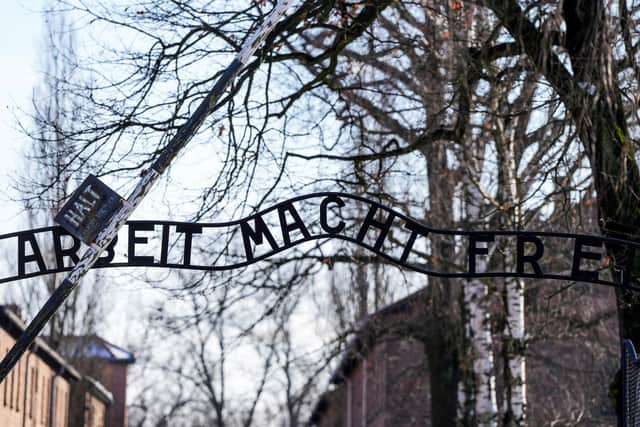
Now 99, she recalls how, when she arrived at Auschwitz, she mentioned that she played the cello, unaware that this chance remark would effectively save her life.
It meant that she could become part of the camp’s official women’s orchestra – one of 15 orchestras ordered to play marches as prisoners forced to carry out slave labour went to and from their work.
Anita looks back on her experiences, which include playing Träumerei (Dreams), from Robert Schumann’s Scenes from Childhood, at the request of the notorious camp doctor Josef Mengele.
The piece is performed in this film by her son, professional cellist, Raphael Wallfisch.
The documentary also features a series of new performances of musical works written by prisoners at the camp and filmed in the shadow of Auschwitz today, as it brings to life testimony from other inmates.
They include the Polish political prisoner Adam Kopyciński, who was a conductor of the first orchestra at Auschwitz. A handwritten manuscript of his composition Lullaby still survives, and there’s an evocative, nighttime performance of the piece in the grounds of the former camp commandant’s house, adjacent to the camp itself.
There’s a tribute to the life and work of Polish composer Syzmon Laks in the form of a performance of the plaintive second movement of his Third String Quartet, based on Polish folk tunes.
Czech and Jewish songwriter Ilse Weber was inspired to write her moving work, And The Rain Falls, after sending her eldest son to safety on the Kindertransport. The programme also features a performance of Wiegala, a poignant lullaby she sang to comfort children on their way to the gas chambers.
Roma and Sinti people were also sent in their thousands to Auschwitz, and here expert musicologist Petra Gelbart, herself of Roma descent, performs a song (‘There Is A Big House In Auschwitz’) believed to have been first sung at the camp and passed down through her family.
Through these stories and compositions, including an emotional rendition of the Jewish Deathsong which concludes the film, The Last Musician of Auschwitz explores how during a time of unimaginable horror, music could be an escape and a source of consolation, as well as a way of sharing and preserving stories we can never allow ourselves to forget.