
Government's budget move on sea border 'does not solve the problem' say unionists as business groups criticise wage hike
There was criticism of the Irish Sea border amongst the reaction to the budget today.
Some £16.6m was confirmed to, in the Treasury’s words, “create a 'one stop shop' support service to help businesses cut through bureaucracy, navigate the Windsor Framework, expand trade across the UK and benefit from Northern Ireland’s unique dual access to the UK and EU markets”.
Suzanne Wylie, Chief Executive of the business lobby group the Northern Irish Chamber, said: “We welcome the £17m support package to help Northern Ireland businesses navigate the Windsor Framework.
"This is a positive step, but more must be done to address regulatory divergence and tackle customs barriers that continue to constrain trade.”
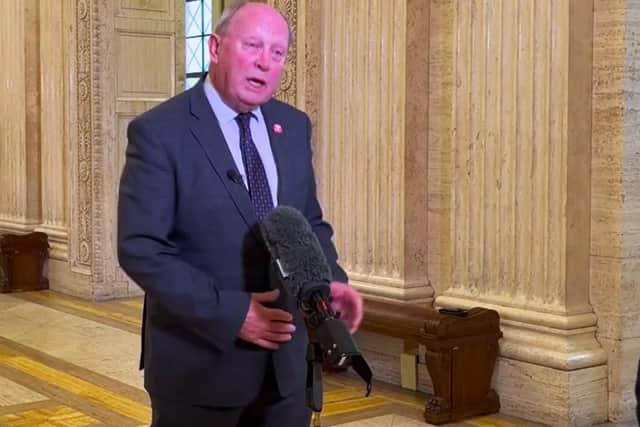

Jim Allister said that this attempt to “ameliorate the disastrous Irish Sea border” actually works out to be less than £5m per annum for three years, adding: “Business and growth continue to be sacrificed to sustain the partitioning of the UK through the international customs border impeding our trade.”
DUP MP Sammy Wilson called it “tokenism which recognises the problem, but is treating the symptoms rather than the cause”.
Robin Swann said the £16.6m package “is an acknowledgment of the challenges businesses face under the Windsor Framework – but falls far short of addressing the real problem, trade divergence.”
He added: “So, rather than sort the issues, money is being spent on systems and structures.
"Until this government faces the reality that Northern Ireland operates under different rules than the rest of the UK, businesses will continue to struggle with uncertainty and extra costs.
"Support services help, but they do not remove the structural barriers created by the framework.”
Another source of complaint from business lobbyists was the hike in wages contained in the budget.
Glyn Roberts, Chief Executive of Retail NI, said: “An inflation-busting rise in the Living Wage so soon after last year’s huge increase and the National Insurance hike will be a heavy blow to struggling independent retailers and small businesses.”
Anna Doherty, Chief Executive of the Derry Chamber, said: “The steep rise in the National Minimum Wage underscores the issue.
"We all want workers to be properly rewarded, and higher wages are a positive outcome in principle, but this increase comes on top of years of cumulative rises and higher employer National Insurance contributions, pushing up the cost of doing business at the very moment when we’ve been urging the private sector to invest.”
Colin Neill, Chief Executive of Hospitality Ulster, said: “This budget does nothing to alleviate the pressures facing Northern Ireland’s hospitality sector.
"There has been no action affecting the local sector on business rates or VAT, the two measures that could provide real relief, while wage rises have further increased operating costs.”
And Angela McGowan, director of the CBI Northern Ireland, said: “Coming on top of the rise to the National Living Wage, increased employment costs will make it even more expensive for employers to offer jobs to young people and jobseekers.”