
Harland & Wolff shipyard: Former employee talks about how his painting hobby turned professional capturing iconic cranes
This year marks the 50th anniversary of the installation of Samson, the second of the two cranes at Harland & Wolff Shipyard.
Together, Samson and Goliath have become more much that important structures in the building and repair of ships.
Over the past half century, they have become a brand symbol for Northern Ireland.
Any tourist shop will have images of the cranes on items ranging from mugs to pot plant holders.
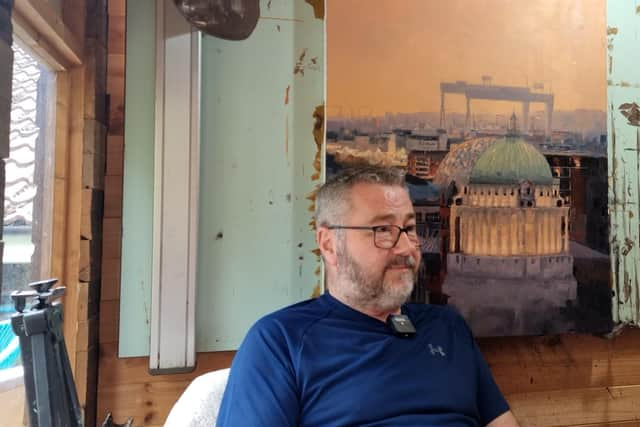

And most art galleries will have at some times have sold paintings of the two yellow giants.
One man who knows a thing or two about their impact on the art world is east Belfast artist Colin H Davidson. He has painted almost 1000 images of the cranes: “Since around 2005 I must have painted upwards of 1000 paintings of the cranes, the shipyard and surrounding areas,” he recalled.
Colin had been an amateur artist while working full-time in the shipyard: “I have a colour-blind imbalance which really frustrated me when I was trying to paint local country scenes like Scrabo or the Mourne Mountains.
"My wife then suggest I paint images of the cranes, saying it would be nice, given my employment history and that of my family
"My first thought was to wonder who on earth would want any image of the cranes handing on their walls. But I decide to give it a go.”
Colin’s first painting was entitled: "Waiting for my Da” and was an image drawn from the top of Dee Street of the workers leaving the Yard at the end of the day.
He then supplied a local gallery with several Yard based works, all of which sold quickly,
An exhibition followed, which was a sell-out.
Colin’s reputation grew and he was commissioned by the Titanic Hotel in Belfast to do eight Yard based paintings, which now hang in what was the shipyards former drawing office.
“In my paintings I have tried to capture a moment in time when either a family member or a friend may have worked there.
Often the people who come to me will tell of a relative who has since died who worked in the Yard and they want something to help keep alive their memories.
For me, whether you are coming into Belfast by plane, boat or on the road, when you see the cranes, you know you are home. They really spell out to that ‘We are nearly there. We are nearly home.’”