
New Stena ferry Connecta features unique Rotor Sails on Belfast to Heysham route
A New Stena ferry coming into service in Belfast on Friday has the unique feature of Rotor Sails - which can deliver up to 9% savings on fuel.
The Connecta - the latest purpose-built freight vessel commissioned by Stena Line for the Irish Sea - is due to begin service linking Belfast with the port of Heysham in Lancashire on 23 January.
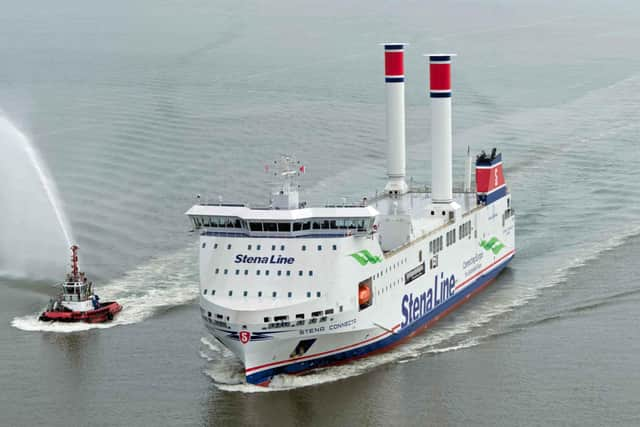

Alongside sister vessel Stena Futura, which started service on the route in October, the two new ships offer an additional 40% freight capacity on the route in response to rising demand.
As hybrid vessels, Stena says the two ships represent a significant step forward in sustainable shipping, built to operate on methanol and able to use battery propulsion and shore power, when available.
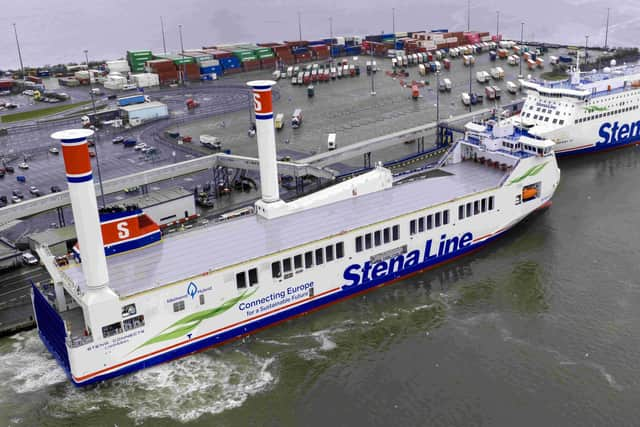
Uniquely, Stena Connecta has two 28m x 4m Norsepower Rotor Sails, designed to enhance energy efficiency and deliver up to 9% fuel savings.
Rotor sails are large spinning vertical cylinders on the deck of a ship. Moving air pulls the cylinders to one side causing them to spin and create sustainable electricity.
The Connecta, like Stena Futura, is a ‘New Max’ RoRo ship which contains almost 2.9km or 1.8 miles of drivable vehicle lanes across all decks in which to carry cars and HGVs.
Paul Grant, Stena Line Irish Sea North Trade Director, said: “Our significant investment in Stena Connecta and Stena Futura - more than £100m - demonstrates our strong confidence in the continued growth of the Irish Sea region and our commitment to strengthening trade and connectivity links.
“In 2025 our Heysham – Belfast freight service recorded its highest volumes in the last 5 years with 113,000 units being shipped. These vessels were commissioned in response to this increasing customer demand for increased freight capacity on this route."
He added: “When operational both vessels will offer a choice of up to 24 sailings per week on the increasingly popular Belfast-Heysham service. We are particularly pleased to introduce two of Stena Line’s most advanced vessels to the Irish Sea region further enhancing Belfast’s significance as a key network business hub.
“These vessels represent the very latest in maritime technology and will not only play a crucial role in maintaining essential transport links in Ireland and the UK but also make a significant contribution to our sustainability goals of reducing CO₂ emissions by 30 percent by 2030.”
Heikki Pöntynen, CEO of Norsepower, commented: “Stena Connecta is a strong example of how forward-looking vessel design can combine operational efficiency with tangible emissions reductions. By integrating Norsepower Rotor Sails alongside hybrid propulsion and alternative fuel readiness, Stena Line is demonstrating a practical, data-driven approach to decarbonising short-sea shipping.
We are proud to support Stena Line and Stena RoRo in bringing scalable wind propulsion into everyday commercial operation on the Irish Sea.”
Both vessels are ‘methanol-ready’ which will play a key role in Stena Line sustainability strategy as a sustainable alternative to fossil fuels.
Green methanol is produced from low-carbon sources such as carbon capture - or by using heat, steam, and oxygen to convert agricultural waste into methanol.
Shore power is when ships plug into shore based power sources, where available, to charge their batteries. This reduces the need for auxiliary fossil fuel engines to be used onboard to generate electricity.