
Stena Line to launch two green hybrid freight vessels on Belfast-Heysham route, Futura and Connecta - battery power, methanol, shore power and rotor sail ready
Stena Line is launching two new freight vessels from Belfast to meet a surge in trade with Great Britain - both of which have innovative green technologies.
Once both are operational, Stena Futura and her sister ship Stena Connecta will enhance freight capacity by 40% on the Belfast-Heysham route - in response to an increase in customer demand for services between Northern Ireland and Great Britain.
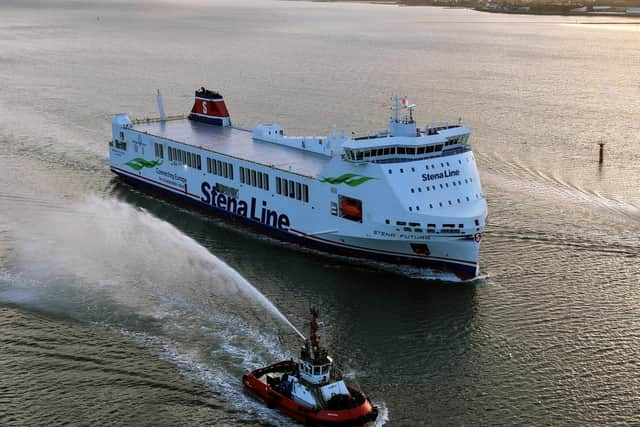

The multimillion-pound purpose-built Futura will go into service on the freight-only Belfast to Heysham route on Monday, 22 September.
The 147-metre hybrid vessel will operate 12 sailings per week providing much needed additional freight capacity on the popular route, which connects local hauliers directly into the key North of England road freight network.
The Connecta is currently under construction and due to enter service, also on the Belfast-Heysham route, in early 2026.
The hybrid vessels are designed to exploit a range of innovative green energy sources - methanol, battery power, shore power and rotor sails.
Both vessels are ‘methanol-ready’ which will play a key role in Stena Line sustainability strategy as a sustainable alternative to fossil fuels.
They are further enhanced with built-in technologies that will be able to utilise both battery propulsion and shore power, when available.
Connecta is also being delivered “rotor sail ready".
Green methanol is produced from low-carbon sources such as carbon capture - or by using heat, steam, and oxygen to convert agricultural waste into methanol.
Rotor sails are large spinning vertical cylinders on the deck of a ship. Moving air pulls the cylinders to one side causing them to spin and create sustainable electricity.
Shore power is when ships plug into shore based power sources, where available, to charge their batteries. This reduces the need for auxiliary fossil fuel engines to be used onboard to generate electricity.
Paul Grant, Route Director Stena Line said the two vessels represent an investment of over £100 million, highlighting the company’s commitment to its Irish Sea network.
"The ships were commissioned in direct response to customer demand for an increase in freight capacity on our routes and we are delighted to see the first ship enter service,” he said.
“These vessels represent a crucial step in our broader sustainability journey. By integrating battery propulsion and shore power capabilities, we are making significant strides towards our goal of reducing CO2 emissions by 30% by 2030, reinforcing Stena Line's position as a leader in sustainable shipping."
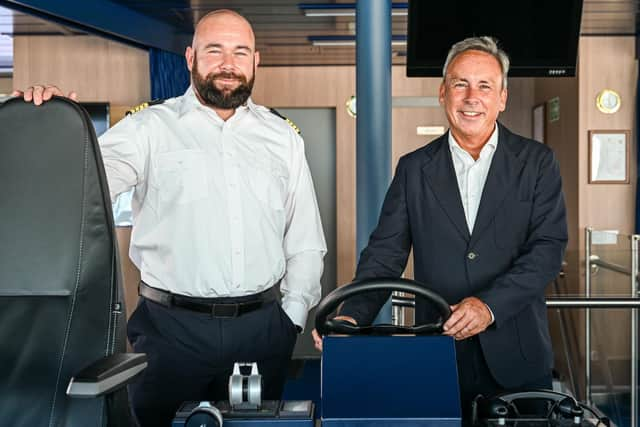
Joe O’Neil, Chief Executive of Belfast Harbour, said the whole team at Belfast Harbour is “looking forward to seeing this state-of-the-art vessel entering service on one of our most important freight routes”.
Phil Hall, Port Director at Peel Ports Group, said the arrival of Stena Futura marks “an exciting new era of sustainable, greener shipping” across the Irish Sea.
He added: “Our own investments to upgrade the Port of Heysham, alongside the long-standing and valued partnership with Stena Line, will enable an improved, more resilient, and environmentally responsible gateway for our customers.”
Stena Line says it is the largest ferry operator on the Irish Sea, with the biggest fleet providing up to 238 weekly sailings. It offers passenger and freight services from Belfast to Cairnryan and Liverpool, Dublin to Holyhead, Rosslare to Fishguard, in addition to the dedicated freight only routes from Belfast to Heysham and Dublin.