
Whiskey emerges as key driver in Northern Ireland’s economic growth
The value of drink exports, especially Irish whiskey, from the Republic of Ireland grew by 19 percent to almost £2 billion.
The recent study of the growing importance of whiskey distilling to the Irish economy was produced by Bord Bia in Dublin, the Republic’s food and drink export body.
Whiskey and gin exports from Northern Ireland, while outside the Bord Bia framework, of course, have also been growing steadily in recent years from a series of distilleries including Old Bushmills, the world’s oldest licensed distillery, along with Dunville’s, Shortcross, Hinch, Mourne Dew, Two Stacks, Killowen and Copeland, all located in Co Down, McConnell’s and Titanic, both Belfast. Whiskey exporting has also become a driver of Northern Ireland’s exports.
Bushmills remains the leader and sold a record one million nine-bottle cases last year. The distillery has significantly expanded its portfolio of premium single markets for global clients. The Sexton, another hugely successful local single malt, is also produced at Bushmills by master blender Alex Thomas.
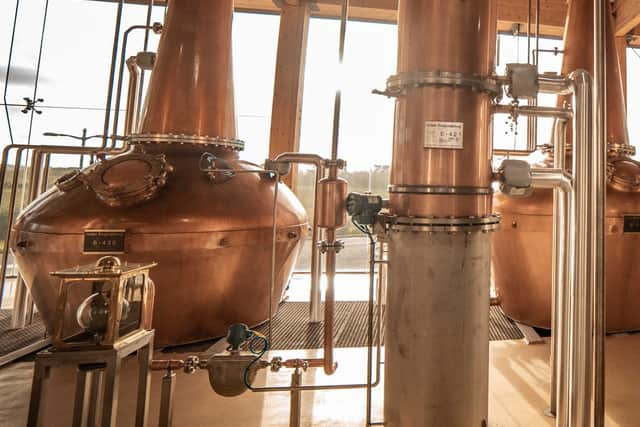

Interestingly, Two Stacks in Newry has produced ‘Dram in a Can’, a first canned whiskey that’s widely acclaimed as among the global industry’s most innovative products. Furthermore, the Irish Whiskey Association, the representative body for distilleries across the island, is chaired by Helen Mulholland, former Master Distiller at Bushmills. She now holds a similar position at Sazerac Ireland in Sligo, the owner of industry leaders like Paddy’s and Michael Collins and believes Irish whiskey should be promoted as an-island industry.
The US remains the biggest market for Irish whiskey. It’s a market, however, that could be impacted by the threat of trade tariffs from the Trump administration to protect bourbon, a sector there that has seen distillery closures.
The overall value of Ireland’s food, drink and horticulture exports increased by five percent last year to hit a record £14 billion, according to Bord Bia’s Export Performance and Prospects Report for 2024/25. The value of Irish drink exports, in particular, grew by 19 percent in 2024.
The value of the Republic’s drink exports grew to just over £1.8 billion, with ‘ready-to-drink’ (RTD) beverages achieving a threefold increase year-on-year to £200 million.
Whiskey exports increased by 13 percent to a value of more than £845 million across more than 100 global markets. Exports of vodka-based RTDs were worth
£200 million in 2024, an increase from £46 million on 2022.
Cream liqueur exports grew by five percent, but remained slightly down on 2022
levels, while beer exports were nine percent ahead of 2022 levels. Large volumes of
Bailey’s, the category leader at Mallusk in Northern Ireland.
Bord Bia said: “This performance marks a milestone year for Ireland’s food and drink
exporters, despite enduring global trade challenges caused by geo-political
instability, fluctuating inflation and on-going high trading costs.
“Higher pricing was the primary driver of growth in 2024, as cost pressures and
inflation continued to affect businesses and consumers.”
However, several categories also recorded volume, as well as value growth, most
notably within seafood, prepared consumer foods (PCF), and meat and livestock.
The value of Irish dairy exports, which is the largest category of food exports,
remained stable at £5 billion, despite weather conditions throughout the year
affecting grass-growth. Total meat and livestock exports increased by six percent to
£2 billion driven by higher volumes and values across beef, pigmeat and livestock.
According to Bord Bia, most Irish food and drink exporters remain optimistic about
achieving growth in 2025. Confidence being particularly strong in the European and
UK markets, with over two-thirds of respondents anticipating opportunities for
expansion in these regions.
Bord Bia chief executive Jim O’Toole said: “The robust performance and sustained
success of the Irish agri-food sector is a testament to the industry’s focus on
strategic market diversification, investment in sustainable practices, and commitment
to world-class quality and traceability standards, evident throughout the supply chain.
“The confidence and continued ambition of the industry is clear in the results of Bord
Bia’s CEO Sentiment Survey, showing that most Irish food and drink exporters
remain optimistic about achieving growth in 2025, despite the business environment
and operating challenges.”
Exports to the EU increased by four percent and were worth almost £4 billion. The
EU now accounts for 35 percent of all Irish food, drink and horticulture exports, back
from a 36 percent share in 2023. France, Germany and Belgium accounted for
nearly 40 percent of total exports.
The UK continues to be the largest single market for Irish food, drink and horticulture
exports, with value up seven percent to £5 billion. The total share of exports for the
UK in 2024 is estimated to be almost 35 percent, however, this remains lower than
pre-Brexit trading, highlighting how Irish exporters have sought to diversify their
exports to other markets.
Whiskey: Irish whiskey exports from the Republic of Ireland grew by 13
percent