
Fermanagh historic houses inspire novel
Writers are often asked where we get our ideas and the answers often surprise even ourselves. Our series of novels about Eliza Mace is set very deliberately in the Welsh Marches, a distinctive area on the border with England, yet we clearly recall that we got our first ideas for the books from a single day spent visiting two stately homes in Northern Ireland.
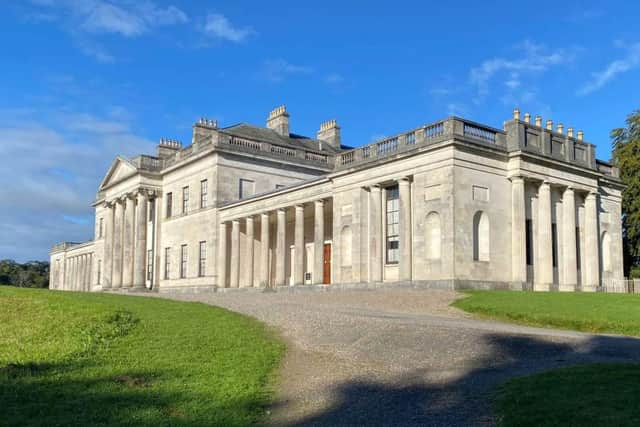
Florence Court and Castle Coole, both National Trust properties, lie within ten miles of each other and have many similarities - each is an imposing house built in the eighteenth-century to accommodate a privileged family whose luxurious lifestyle was serviced by a large staff. Special features of both houses include an ice house, a deep brick-lined pit with a domed roof in which ice, gathered from a local water source in the depths of winter, would be stored, to be hauled up in warmer weather to provide refrigeration for the kitchen. Cold (of course), dark, and featuring a perilous drop, the ice house stuck in our minds and, transported to Wales, forms an important part of the plot of Eliza Mace, the first book in the series.
An oddity of Castle Coole is a large sunken bath conveniently located so that when the Earl returned from hunting, covered in mud, he could dismount, disrobe and step straight into a hot tub. Thinking about the work required to heat the water and fill the bath (not to mention the labour involved in sawing and carting blocks of ice in the depths of winter to fill the ice house) as well as all the daily business of cleaning, food preparation, laundry, water-carrying, keeping lights and fires going in many rooms, answering bells and serving elaborate meals often to numerous guests (not to mention washing up afterwards) brought home to us the sense in which there were two very different and separate worlds in such houses. The 'family' - the aristocrats who were the beneficiaries of all this domestic industry - appeared rather like the serene swan cruising the surface of the lake - and the staff - the small army of servants, paddling away furiously under the surface, keeping it all going.
The extent to which it was desirable to keep a separation between these two worlds was clear at Coole, where a tunnel had been especially constructed so that the servants could move between the house and the service quarters without offending the eyes of their masters. (This was not as eccentric an idea as it now seems: in some great houses servants were instructed that if they met a member of the family in a corridor, they should stop whatever they were doing and turn their faces to the wall until their supposed betters had passed). The awful possibility of masters having to acknowledge the existence of servants was of course greatly reduced in all such houses by having two sets of staircases: an appropriately grand one for the family and a narrow and functional one for the servants.

And the children. This was the biggest surprise for us. At one of the houses the guide pointed out that the main staircase did not even go up to the top floor, where the family's children ate, slept, played and were educated. The house was clearly designed on the assumption that their parents never need visit this floor. While the children might be allowed to come down and see Mama and Papa for perhaps half an hour a day they would spend the vast majority of their time with servants until they were deemed civilised enough to join adult society. The guides warmed very much to the theme of the distance between the parents and children. One told how the future master of the house had learned his dance steps as a child from the kitchen servants. The warmth and conviviality conjured up by this bit of information contrasted sharply with another circumstance described to us: the children being allowed to stand against the wall in the dining room and watch their parents eating their dinner, so they could learn their table manners from them, for when the time came. One guide told how the master of the house had come across a small boy while walking in his grounds and demanded to know who he was. 'I'm your son, sir,' came the reply.
If this was not a strictly true story, it didn't matter - it conveyed the quality of relationships if not the absolute fact of a single incident - perhaps a fiction that holds a truth. And in fact it was the willingness of the guides to tell stories that made these visits so rich. Unlike in most National Trust properties, where you can wander about on your own, both these houses required you to join a tour; a guide with local knowledge can go interestingly off piste, where a printed sign or information sheet offers only one authorised version. So it was that we learned that two daughters of the house - probably later in the family's history, perhaps in the 1920s - used to slip out of the library window for unauthorised nocturnal expeditions (another detail we used in Eliza Mace). There is an odd circumstance that the same (huge) set of fine china is split between Florence Court and Castle Coole - we were treated to quite different explanations for this at each house, each equally entertaining.
When we returned from Northern Ireland we were not able immediately to start work on our book - we had teaching commitments to fulfil and by the time we were ready to write the first Eliza Mace book, our idea of where Eliza lived had developed along with the problems she was facing. She now lives in a manor house rather than a stately home, her parents are modest landowners rather than aristocrats, and as they are in financial difficulties due to her father's failings, the staff has dwindled. What remains (apart from the ice house and the window escape) is a sense of being caught between two worlds, but in Eliza's case it's not just between the world of the servants and the family, but between childhood and womanhood; between respecting her parents and seeing their flaws; between being the obedient daughter and the natural adventurer.
Memory is untidy, of course, and when we sat down to write this piece we could not be certain in all cases which of the two houses our recollections related to, so we have had to do a little retrospective research to pin some of them down. But this is actually typical of how source materials develop. J. R. R. Tolkien described how all the experiences we have mix up and mature in the deep darkness of our subconscious like a kind of compost, out of which ideas grow. What emerges has qualities of the materials feeding it, but also has its own new and unique character. It is this mysterious transformation of experience that we call inspiration.