
The Ferguson 20 tractor for Europe that could and should have been built in Northern Ireland
Harry Ferguson didn’t just invent the modern tractor a century ago but his ultimate ideal was the betterment of humanity itself. Ten years of perfecting his invention of 1925 crucially in the quite fields of County Tyrone at Tullylagan Manor outside Cookstown owned by friend and business partner Thomas MacGregor Greer would see the Ferguson Belfast Black Tractor that was built in Belfast from 1931 – 1933 finally a working prototype by 1935 and why County Tyrone is considered very special in the Ferguson System story.
Harry Ferguson in 1934 signed a deal with David Brown of Huddersfield to build the world’s first production version of the Ferguson Belfast Black Tractor with production commencing in early 1936.
The high hopes of the tractor being mass produced by the David Brown Company would quickly evaporate and after two years of production only 700 had actually been built.
This would force Harry Ferguson in the autumn of 1938 to look once again for another company to mass produce an improved version of the tractor and Harry Ferguson was drawn to the mass production facilities that the Ford Motor Company in the USA and a possible deal with Henry Ford could offer.
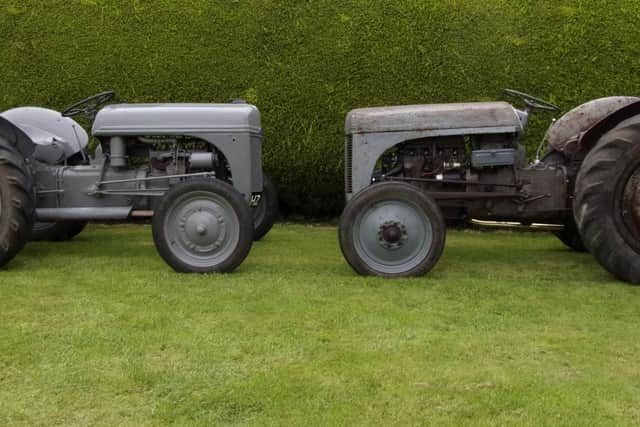

The result after the meeting in the famous “Gentleman’s Agreement” between Harry Ferguson and Henry Ford was that the Ford Company would built a Ferguson System tractor to the design of Harry Ferguson. Harry Ferguson would also market and sell the tractor. The Ford-Ferguson would feature the final component in the evolution of the Ferguson System as standard and that was the central Power Take Off to allow implements to be driven by the tractor’s engine.
The revolutionary Ford-Ferguson would be launched on the 29th June, 1939 and become the world’s first mass produced Ferguson System tractor that would ultimately see over 306,000 built by the time production ended in 1947. Every tractor today is based on this little grey tractor.
It was always Harry Ferguson’s great hope to build his Ferguson tractor in Northern Ireland and eighty years ago that came so very close to actually happening. The farmers of Northern Ireland knew the value of the Ferguson System in the Ford-Ferguson and over 3,000 would be in use here by the end of the war. That number could easily have been double if the tractors had been available and with continued high demand for the tractor, Harry Ferguson knew he had a market to sell any tractors he could build.
By July, 1945 and the end of the war in Europe Harry Ferguson was back in Northern Ireland after spending 5 years in the USA and making detailed plans for an improved Ford-Ferguson which he called the Ferguson TE20 (Tractor Europe 20HP). Improvements included a new 4 cylinder Overhead Valve engine, 4 speed transmission to replace the three of the Ford-Ferguson and other small changes to the brakes and extra mounting points to allow a wider range of implements to be attached to the tractor. The bonnet also tilted forward to allow easier access to the engine, battery and fuel tank.

Harry Ferguson based the tractor closely on the Ford-Ferguson as he owned the intellectual property rights to the tractor and not the Ford Motor Company who only built the tractor.
Initially the government in Northern Ireland under Prime Minister Sir Basil Brooke who was a long-time friend of Harry Ferguson and who supported his development of the Ferguson System from its earliest days, agreed that Northern Ireland would build the new tractor in a now unused factory in Belfast. Harry Ferguson already had manufacturing facilities with a factory in Moira, County Down manufacturing Ferguson implements since 1944 and gave interviews to the press of wanting to build 1,000 tractors a day in Northern Ireland. Just think what that could have done for the economy of Northern Ireland.
However under a new Labour government led by Clement Attlee who became British Prime Minister on the July 26, 1945 things started to change and the UK government would not release the materials to build the tractor in Northern Ireland. The result was that Harry Ferguson would with great regret have to accept production of his Ferguson tractor despite being designed in Northern Ireland would not be built here.
He would sign an agreement in October, 1945 with Sir John Black of the Standard Motor Company, Coventry to build the tractor in the Banner Lane factory. The factory had built aero engines during the war and would be repurposed for tractor production. The tractor was still called the Ferguson TE20 but the TE now stood for Tractor England. Once again as with previous Ferguson practice it would be built to order for the Ferguson Company.

When the announcement was made that the Ferguson tractor was not going to be in Northern Ireland it was greeted by sadness and dismay. The announcement in the local papers was made under the headlines “Ferguson Tractor Lost to Ulster.”
When we consider the amount of equipment Northern Ireland produced for the war effort in the large numbers of ships, planes, tanks and armaments, the mass production of the Ferguson TE20 tractor in Northern Ireland was entirely feasible and economically viable. The only issue was being able to get a casting plant to cast gearboxes and other gear components for the tractor, but even that could have been resolved by having the castings cast and gears cut in England for example like what the Standard Motor Company did anyway and shipped into Northern Ireland for machining and final assembly.
Remember there was no customs border between Northern Ireland as exists now and the rest of the UK. The big problem that could not be overcome by Harry Ferguson and Sir Basil Brooke was the Labour government’s flat refusal to provide the £3 million Pounds in funding and materials to assemble the tractor in Northern Ireland.
Eighty years after the Ferguson tractor was sadly lost to Northern Ireland and the question was asked why can Northern Ireland develop these great world beating technologies but not capitalise on actually building them, the same question can still be asked about the legacy of Harry Ferguson by the continued failure in not establishing a Harry Ferguson Museum of Innovation in 2025.