
Former governor of Queen's University Belfast says it is 'preposterous' to put Irish on same footing as English at university
A former Queen’s University Belfast senator has said that the demand to give Irish and English equal weight on campus is “preposterous”.
Peter Weir also pointed to the 20% turnout in last week’s Student Union vote on the topic, saying this shows that this is not a priority for most students.
The student group which was driving the referendum has hit back meanwhile, accusing Lord Weir of seeming to “oppose a truly shared environment”.
The Students’ Union had carried out a week-long vote, which ended last Thursday, asking Queen’s’ management to introduce bilingual signs and branding for the institution, and adopt a policy “that gives the Irish language equal status to the English language”.
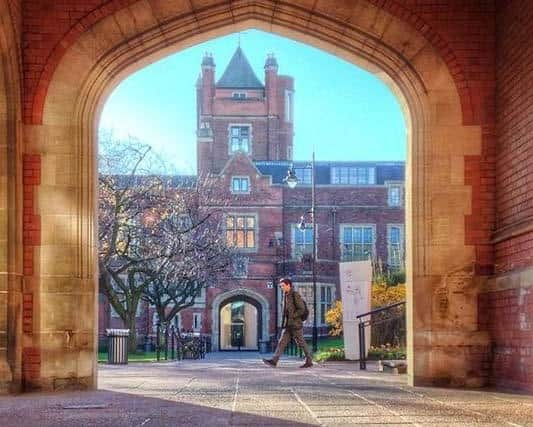

About 5,000 of the university’s 25,000 students voted. Of those who did cast a vote, 91% were in favour.
Lord Weir studied law at Queen’s, and was a former leader in the UUP’s university branch.
He was also education minister intermittently from 2016 to 2021, and served on the Queen’s senate – the university’s governing body – during the 1990s and 2000s.
He told the News Letter the proposals risk making Queen’s “a cold house for unionists”, and “the university have got to think long and hard so they do not alienate sections of the community by that”.
“Signage would send out a signal of sort of marking of territory,” he said.
"But I also think it’s fairly preposterous to claim that the two languages are entirely on an equal footing because English would be the language that virtually everybody at Queen’s speaks.
"Irish, as indeed with other languages, is very much a small minority language, and I suspect may not even be the second most-spoken language within the university.”
Of the 20% turnout, he said it indicates most students “don’t particularly want anything to do with the issue, and don’t want to be involved”.
"I think it certainly calls into question how pressing this is for the vast majority of students,” he added.
He said many unionists already shun involvement with the Students’ Union, and this vote could “only lead to greater levels of disengagement”.
Eoghan O Conghaile of the student group An Cumann Gaelach, which was one of the driving forces behind the referendum, said: “It is our understanding that this was one of the biggest democratic exercises to ever take place within QUBSU in regard to turnout.”
He said there has been a 227% increase in the number of students studying Irish at QUB over “recent years”, and that “Beal Feirste/Belfast boasts one of the highest percentage of daily Irish speakers in Ireland alongside Baile Atha Cliath/Dublin”.
"Lord Weir's remarks, in that context, seem to give preference to exclusion over inclusion, to prioritise ‘English-only’ policies, rather than dual-language approaches, and to oppose a truly shared environment where both English and Irish can co-exist in harmony,” he said.
"Just 407 students voted 'No' in the referendum. This opposition represents 1.6% of the student body at Queen's.
"In our opinion, that illustrates that opposition to language rights and equality is virtually non-existent amongst the overall student body and that a campaign to manufacture opposition and to amplify controversy was overwhelmingly rejected by a vast, vast majority of students who chose rights and equality over fear and exclusion.
"Does Lord Weir suggest that it is preposterous that Scots-Gaelic is given equal status to English within both universities and society at large in Scotland, or that it is preposterous that the same equality exist for the Welsh language in universities in Wales?”
Queen’s University itself said the referendum generated “strong student engagement in an important campus debate”, adding that “the university already has strong Irish language provision and will continue to support and promote it as part of campus life”.
It said the institution has “proactively engaged” with both the Irish Language Commissioner and the Commissioner for Ulster Scots and the Ulster British Tradition.
The former “is currently developing proposals for public institutions and has asked for the time and space to complete this work,” and that “we look forward to working with both commissioners on their proposals”.