
Research confirms Old Irish Goat herds today are closely related to 3000 year old goats in Armagh and Carrickfergus
New research has confirmed what local communities and conservationists have long believed - that the Old Irish Goat breed is a living piece ancient history is linked by DNA to ancient goats from 3000 years ago.
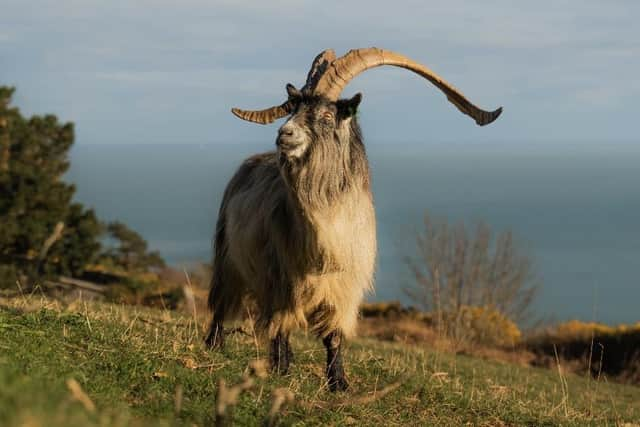
Known historically as 'an Gabhar Fiáin' – the wild goat – the Old Irish Goat is deeply rooted in Irish folklore.
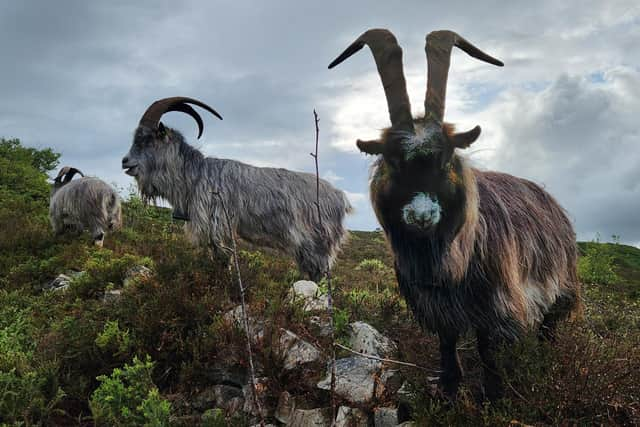

Surviving today in small wild-roaming, feral herds, it has long been viewed as a symbol of resilience, wisdom, and marginal rural life, where their hardiness, capacity to survive on marginal land, and nutrient-dense milk made them invaluable to small farmers.
Led by University College Dublin, in collaboration with Queen’s University Belfast (QUB) and international partners, the new biomolecular and archaeological study reshapes the understanding of Irish agricultural history and shows the importance of conserving the critically endangered breed – as a living link to ancient farming communities.
Researchers analysed goat remains from the hillfort at Haughey’s Fort in Co Armagh, dating to around 1100–900 BC, and the medieval town of Carrickfergus in Co Antrim.
Radiocarbon dating, genetic and protein analyses confirm that these Late Bronze Age remains are the oldest goat remains to be identified on the island of Ireland.
DNA comparisons reveal that the ancient remains from Armagh and Carrickfergus are most closely related to the critically endangered Old Irish Goat population that still survives today.
Sinead Keane, from The Old Irish Goat Society, says: “This research is a huge milestone for the Old Irish Goat, and provides powerful scientific validation of what local communities and conservationists have long believed – that the Old Irish Goat represents a living piece of our ancient heritage. It also underscores the urgency of protecting this critically endangered breed, which carries within it a living genetic record of Ireland’s ancient past.”
Ancient DNA was extracted from the ancient goat remains and compared with hundreds of modern goat breeds worldwide.
The study found that both prehistoric and medieval Irish goats share their highest genetic affinity with the surviving breed of the Old Irish Goat, pointing to a remarkable continuity of goat populations on the island over three millennia.
The research also sheds light on more recent changes in the breed. While medieval goats showed varied genetic profiles, Old Irish Goats today display clear signs of inbreeding linked to a dramatic population collapse over recent decades.
Co-lead author Assistant Professor Kevin Daly from the School of Agriculture and Food Science at University College Dublin, says: “Combining genetics, proteomics, and archaeological science has allowed us a glimpse of our animals hundreds and thousands of years ago – and how their descendants likely still live with us, as part of our biocultural heritage.”
Co-lead author Professor Eileen Murphy from QUB, said that historical sources suggest that “herds of goats may have been kept to supply a trade in skins from ports such as Carrickfergus”.
Dr Jolijn Erven, also co-lead author, added that despite thousands of years, changing farming practices, and recent decline, the Old Irish Goats goats have retained “a remarkable genetic connection to their ancestors, and to the island’s agricultural past”.
Dr Judith Findlater from QUB undertook detailed research as part of her PhD on Medieval Carrickfergus but sadly passed away prior to publication of the study.