
Lip-reading software gives 'voice to the voiceless'
Liopa, a spin-out company from Queen’s University’s Centre for Secure Information Technologies(CSIT) has brought to market its lip-reading software which aids communication for patients who have lost the ability to speak.
The Speech Recognition Application for the Voice Impaired (SRAVI) has already been licenced by the
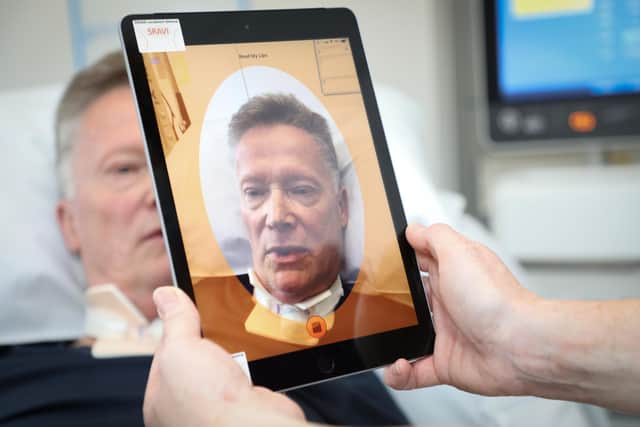

Royal Preston Hospital in England. The technology, which sees a user mouth words into a
smartphone’s camera for the SRAVI app to speak them aloud, will be used to help communicate with
those who are voice impaired such as tracheostomised patients.
The development of the software is particularly timely as a large number of ventilated patients
required a tracheostomy during the Covid-19 pandemic.
Liopa’s Chief Operating Officer, Richard McConnell said the company had received funding through
Innovate UK and Invest NI which has helped support its extensive R&D programme.
As the pandemic impacted the amount of venture capital investment available, Liopa also received
support from the Government’s Future Fund, which allowed the company to maintain its business
plan.
Administered by the British Business Bank, the Future Fund provided support to UK businesses
affected by Covid-19 that were otherwise unable to access other government business support
programmes because they were either pre-revenue or pre-profit.
Liopa used both grants to support research and development which led to the development of their
app which works on any mobile smart device and captures lip movement.
Richard McConnell said: “We are the first company in the world to successfully bring visual speech
recognition software to market.
“Our next step now is to explore various vertical markets such as the digital health market and find
new customers.”
With the pandemic accelerating the adoption of medtech, the global digital health market is
expected to grow to around $660billion, according to Statista.
Richard said Liopa is delighted to be working with the Royal Preston Hospital.
He said: “We see SRAVI bringing real benefits to patient care. Imagine how traumatic it would be to
wake up in an intensive care ward following a tracheostomy and not being able to communicate
with anyone.
“Until now it would have been a case of using a pencil and paper to communicate with medical staff,
which can cause stress on both sides.
“We believe Assisted Augmented Communication (AAC) can help speed up the clinical pathway and
improve the well-being of the patients.”
Liopa believe their software can also play a role in the automotive and security industries.
With cameras becoming more commonplace in cars, the technology could be used to monitor a
driver’s attentiveness or to help understand what happened prior to an accident. With a lot of CCTV
not having audio capabilities, the tech could be harnessed to decipher what was being said during a
crime.
Meanwhile, for the first time, the British Business Bank and UK Research and Innovation – including
Innovate UK – have come together to share data and release a joint research report. The ‘Backing
innovation-led businesses: the role of public investment’ report explores the role of public funding
and financing of innovation in the UK.
The report said: “We want to lead the way in turning this ambition into reality, building on the range
of recent government commitments in this area.
“Public funding of R&D will have a significant uplift by 2024-25, and the British Business Bank has an
increased volume of finance to deploy over the next three years.
“We know that achieving this objective won’t be straightforward. Growing the complex innovation
ecosystem, and enabling innovation-led businesses to succeed, takes many ingredients, often
working together in different, unique combinations.”
The Bank’s UK Network Director for Northern Ireland, Susan Nightingale said: “Investing in
innovation-led businesses, is an essential part of fostering an innovation economy, and central to
strengthening the UK’s position as a global science superpower.
“The British Business Bank is committed to driving sustainable growth and prosperity across the UK,
and our programmes will continue to fund R&D intensive businesses including spinouts from the
UK’s universities and research institutes. By doing so, we will help lead the way in turning UK
innovation ambition into a reality.”
Support is in place for Northern Ireland entrepreneurs to start and scale up their innovation-led
businesses and Richard McConnell is urging others to step forward.
He said: “Our experience is that you will likely be successful when you approach bodies like Invest NI,
Innovate UK and the British Business Bank.
“If you have identified a specific market and have evidence your tech solves a problem that nothing
else can solve, then these sources can help your business take the step up that it needs.
“You will need to have carried out your research and have a justifiable and credible business case
but the support is certainly available.”
For more information about Liopa visit www.liopa.ai