
MLAs group demand action on bowel cancer screening
Over a third of MLAs have joined calls from the UK’s leading bowel cancer charity Bowel Cancer UK to urgently fund the extension of bowel cancer screening to people aged 50-74 in Northern Ireland.
The charity and a cross-party group of 36 MLAs have written to Health Minister Mike Nesbitt to secure the funding needed to lower the screening age for bower screening from 60 to 50, and, in time, increase the sensitivity of the screening test to also match the rest of the UK.
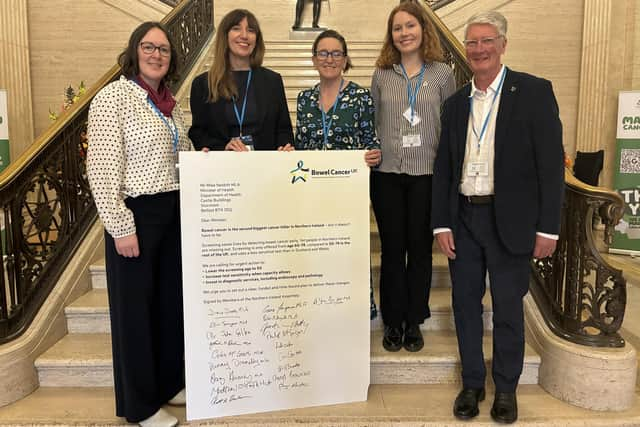

The letter has attracted support from representatives across the Assembly, including the chair of the Committee for Health Philip McGuigan, the chair of the All-Party Group on Cancer Stewart Dickson, the Social Democratic and Labour Party’s health spokesperson Colin McGrath, and Alliance’s health spokesperson Danny Donnelly.
“Bowel cancer is the second biggest cancer killer in Northern Ireland – but it doesn’t have to be,” the letter reads. “Screening saves lives by detecting bowel cancer early. Yet people in Northern Ireland are missing out. Screening is only offered from age 60–74, compared to 50–74 in the rest of the UK, and uses a less sensitive test than in Scotland and Wales.
“We are calling for urgent action to: lower the screening age to 50, increase test sensitivity when capacity allows, and invest in diagnostic services, including endoscopy and pathology. We urge you to set out a clear, funded and time-bound plan to deliver these changes.”
Bowel cancer is the fourth most common cancer in Northern Ireland, with over 1,300 people diagnosed with the disease every year. It is more common in people over the age of 50.
Bowel cancer screening uses a faecal immunochemical test (FIT), which looks for tiny amounts of blood in a stool sample that may indicate bowel cancer. Screening can help detect bowel cancer at an earlier stage, when treatment is more likely to be successful.
It can also help find polyps (non-cancerous growths) that can develop into cancer, allowing them to be removed before cancer develops.

As people in Northern Ireland are offered bowel cancer screening from the age of 60, they miss out on up to five screening opportunities compared to those living in the rest of the UK, where screening begins at the age of 50.
Northern Ireland also uses a less sensitive screening test threshold (120µg haemoglobin per gram of faeces) than Scotland and Wales, which already use a more sensitive threshold of 80µg/g. England is working towards a full rollout of this lower threshold by 2028.
The lower sensitivity of the test in Northern Ireland means that people are less likely to be diagnosed with bowel cancer at an earlier, more treatable stage. This is contributing to potentially avoidable late diagnoses, poorer survival rates and higher long-term treatment costs.
Northern Ireland’s cancer strategy identifies early diagnosis as a key priority for improving cancer outcomes. Bowel Cancer UK says extending bowel cancer screening to people aged 50–74 would be an important step towards helping more bowel cancers be detected earlier.
Bowel Cancer UK previously organised an event at Stormont this April, hosted by Eóin Tennyson MLA and attended by over 20 MLAs from across the Assembly, focusing on the urgent need to fund lowering the bowel cancer screening age.
The call follows Bowel Cancer UK’s new campaign highlighting stark inequalities in access to bowel cancer screening, an important tool for early diagnosis.
Genevieve Edwards, chief executive of Bowel Cancer UK, said: "People in Northern Ireland are currently missing out on bowel cancer screening opportunities that are already available everywhere else in the UK.
"We're delighted that 36 MLAs from across the political spectrum have backed our call for the Executive to fund the extension of bowel cancer screening to people aged 50–74, in line with the UK National Screening Committee recommendations.
"Earlier detection gives people the best chance of successful treatment, and we urge the Minister to set out a clear, funded, time-bound plan for delivering these long-overdue improvements to bowel cancer screening."
Bowel Cancer UK
Bowel Cancer UK support and fund targeted research, provide expert information and support to patients and their families, educate the public and professionals about the disease and campaign for early diagnosis and access to best treatment and care. For more information visit bowelcanceruk.org.uk.
About bowel cancer
Bowel cancer is the fourth most common cancer in the UK and the second biggest cancer killer, affecting both men and women. Around 46,000 people are diagnosed with bowel cancer every year in the UK. Bowel cancer is treatable and curable especially if diagnosed early.
Nearly everyone survives bowel cancer if diagnosed at the earliest stage. However, this drops significantly as the disease develops. Early diagnosis really does save lives.
The symptoms of bowel cancer can include:
l Bleeding from your bottom; blood in your poo.
l A change in your pooing habits. You might be going more or less often, or have diarrhoea or constipation that might come and go.
l Losing weight but you’re not sure why.
l Feeling very tired all the time but you’re not sure why.
l A pain or lump in your tummy.