
Northern Ireland amongst the first in the world to produce estimates of people living with metastatic breast cancer
A Belfast woman has welcomed a new study which, for the first time, estimates the number of people living with metastatic breast cancer, often referred to as secondary breast cancer, in Northern Ireland.
Metastatic breast cancer patient Ann McBrien said the study, funded by Cancer Focus Northern Ireland, would ensure people like her are ‘no longer invisible’.


The landmark audit estimates there are around 250 patients diagnosed with metastatic breast cancer annually in Northern Ireland, and almost 1,000 patients are currently living with the disease.
Metastatic breast cancer is incurable and occurs when breast cancer spreads to another part of the body such as the liver, lungs, brain, or bones. The average survival is two to three years for metastatic breast cancer patients.
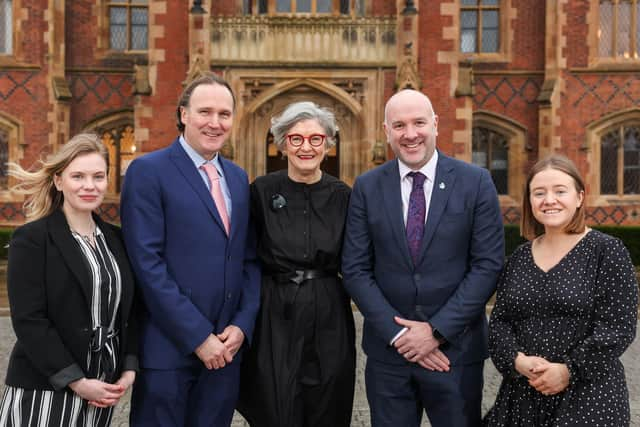
Crucially, patients with secondary breast cancer are not routinely counted in Cancer Registries worldwide, leaving this group of patients feeling overlooked and forgotten.
Ann McBrien, who campaigned for the audit, and previously worked as an accountant in the NHS, said: “I was diagnosed with primary breast cancer in 2013, but in 2019 my cancer came back in my lungs as metastatic breast cancer. I was shocked to find that cancer reoccurrences are not identified in the Cancer Registry’s statistics. This leaves patients feeling invisible and left behind. Knowing the importance of data to plan and allocate the correct resources to treatments and care, I wanted to do something to address this information gap."
Ann and fellow patient, the late Julie Anne Lillis approached Cancer Focus NI and the charity responded to their campaign by funding the important work.
“After lobbying for the audit, and working with the NI Cancer Registry on the findings, publication of this research gives me a great sense of achievement – we are no longer invisible,” said Ann.
"However, the advocacy work goes on. Determining the data was just the first step, the real focus is using the data to drive optimal outcomes for metastatic breast cancer patients. I am now asking the Department of Health to apply this data and develop a metastatic breast cancer pathway, with appropriate supports for patients across Northern Ireland. I also hope that this research, which focuses on breast cancer, will lead the way for improvements in data for all cancer patients with metastatic disease.’’
Richard Spratt, chief executive of Cancer Focus NI said the groundbreaking research represents a “pivotal moment” for metastatic breast cancer patients.
"We are immensely proud to have funded a study that recognises these overlooked patients and which directly addresses a critical gap in cancer data and intelligence.
"I would like to acknowledge people who were instrumental in advocating for this research, notably Ann McBrien and also Julie Anne Lillis who sadly is no longer with us. This landmark study is not just about numbers – it's about giving voice to those who have been forgotten and to those patients who have gone before us, such as Julie Anne. This is only the first step towards transforming care and support for metastatic breast cancer patients across Northern Ireland, and I am delighted to announce that Cancer Focus NI will be holding two support days in Spring 2025 for anyone with a metastatic breast cancer diagnosis, one in the East and one in the West of the country.”
The research, published in JAMA Network Open, aligns with the international Lancet Breast Cancer Commission’s Call for Action to improve data on metastatic breast cancer patients. The Commission highlighted that because the number of people living with metastatic breast cancer is unknown, patients may not receive optimal care and access to clinical research.
The study was led by Dr Damien Bennett, director of the Northern Ireland Cancer Registry (NICR), analysts Sinéad Hawkins and Helen Mitchell, and other NICR staff.
Dr Damien Bennett said: “Although we have good data on first breast cancers, we do not have the same data on secondary breast cancers, which come back after the first diagnosis. This was a real gap in our knowledge which has implications for patients. Now, for the first time in the UK, Ireland, and indeed in most parts of the world, we have produced estimates of new and existing cases of metastatic breast cancer for a whole country using population-based cancer registry data.”
He added: "We linked cancer registry data with hospital data and reviewed detailed information recorded on death records to identify cases. We estimate an average of 250 new metastatic breast cancer cases each year and just below 1,000 people living with the disease at the end of 2021. Importantly, we estimate the numbers of people living with metastatic breast cancer has increased over time, from 587 in 2009 to 911 in 2020, suggesting metastatic breast cancer patients are living longer, which may be related to new targeted treatments. However, while it is a great step forward to produce these estimates based on past records, there is no substitute for prospective recording and collection of cancer recurrences by cancer registries, which will require resources.”
Stuart McIntosh, consultant breast surgeon, and Professor of Surgical Oncology at the Patrick G Johnston Centre of Cancer Research at Queens University, said the initiative is a “fine example of patients driving forward change that will have benefits for many now, and in the future.”