
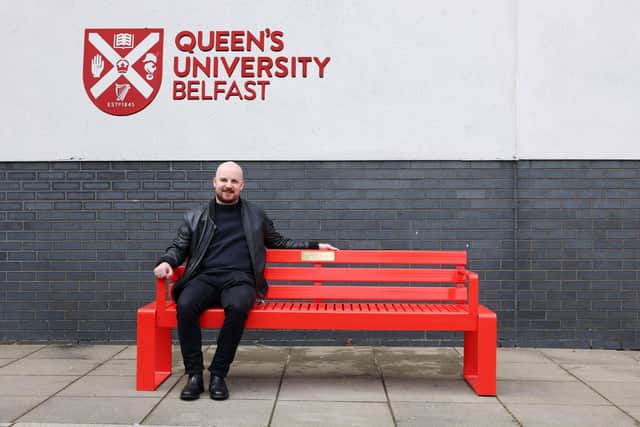
QUB graduate has red bench unveiled in his honour
An iconic British Heart Foundation red bench has been unveiled at Queen’s University Medical Centre to honour a graduate who had lifesaving surgery at just six months old and recently celebrated his 30th birthday.
At three months old, Newry man Karl Murray’s parents were given the devastating news that their first child had a congenital heart condition, tetralogy of Fallot – a defect that affects how the heart works and how blood flows through it. Karl needed open-heart surgery to survive.

Congenital heart disease affects thousands of families across Northern Ireland. It develops in the womb before a baby is born, and for many, it becomes a lifelong condition.
Karl’s early surgery was a success, and although he is still waiting for further surgery to replace a damaged heart valve, he is determined to use his voice to help others. He now sits on the British Heart Foundation’s Patient and Public Research Strategy Advisory Group, offering insight from his own lived experience.
Karl, who recently celebrated his milestone birthday, is happily married, living in Lisburn, and has built a professional career in the education sector.
But he is only too aware of the stress, anxiety and fear that can come with congenital heart disease. By sharing his story, he hopes to show that a fulfilling life is possible despite the challenges.
He recalls: “When I was two or three months old, my mum first thought something may be wrong as I wasn’t eating properly and kept falling asleep every time they tried to feed me.
"My granny, who was a nurse at the Royal Children’s Hospital, suggested they take me into hospital, where I was tested and diagnosed with congenital heart disease. I was in and out of hospital over the next three months.”
At just six months old, Karl underwent seven hours of open-heart surgery at Belfast’s Royal Victoria Hospital. Surgeons repaired the hole between the two bottom chambers of his heart and widened the pulmonary valve. The operation was successful, but his parents were warned he would likely need further surgery and medication in the years ahead.
“Since I was about 13 or 14 years old, the doctors have been telling me surgery is likely next year,” Karl admits.
“However, I’ve had regular check-ups with my cardiologist and as I’m doing well they don’t want to perform the surgery until I absolutely need it. It is difficult to have the thought of surgery hanging over me, but I’m still healthy, which is the main thing.”
Growing up, Karl experienced chest pain, palpitations and tiredness, though medication has helped. It did, however, mean he couldn’t pursue the family sport – football.
“I come from a very big sports background,” he says. “My grandfather and my dad played football competitively, but I had to accept from a young age I couldn’t play contact sports or do any form of intense exercise due to the risk of further damage to my heart.
“My childhood was filled with hospital visits. I remember spending one Christmas in hospital when I was around five years old. However, my parents worked very hard to give me a normal childhood and while sports wasn’t an option, I picked up the guitar instead. My interest in music eventually led to an interest in technology and my professional career.”
When Karl was around 15, he was told the damage to his heart was reaching the point where more surgery would be needed - news that understandably created anxiety.
“I’m lucky enough to have very supportive parents who I can openly talk to,” he says. “They helped me through the anxieties of living through my teenage years with a heart condition and how to overcome certain challenges.”
Karl continues to have regular check-ups with his consultant cardiologist. While he feels fortunate to be healthy, he knows that at any appointment he could be told further surgery is necessary.
“For years, I think I was kind of living on the idea of always getting surgery the next year. Then when I got engaged and bought a house, it made me start to question whether I should be constantly waiting for it, as it was affecting my plans for the future around my wedding and having kids. It is always in the back of my mind - or I should say it always was. But I have now taken the attitude that I’m going to get on with my life and not let my condition put any future plans on hold.”
Throughout his teenage years and into his twenties, Karl stayed connected with the BHF through its patient and public involvement network, Heart Voices. It helped him build confidence and develop his own patient voice. He is now an important member of the BHF’s Patient and Public Research Strategy Advisory Group.
“I joined the group in 2023,” Karl says. “I’ve had the opportunity to share my experiences as the youngest member and learn from others about what they have overcome.
"From discussing the impact of CVD on mental health to seeing more research opportunities across Scotland, Wales and Northern Ireland, we have an opportunity to make our voices heard. It’s incredibly rewarding to see the impact the group has had already.” Karl added: “I know how much research into heart and circulatory conditions has helped develop better treatments and care for people living with congenital heart conditions, so I want to give back by helping where I can.
"I’m using my voice and my experience to encourage others to share their story and for people to understand how they can help support the thousands of families who are living through these challenges every day.”
Karl’s bench is situated outside the Queen’s University Medical Biology Centre on the Lisburn Road. “I’m delighted that my bench has been placed in a setting that has a lot of personal meaning to me,” he says.
“Queen’s University is a special place for me as it’s not only where I achieved my degree, but also where I met my wife Nicole, and my grandfather studied there.
“It is also home to internationally recognised cardiovascular research which transforms outcomes for patients such as me.”
Professor Frank Casey from Queen’s University Belfast said: “Karl has turned his personal experience into a powerful force for good, supporting others and raising awareness through his work as a dedicated patient advocate. His story highlights the major progress made in congenital heart research and care over recent decades.”
To mark 65 years since BHF began, the charity has unveiled 65 red benches across the UK in tribute to those living with cardiovascular disease. Every day in Northern Ireland, around 12 people die from cardiovascular disease, which affects more than 230,000 people here.
Fearghal McKinney, Head of BHF Northern Ireland, said: “By sharing the stories of people who live with cardiovascular disease on our iconic red benches across the UK, we hope to start more conversations that change dangerous misconceptions.”
Every three minutes, someone in the UK dies from cardiovascular disease. Donate now to keep Northern Ireland beating - visit bhf.org.uk/keepusbeating