
Spike in flu cases this year says health minister Mike Nesbitt as he rules out bringing in the army to aid A&E crisis
The number of people admitted to hospital with flu in Northern Ireland this winter is 3.6 times higher than the previous year, Stormont’s health minister Mike Nesbitt has said.
He also said that he is not considering bringing in the military to help with the situation in the province’s A&Es, because they are unlikely to be able to address the problem.
The health minister was appearing before Stormont’s health committee tonight to answer questions about the state of emergency departments in the country, which are currently under severe pressure.
As the News Letter reported last week, at times patients in some hospitals face an average wait to be admitted or discharged of over 12 hours.


Mr Nesbitt said: “I want to emphasise this is not just a Northern Ireland-specific problem.
“Over the weekend past Liverpool health trust has declared a critical incident. Two others have similarly declared critical incidents, Plymouth and Hampshire ...
“It is an illustration that the pressures are both serious and nationwide.
“Across Northern Ireland we have seen 3.6 times as many patients hospitalised with flu this winter compared to last year.”
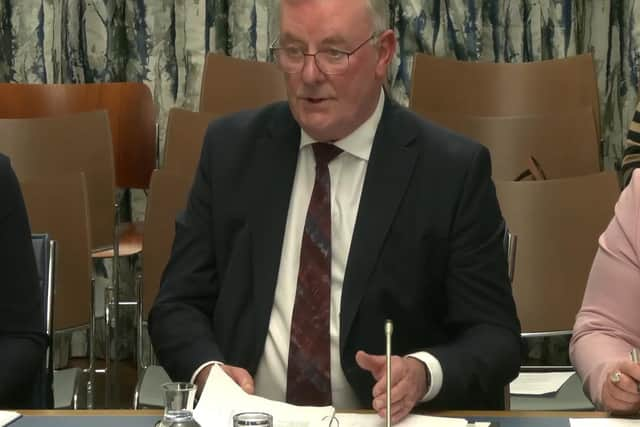
He also announced that the flu vaccination programme would be extended to all those over the age of 50.
At the outset of the hearing he had issued a challenge to MLAs, telling them: “The question for you chair is: what role does the committee want to play? Do you want to be positive?
“Because it appears to me certain MLAs engage only after the fact when the opportunity arises to criticise, without alternatives.”
He went on to add: “If anybody around this table thinks there is an easy solution, a quick solution, or a cheap solution, I'm afraid they are mistaken.”
Mr Nesbitt stressed that one of the key obstacles the NHS faces is that there are hundreds of people in hospital beds who do not need to be there, hampering ‘flow’ through the hospitals.
“As of yesterday there were 516 patients who were deemed to be medically fit and awaiting discharge – which is a lot more than the number of patients who are in ED waiting for a bed,” he said.
“So that's where the problem is with the flow.”
He turned to the question of whether the armed forces could help.
“In terms of the military, because the problem is with the internal flow within the hospitals and the lack of capacity – in terms of community provision, in terms of care homes and domiciliary care – I don't see any role, practical role, for the military coming in,” he said.
“I think when they were here for Covid their use was in offering vaccines and in physically moving people around within the hospital campus and that's not what we need for this. So I don't see that as an option.”
He added that “MLAs voted for an entirely inadequate health budget, and you’re now seeing part of the consequence of supporting that budget”.
Mr Nesbitt said that he wanted to rejig the system at large, but “if you're going to transform and reform, you need resource and you need budget”.