
Before and after: Tomb of former Northern Ireland and UUP leader Lord Craigavon cleaned after concerns about upkeep
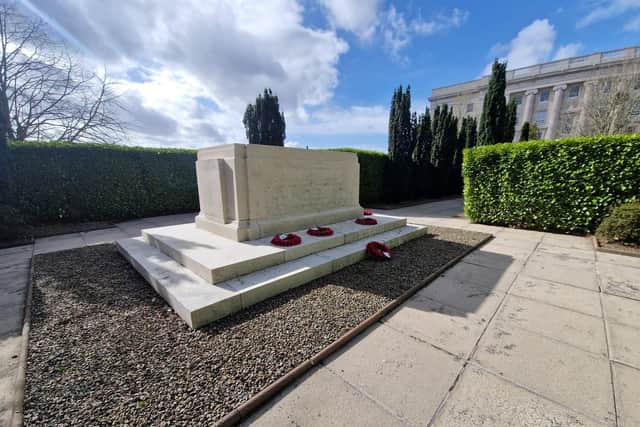
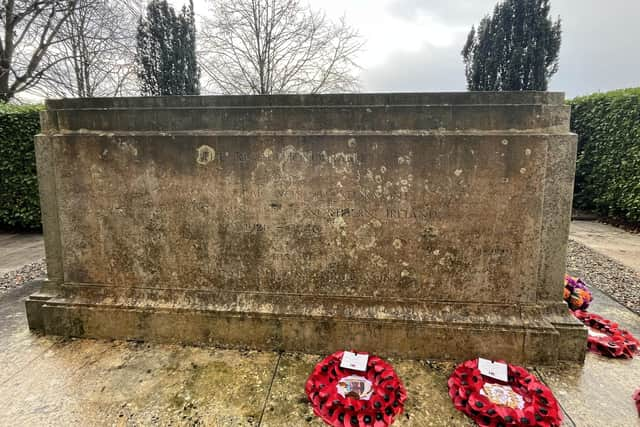
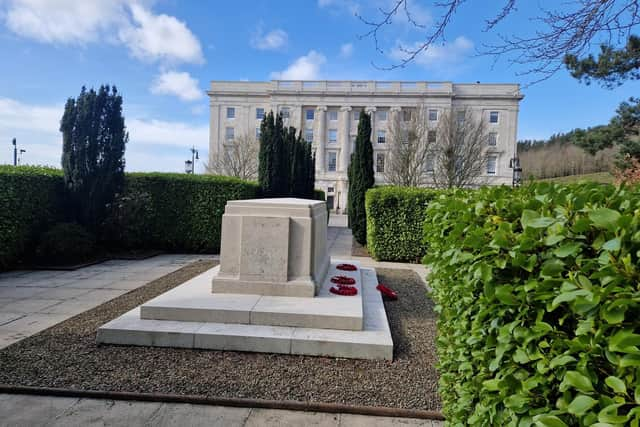
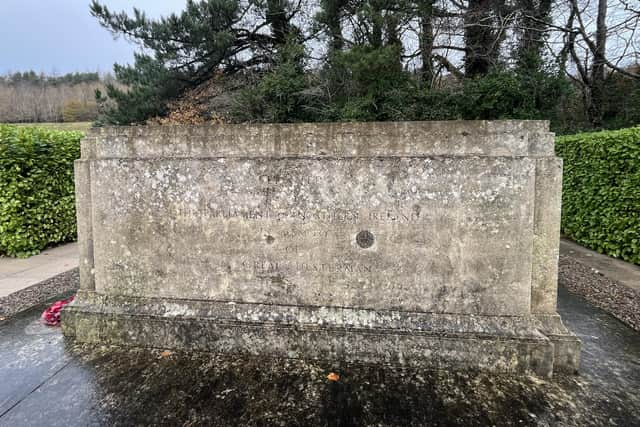
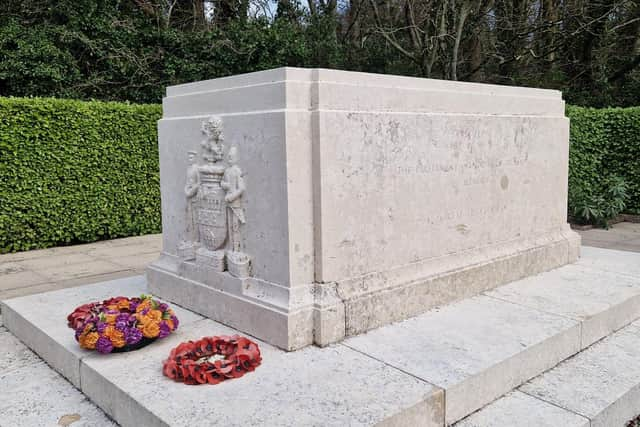
Lord Craigavon's tomb at Stormont has now been spruced up after concerns were raised about the state of the monument.
DUP MLA Trevor Clarke – a member of the Assembly Commission which looks after the Stormont estate – told MLAs that the resting place of Northern Ireland's first leader was cleaned this week for the first time since 2019.
TUV MLA Timothy Gaston had complained about its condition in December, saying "the neglect of Lord Craigavon’s tomb is symbolic of a wider problem and the fact that Stormont is scared to associate itself with anything Unionist".
Mr Clarke told the Assembly that whilst the Grade A listed monument on the east side of Parliament Buildings (which is also the burial place of Lady Craigavon) has now been power-washed, that cannot happen too often.

"Portland stone is a natural and comparatively porous material," he said.
"Overly frequent cleaning can accelerate surface erosion and, ultimately, shorten the lifespan of the stone.
"Cleaning is scheduled to balance the need to maintain the asset against the risk of damaging it."
Mr Clarke had been responding to a question from DUP colleague Stephen Dunne about progress on its upkeep, and afterwards Mr Dunne said: "Following a question to the Assembly Commission, I am pleased that action has now been taken to clean and restore the tomb, and it is important that a regular maintenance schedule is put in place to preserve this important landmark with the respect and decorum it deserves.
"Lord Craigavon served as Northern Ireland’s first Prime Minister and, alongside Lady Craigavon, remains an important part of our history.
"Their final resting place is visited by many visitors and people who walk through the Stormont Estate throughout the year."
He called for an information board to be installed at the monument, letting people know about the "significant impact" of the "great Ulsterman", and Mr Clarke said this suggestion will be taken back to the commission.
Meanwhile Mr Gaston said in a statement of his own: "At the end of last year I raised serious concerns about the condition of the tomb of Lord and Lady Craigavon at Stormont…
“I welcome the progress which has now clearly been made because of my questions on the issue.
"The photographs show that work has been carried out to a high standard that the site is now in a far better condition than the one which prompted my original intervention.
“It should never have taken Assembly questions to prompt action on a monument of this significance.
"However, the important point now is that the issue has been addressed and the site has been improved."
Lord Craigavon (also called Viscount Craigavon), whose given name was James Craig, lived from 1871 to 1940.
He was the Belfast-born son of a whiskey distiller who served as a soldier in the Second Boer War before entering politics as an Irish Unionist, being variously the MP for East Down, Mid Down, and North Down.
He helped organise the signing of the Ulster Covenant alongside Lord Carson.
His parliamentary biography states: "By 1912 Craig had also begun the process of organising and forming a private army in the form of the UVF.
"Working with an intermediary, Craig managed to procure a large quantity of arms from Germany.
"By April 1914 the UVF was 100,000 strong and smuggled in approximately 35,000 rifles and three million rounds of ammunition.
"If the Home Rule legislation had been enacted it would have put Craig in a perilous position, defying the law and Crown and constitution, which its party had pledged to support."
It never came to that because the First World War intervened and the UVF marched off to war as the 36th Ulster Division (whilst Craig was made a lieutenant-colonel in it).
His parliamentary biography continues: "It was his decision to propose the six Ulster counties that would eventually form Northern Ireland.
"Many of his colleagues were angered that he left out the three other Ulster counties of Cavan, Donegal and Monaghan.
"In Craig's opinion the six counties would create a more robust unit, both in terms of its political and religious makeup and in securing the borders."
It adds that he was also instrumental in setting up the RUC and B Specials.
In 1921 he took over from Carson as leader of the UUP, which had been founded three years earlier.
At the same time he was made Prime Minister of the newly-formed state of Northern Ireland, and served in that role until his death.