
Block demolition of Hilden Mill, say officials: Planners find no reason to send wrecking ball in to beloved Lisburn landmark
Moves to knock down Hilden Mill should be thrown out, officials have concluded.
The much-loved Lisburn landmark’s owners want to demolish much of it, claiming that an arson attack in 2021 left it structurally unsound.
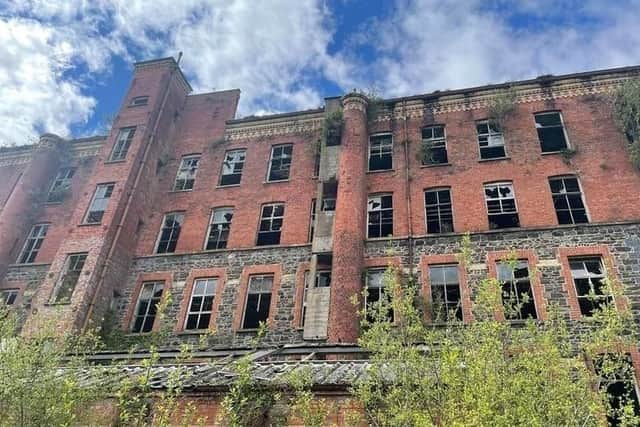

But planners at the local council have recommended the move be blocked, stating the owners haven’t submitted strong enough evidence that destroying the listed building is justified.
The 19th century mill was at one point one of the largest linen-thread manufacturers in the world and played a huge part in the cultural life of Lisburn, as well as being acclaimed for the classic style of its large buildings.
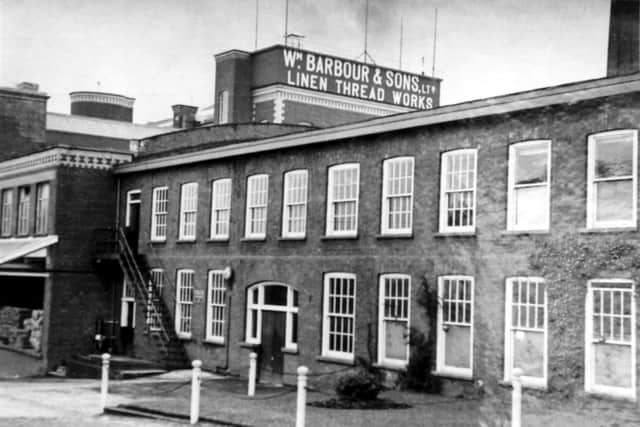
It closed down in 2006; despite several plans to redevelop it over the years, none have come to fruition.
Last year, owners PJK Developments filed an application to demolish the listed building. Now, planners have said that application should be refused. The final decision on whether to stop the demolition lies with the Planning Committee of Lisburn and Castlereagh Council, which next meets during the first week of August.
Provincewide rules state a listed building should only be demolished if there is exceptional evidence that it needs to happen. Official reports from council planners conclude PJK Developments hadn’t delivered evidence to that standard.
State planners: “No evidence has been submitted to justify the demolition of these listed buildings nor is any exceptional reason given why the buildings cannot be retained in their original or a reasonably modified form.
“Demolition of these important buildings will detract from the setting of a listed building in terms of group value with Hilden Mill Primary School and the Iron Lattice Bridge, built for the mill workers nearby.”
Stormont’s Historic Environments Division, which looks after listed buildings, objected to the demolition plan, officials state – and maintained that objection even after surveyors commissioned by PJK Developments submitted reports setting out their reasons why Hilden Mill couldn’t be saved.
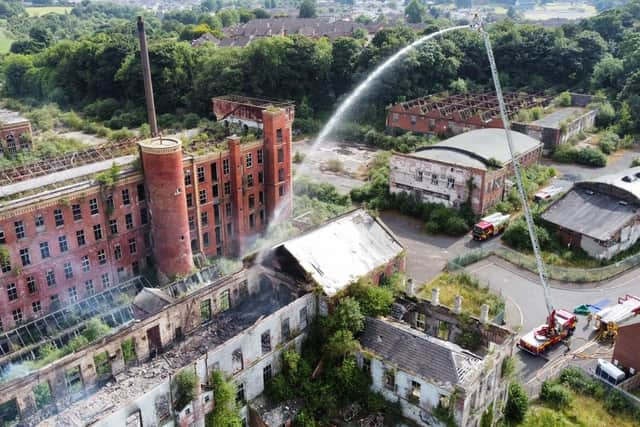
The roof of one large building was completely destroyed in the June 2021 arson attack, said the surveyors’ report, and a buttressing wall had partially collapsed. Without those, the building’s other walls were stated to be unstable.
The report added: “The remaining mill buildings scheduled for demolition also sustained extensive damage in the 2021 fire and have experienced continued dilapidation and disrepair.

“The existing mill buildings exhibit extensive fire damage and significant deterioration. Many structures are visibly roofless, partially collapsed, and overgrown with vegetation.
“The degree of structural stability varies across the site; some elevations appear relatively intact, while others are severely degraded, with exposed roof trusses collapsing inward.”
The report went on to argue that Hilden Mill has become a serious health and safety problem, with the 2021 arson attack also raising concerns about risks to nearby housing developments.
Built during the 1820s and greatly expanded over the next century, the mill was listed for protection at grade B+ in 1989, but has lain empty for almost 20 years since the linen-thread factory there shut down.
Its previous owners were at one point given planning permission for up to 650 homes on the 24-acre site, but construction never began.
PJK Developments bought the mill in 2017, at the time indicating that they hoped to create an affordable housing scheme with more than 200 homes.