
Co Down-born flaxdresser was a trade union pioneer in late Victorian Belfast


Two weeks ago I recalled how my great grandfather Alexander Bowman was born in Derry townland outside Dromara in March 1854 but had to move to Belfast, aged 10, following the death of his father.
To mark the centenary of his own death, on 3 November 1924, in this second feature I relate how Alexander became the first working-class Irishman to stand for Westminster (1885), his election as a labour member of Belfast Corporation, another first (1897), and his presidency of the Irish TUC (1901).
Within days of moving to Tennant Street in Belfast, Alexander had found work in the Agnes Street spinning mill – dividing his time between the machine room and the adjoining classroom.
His interest in workers’ rights first manifested itself in 1874 when, during a strike, the apprentice flaxdresser led a delegation to the manager. For his efforts he was dismissed but he quickly found new employment at the Crumlin Road factory of William Ewart and Son.
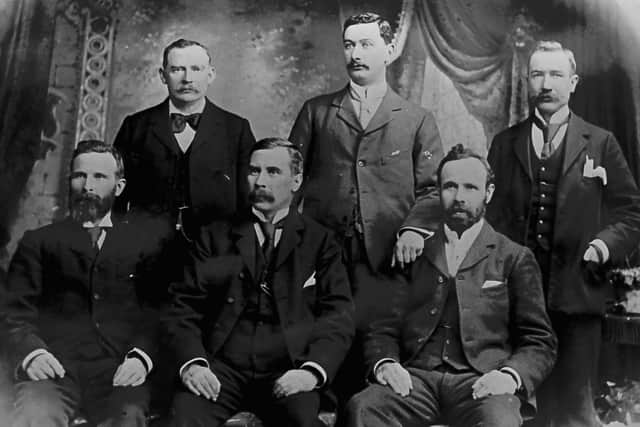
When Belfast Trades Council was formed in October 1881, Alexander was elected as its secretary. Thanks to his growing public profile, he was approached to stand for North Belfast in the November 1885 General Election. His opponent was none other than sitting Conservative MP and factory owner William Ewart!
Although he faced an unrelenting campaign of intimidation, Alexander’s manifesto advocating an end to the landlord system, free primary and technical education, unrestricted trade between nations, a reduction in working hours, improved welfare rights and votes for women, proved popular with voters. In a two-horse race Ewart attracted 3,915 votes to Alexander’s 1,330. It was a noteworthy beginning for the local labour movement.
The return to power of William Gladstone in February 1886 and his subsequent Home Rule Bill won my great-grandfather’s support. Alexander favoured a Dublin parliament, but answerable to Westminster. Although the Bill was defeated, he and a few steadfast Gladstonians re-grouped in the new Irish Protestant Home Rule Association.
This provoked a storm on Belfast Trades Council, which compelled him to resign. Alexander went on to serve the IPHRA as its paid secretary, immersing himself in the fight for Irish self-determination. He undertook speaking engagements in towns and villages throughout the North, earning the respect of Catholic Nationalists but incurring the wrath of fellow Protestants.
Faced with such unremitting bitterness, along with his acceptance that a Dublin parliament remained many years off, Alexander decided to move to Scotland. The Glasgow of that period was a centre for radical thinking and American land reformer Henry George enjoyed considerable support. Alexander became a frequent speaker at the city’s Henry George Institute and at the beginning of February 1890 was elected its president.
In early 1892 Alexander moved again, to London, as the Ulster Bacon Curing Company’s local agent. Expanding on the political interests he had cultivated in Scotland, he joined the fledgling Social Democratic Federation and in December 1894 was one of 15 party candidates to seek election to Walthamstow Council. While none was elected, Alexander received more votes (209) than anyone else in the SDF team.
In the autumn of 1895, struggling to make ends meet, the father-of-six returned to Belfast. Within two years he was back on Belfast Trades Council representing local flaxdressers.
At a time when Belfast Corporation was under attack over its failure to tackle serious health problems, including several outbreaks of typhoid, the Trades Council decided to put forward candidates in seven of the city’s 15 wards in the November 1897 elections.
Six were successful, with five topping their respective polls, including Alexander in Duncairn. They were the first labour councillors to be elected to any local authority in Ireland without the patronage of either the Nationalist or Unionist political parties.
Alexander’s trade union career peaked in May 1901 with his election as ITUC president. His address at Sligo included a call for the ‘uniting of all sects, creeds and parties in the attempt to raise our common and beloved country to that material, moral and social position to which she is entitled’.
By then he had already decided against seeking a second term on Belfast Corporation, mainly due to the Trades Council’s unwillingness to make good wages he had lost while attending Corporation meetings.
With a view to providing financial security for his family, Alexander did rejoin Belfast Corporation – but as superintendent of the Falls Road municipal baths, a position he would hold for two decades.
He was one of 115 candidates for two vacancies, the other being at the Ormeau Avenue baths. It is not hard to conclude that because of Alexander’s previously well-publicised views on Home Rule, Councillors believed his appointment, as a Protestant, would go down well with people in the Catholic Falls area.
While he had no further involvement in politics, Alexander would surely have welcomed the 1920 Government of Ireland Act which created ‘Home Rule’ parliaments in Dublin and Belfast, and, four years later, just days before his death, the election of Britain’s first Labour government under Ramsay MacDonald.
Alexander, who was buried in Carrickfergus a century ago this week following a service in Cooke Centenary Presbyterian Church, Belfast, would not have seen himself as a trade union pioneer. Like so many other working-class leaders he was under-valued in his day and even now remains largely ignored by historians.
There is clear evidence to support my contention that it isn’t too late to recognise Alexander formally for his endeavours on behalf of the Irish and British labour movements.
Terence Bowman is the author of People’s Champion – The Life of Alexander Bowman, Pioneer of Labour Politics in Ireland (Ulster Historical Foundation, 1997).