
David Hoey: Story of Londonderry siege did not stop in 1689; the same ‘no surrender’ spirit of the besieged city later helped to forge a new American nation
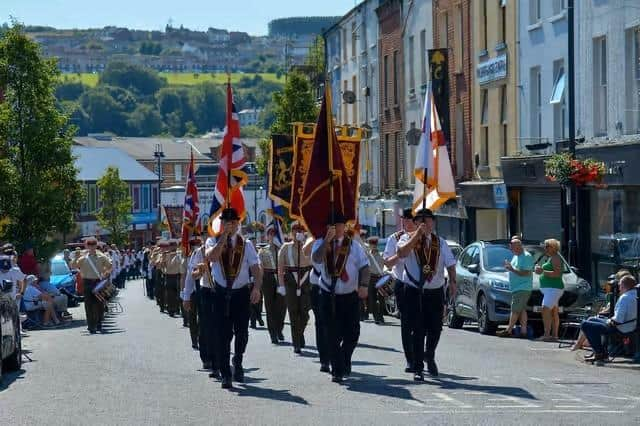
On Saturday, the Associated Clubs of the Apprentice Boys of Derry will commemorate the 337th anniversary of the Relief of Londonderry in 1689.
In the years following 1688-1689, many Presbyterians in Ulster believed that the civil and religious liberty expected during the reign of William and Mary had not materialised, and so Presbyterian migration to the New World began.

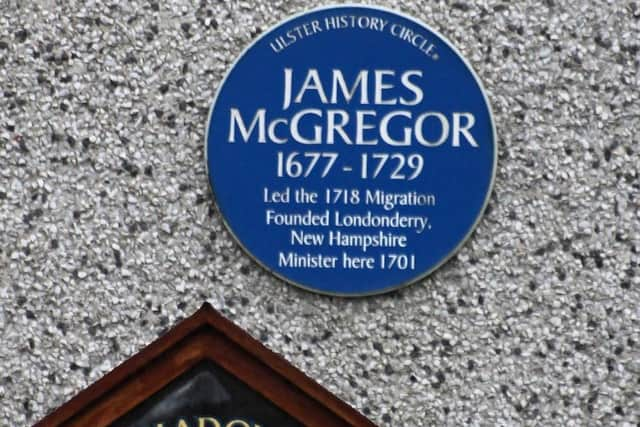
The Rev James McGregor, who had been within the walls during the siege, led one of the early significant migrations with much of his congregation from Aghadowey.
The Rev McGregor founded Londonderry in New Hampshire (NH). His grandson, Robert McGregor, was a colonel in the Revolutionary War and an aide-de-camp to the highly distinguished General John Stark, also from Londonderry, NH.
Matthew Thornton, whose family had travelled with Rev James McGregor, was a doctor in Londonderry NH and was one of the signees of the Declaration of Independence.
Matthew Thornton was not the only man of Scotch-Irish heritage connected to the signing of the Declaration of Independence. The Declaration was hand-written by Charles Thomson of Maghera and the first signatory was John Hancock, a descendant of Presbyterians from Co Down.
It was first printed by John Dunlap of Strabane, and first read in public in Independence Square, Philadelphia, by Col John Nixon of Ulster-Scots descent.
The migration of many from Ulster coincided with a wider movement from the north of England, the Borderlands, and lowlands of Scotland to America. Yet it was the Ulster-Scots character that encompassed all the Scotch-Irish as they became known, broadly defining the people of that movement.
The nature of that character was addressed by future President, William McKinley, at Springfield in 1893 to the Scotch-Irish Society of the USA, who said: “… It is said of the Scotch-Irish that they are doers rather than talkers or writers. True, they have been builders; and their foundations were deep and strong and enduring…. So long as there is a struggle for human liberty, so long as patriotism has a place in the American heart, that long will the name and fame of your ancestors be preserved and enshrined…"
There are notable exemplars of Scotch-Irish character.
President Andrew Jackson defined the populist thread that runs through American politics to the present day; a man so intensely competitive that under no circumstances would he be defeated. Jackson just one of many presidents with Scotch-Irish heritage.
John Rankin and John Caldwell Calhoun were both independent-minded inspirational leaders with an indomitable fighting spirit and passionate dedication to their cause – yet arch enemies in the Civil War. While Stonewall Jackson (a great-grandson of John Jackson from Coleraine) inspired his troops with his unwavering faith in God, George S Patton, the supremely confident World War II General, was said to have inspired his men with an unwavering faith in himself.
Lest we imagine that the Scotch-Irish influence impacted only on politics and war, in literature Mark Twain is mentioned in that context. Perhaps less well appreciated is William C Faulkner who spawned the New American Gothic genre.
In commerce, Thomas Mellon, born in Omagh, Co Tyrone, founded Mellon National Bank in Pittsburgh, which became one of the world’s largest money management firms.
In the story of the newest frontier, space, Neil Armstrong is known as being of Scotch-Irish heritage. Less well-known is James E Webb, in charge of the moon mission at NASA, who would let nothing get in his way to land a man on the moon and bring him home.
JD Mackie’s book ‘A History of Scotland’ describes lowland Scots as a people trained by the Kirk as “…strong in faith, patient of discipline, ready to venture and even to die for their beliefs.”
In ‘Born Fighting’, James Webb, senator and author, believes Ulster taught the people of the Kirk to be anti-establishment; to be ready to withdraw compliance with authority; offer only conditional loyalty; reliant on God and each other; holding both family pride and patriotism; and reluctant to follow government dictate where it contradicted their individual conscience.
It was this mindset that would shape America.
The young apprentices that closed the gates in December 1688 did not wait for the dithering city grandees to decide. It was the citizens of the besieged city who demanded no surrender, and Col Adam Murray stood with the people and his men at arms rather than be governor – the cause of civil and religious liberty was much more than an ideal, it was a cause to be fought for without compromise.
For more than 300 years we have remembered the resilience, fortitude and determination of the besieged to defend the cause of civil and religious liberty. The character of those who defended Londonderry is the same as that which shaped a new nation and burns undiminished today.
l David Hoey, General Secretary, General Committee, Associated Clubs Apprentice Boys of Derry