
How the News Letter's own Roamer, Charlie Warmington, brought Belfast's maritime and industrial history to the surface in a barge on the River Lagan
Charlie Warmington was beloved by News Letter readers for the curious tales of colourful history and folklore in his Roamer columns – but he also brought a vital history of Belfast’s maritime and industrial past to the surface, right on the River Lagan.
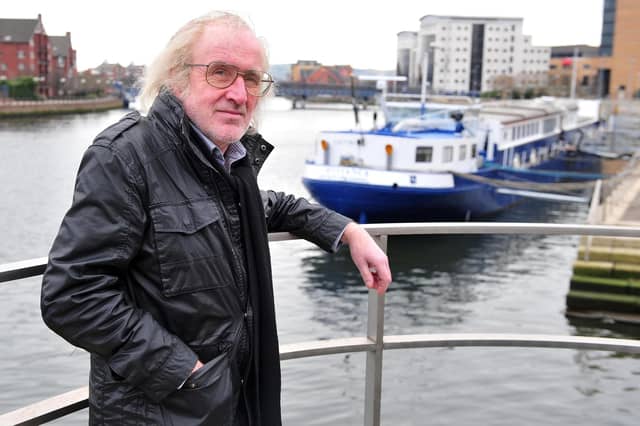

He was instrumental in the creation of the Belfast Barge, a permanent museum and venue that’s moored on the river close to the capital city’s Waterfront Hall.
Opened around 15 years ago after restoration work, the barge quickly became a floating focal point in the heart of Belfast, home not just to the museum’s exploration of how the river was vital to the growth and development of Belfast’s commercial and manufacturing power, but also hosting arts events involving music, poetry and theatre – and it’s even been used for weddings.
Charlie, who died this week, was research administrator at Lagan Legacy, a social enterprise formed in 2002 to preserve and promote Belfast’s maritime history and heritage. That project hit upon the idea of repurposing a 600-tonne Dutch barge, intending to demonstrate there’s much more to Belfast’s history than just the famous headline events.
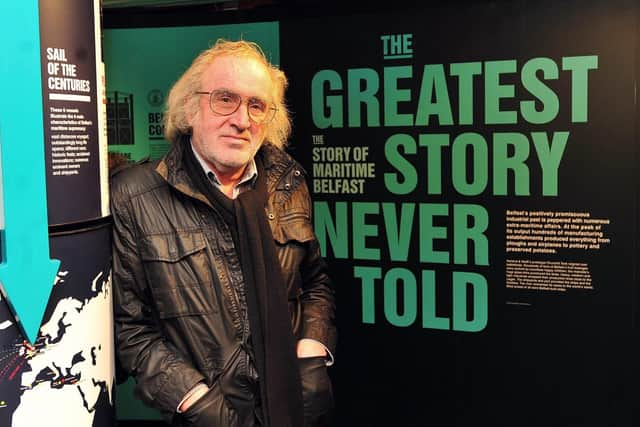
When the barge officially opened in 2011, he told the News Letter: “Belfast is remembered for the two Ts - the Troubles and the Titanic.”
He regarded the Titanic as a “weapon of mass distraction”, arguing a fixation on the world-famous sunken ship detracted from the significance of other boats and infrastructure built in the city.
However, even getting the barge to Belfast was a feat. In order to sail it to the city, he revealed: “They basically welded down the hatches, put a lot of ballast in her and she came over as a submarine.
“She’s a long river vessel, she would just crack in two unless they kept her down in the water.
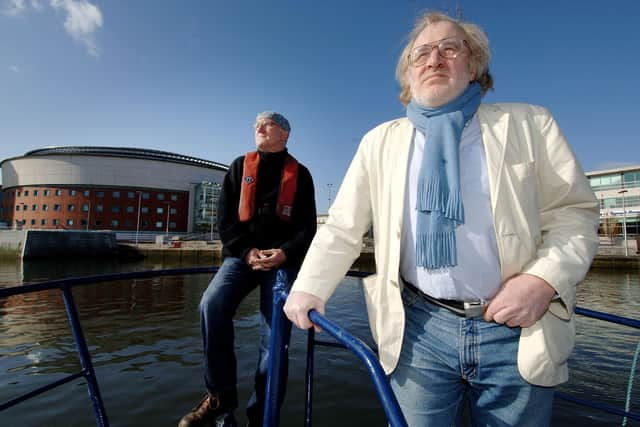
“The calculations were phenomenal; you needed enough water to float her, the speed so that her side thrusters and rudders would steer her, and it had to be the right depth of water, yet it couldn’t be so deep that she wouldn’t get under the bridge.”
As Charlie’s research and the standing exhibition make clear, the Lagan powered giants like Harland and Wolff, once ranked as the biggest shipyard in the world, as well as 19th century rivals like Workman and Clarke; the river also facilitated important industries such the city’s ropeworks, linen mills and tobacco factories.
“Without the Lagan none of that could have happened,” commented Charlie, who insisted on calling himself “a hack” rather than a historian, but maintained a passion for the history of ordinary people as they lived and worked.
At one point, every single day of the year except Christmas Day saw at least two ships under construction in Belfast, he stated, and sometimes as many as a dozen were being built.
A whole range of vehicles and structures were made in Belfast at the height of its industrial power, the project uncovered, ranging from trains to wind turbines to the famous Churchill tank; “one of the most famous fighting vehicles the world has ever known,” as Charlie put it.
But the city never built any submarines; at least, not intentionally. As Charlie pointed out with waspish wit, in some ways the ship he disliked became a submarine – the Titanic, when it sank.