
IRA Border Campaign and 18th-century foreign affairs: Old editions of the News Letter uploaded to the web
Reports on the IRA's mid-century Border Campaign and strife in imperial Russia are among the stories which have now been placed online as part of a project to make the News Letter's old editions readily available to the public.
On Thursday it was announced by the UK government that the "digitisation" project had added a stack of scanned copies of the paper from the 18th to 20th centuries online.
The archive is available online via the websites British Newspaper Archive and Findmypast (but requires a paid-for subscription to view them – though the option of a week-long free trial is also available at the latter site).
They can also be viewed for free in person at the British Library, or at any library which has a subscription.
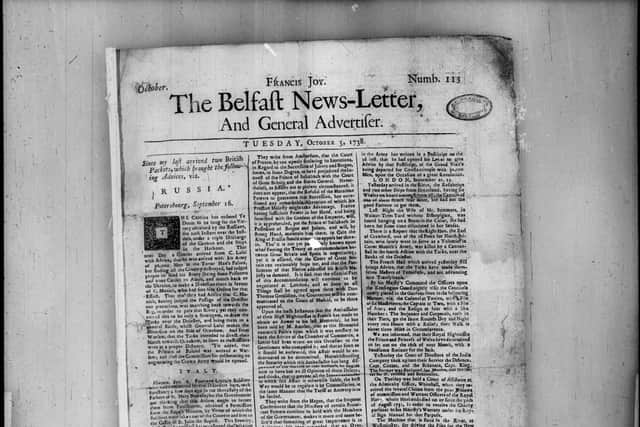

Here the News Letter delves into what some of those bygone editions contain.
Though the paper was founded in 1737, the oldest edition of the News Letter which survives dates from October 3, 1738. It is among those to have been uploaded online this month as part of the project.
The front page is taken up entirely with international news: a military victory over "infidels" by Russian forces (or "Ruffians", as the word is spelled in the old edition – the letter ‘s’ being rendered as ‘f’ in the old-style script), the punishment of a group of soldiers in Florence, Italy, "who had committed several disorders", and the arrival in London of hunting ships from Greenland bearing six whales.
Inside, readers can learn about a reward being offered for a missing horse – described as "13 hands high" and "mealy mouthed" – near Stoneyford, the arrival of an "exceeding good" consignment of millstones at "The White House near Belfast", and the theft of a horse from Ballyholme.
The most recent editions to be uploaded are many from the late 1950s and early 1960s – many of them dealing with the IRA's floundering-but-bloody Border Campaign.
On April 24, 1961, alongside news of a Campaign for Nuclear Disarmament march in Belfast and a possible visit to the UK of Yuri Gagarin – the first man in space – was a report titled: "IRA raids warning alerts army camps" about the threat of attacks on bases in the English West Country.
On June 17, 1961, home affairs minister Brian Faulkner said that since the IRA's renewed campaign had begun four-and-a-half years earlier, there had been nine "incidents" purely in the Derrylin district of Fermanagh alone.
He praised the local population, saying: "The attitude which you have adopted is typical of the people who live close to the border... you have set an example to everybody in Ulster. You have shown your faith in the ability of the government to maintain normal administration and keep the peace."
Faulkner also noted that while the IRA had been condemned by nationalist politicians, "most nationalist spokesmen still took every opportunity to indulge in verbal condemnation of the security forces, and especially of the Ulster Special Constabulary".
On December 5, 1960, there was news of a gun attack by the IRA on Belleek RUC station; it was the second time it had been attacked and "the incident was the 30th involving police stations since December 1956".
And April 22, 1959's edition carried a report of four IRA men aged between 19 and 26 in court for a range of offences including blowing up a Crossmaglen bus and electricity substation and possessing explosives. They refused to recognise the court.
Other reports cite figures lamenting a failure of southern authorities to stem the movement of IRA men across the border.
Beth Gaskell, lead curator of news and moving image at the British Library, said: “The News Letter is considered the world’s oldest English language general daily newspaper still in circulation and it offers valuable insight into centuries of life, politics, and culture in Northern Ireland and beyond.
“The newly digitised pages provide a unique perspective of the turbulent and changing political situation in Ireland from the mid 18th to the early 19th centuries.
“They also fill critical gaps in the mid-20th century record, making all known surviving copies of the historic Belfast title accessible online for the first time.
“The British Library cares for one of the world’s largest news archives, comprising over 60 million newspaper issues dating back to the 1600s, alongside growing collections of broadcast and digital news.
“By digitising and preserving these invaluable documents, the British Library ensures that this vital piece of heritage is safeguarded for future generations and made available to researchers around the world.”