
Lights sadly go out at Broadway Presbyterian Church as another congregation is lost (July 1982)


Intolerance, bigotry and unconcealed hatred finally spelt the end for Broadway Presbyterian Church in July 1982, reported the News Letter.
The building, which fronted on to the Falls Road, had long borne the brunt of repeated sectarian attacks – so much so that the minister, Reverend Wilbur Gillespie, was unable to announce his final service on June 27, 1982, least he attracted the attentions of what he termed “the ungodly”.
Those elements had, during the past 12 years, devastated the church’s Upper Lecture Hall, burnt the unoccupied sexton’s residence to the ground, rampaged through the Minor Hall ripping bookcases from walls and spraying graffiti as they went, and poked steel rods through the protective wire grilles to shatter priceless stained glass memorial windows.
Added to that could be scores of less serious incidents.
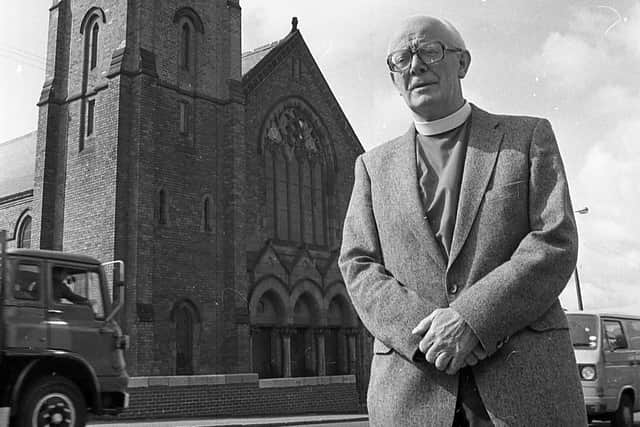
Even the republican terrorist organisations got directly involved: in 1974 the IRA warned that it would blow up the building, accusing the army of using the tower as an observation post, and again in 1976 the congregation was threatened after a passing military patrol was welcomed in by ladies of the church.
The Reverend Gillespie explained: “Certainly we could have gone running to the media in every month that passed, but what good would that have done?
“We may have brought down more trouble on ourselves, or some Protestant cowboy would have gone off and burnt a Catholic chapel in reply.”
So, instead, the Broadway congregation adopted an extremely low profile, shifting their mid-week meetings to Windsor Presbyterian on the Lisburn Road and using their own church only for Sunday morning services.
They took every possible precaution to avoid drawing attention to themselves.
Even the article published in July 1982 had been “postponed until after the building could be cleared”, commented the News Letter.
The Reverend Gillespie placed the blame for the almost continual vandalism squarely on lack of parental control; “youngsters being permitted to roam at will without any evident concern for what they might be doing”.
He recalled one incident when the caretaker of the church, cautiously investigating an open door, was confronted by a child with a dummy-tit in its mouth!
He elaborated: “One of the local Catholic priests once told me about giving a lift to a couple of youngsters around midnight. When he asked them why they were not at home they replied that could not get in as their parents were out for the evening.”
The problems facing Presbyterians in the surrounding republican enclave began to emerge with the build-up of community tensions at the start of the 1970s, and even then a number of people left the area.
The major exodus came, however, in the aftermath of internment, when hostile mobs drove 20 families out of their homes in a single night.
By July 1982 just one lady member of the congregation lived within the church’s own “parish”.
Adapting a Biblical term the minister, who was retiring with the closure of his church, conceded: “We are a church of the dispersion; our clerk of session lives in Newtownards, the treasurer’s home, is in the Cregagh area, our secretary lives at Dundonald and the organist on the Upper Crumlin Road. Most, of the members pass up to six other Presbyterian churches to get to Broadway for the Sunday morning service.”
He added: “The younger members of the congregation have been moving further away and their children getting involved in the youth organisations of other churches.
“Now we have only 50-80 people, most of them elderly, at the services, although they have been extremely faithful throughout all the trouble.”
In spite of the savage attacks by hooligans, the church has always enjoyed good relations with local Roman Catholic clerics, who had expressed their regret at the departure of Presbyterianism from the Falls Road.
But even their support had not been able to postpone the inevitable.
It was a sad end to a congregation started by simple and hardworking folk, most of them imports from the countryside, in the tea room at the old damask mill not far from the present church building.
The church itself was not completed until September 1896, in what was then a predominantly Protestant area.
The first minister, the Reverend J W Gibson – he and his wife had been depicted on a memorial window which had been destroyed by the vandals – was replaced by the Reverend Hugh Scott, and he in turn gave way to the Reverend Roy Hill.
The Reverend Gillespie, a native of Belfast, who was ordained at Eglish in Co Tyrone on July 22, 1942, took over in 1971.
The News Letter lamented: “Today, Broadway Presbyterian lies empty and desolate, its pews and other fittings stripped and distributed to other churches, while the building itself is on the market.
“The congregation, meanwhile, has affiliated with Windsor Presbyterian, a formality to take care of bequests or similar that may be left to the former church.
“But probably the remaining members of the congregation will, in the future, attend the Presbyterian place of worship nearest their home.”