
Signs bearing three languages built on historic Belfast Assembly Rooms, after Sinn Fein lost bid to exclude Ulster Scots in advance of Fleadh
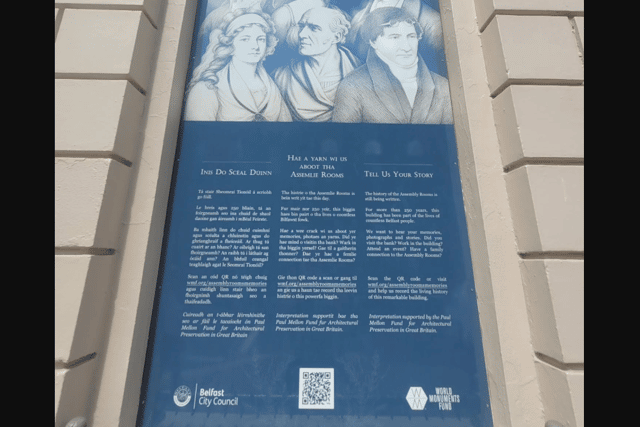
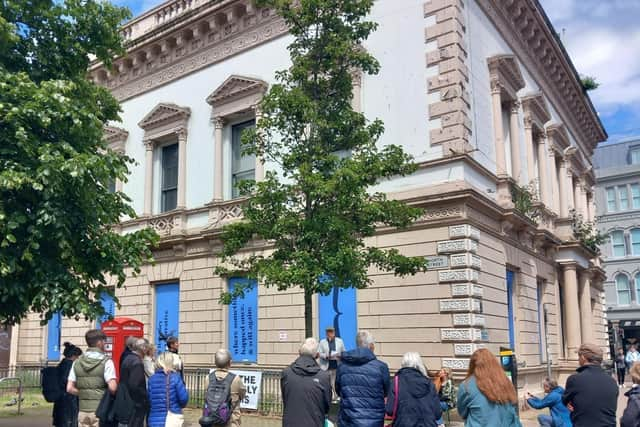
Trilingual signs bearing cultural information have been built on one of Belfast’s most historic buildings – after Sinn Fein tried and failed to eliminate Ulster-Scots from them.
The nationalist party wanted the 18th century Assembly Rooms plastered in Irish in time for the all-Ireland Fleadh, rushing the idea through a hurriedly-arranged council meeting three weeks ago.

But when unionists and Alliance suggested adding Ulster-Scots to hoardings as well, Sinn Fein were outraged.
Leader of the party’s council bloc, Ciaran Beattie, accused the DUP of secretly trying to stop Irish, before going on to insist that it would be “disgraceful” for anyone to support the addition of Ulster-Scots as it would amount to “assisting them in that blockage”.
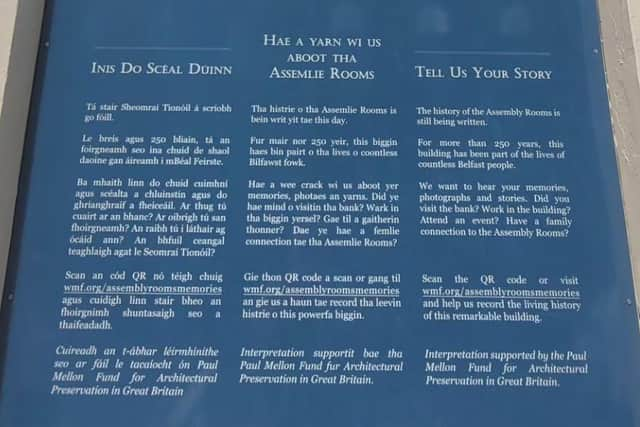
Sinn Fein were adamant that even as little as adding a QR code that interested people could scan with their phones to get info about the third language could not happen, as it would constitute a redesign of the signs.
The nationalists maintained it would be impossible to come up with a new look for the signs that included a QR code in the three-week gap between their rush meeting to approve Irish and the start of the Fleadh in the first weekend of August.
But they lost to the combined votes of the DUP, Alliance, SDLP and Greens.
Before the end of last week, trilingual signage went up – with at least one example bearing fully translated messages in all three languages.
A photo of one panel posted by Alliance group leader Michael Long showed a call for members of the public to submit their information, stories and family history connected to the 257-year-old building. The message appears in three columns reading in Irish, Ulster-Scots and English, in that order.
In a social media post, Mr Long stated it was “positive to see the erection of the trilingual message boards at the Assembly Rooms, reflecting the shared heritage of our city”.
Built in 1769, the landmark was the site of the Belfast Harpers Assembly in 1792, a pivotal moment in the preservation of Irish traditional music.
The building was massively reworked in the 19th century by the visionary architect behind many of Victorian Belfast’s most well-known sites, Charles Lanyon. Listed for protection in the 1970s, it has been derelict since the year 2000 and officially at-risk since 2003.
After two decades of calls for it to be preserved, last autumn Belfast Council bought it; early in July, city officials started work on fixing it and just days later Sinn Fein bolted through their bid to add boards bearing Irish to it.
Hoardings explaining the history and significance of the building were always planned as part of the repair work, but Sinn Fein explicitly stated they wanted them up and bearing Irish in time for the Fleadh – then moved to exclude Ulster-Scots.
During last month’s debate, the DUP’s Sarah Bunting pointed out that many of the civic and business leaders in the capital city when the Assembly Rooms were built would have been Presbyterian descendants of Scottish settlers, stating there is a “compelling case for recognising both the Ulster Scots and Irish traditions that helped shape 18th century Belfast”.
And Mr Long felt trilingual signs would be “a chance to bring cultures together” at an important historic landmark.