
The laughter stopped on the day ‘Our Jimmy’ died (1974)


Northern Ireland stopped laughing and shed many tears fifty years ago at the sudden and untimely death of beloved Ulster comedian James Young.
Young had died of a heart attack near the Grove Theatre on Belfast’s Shore Road shortly after 3pm on July 5th, 1974.
He had gained a reputation for being almost the only man who could go anywhere he liked in Northern Ireland and say what he liked about anybody and get away with it.
“He succeeded in the midst of the troubles in making his audiences laugh at bigotry and intolerance. His best known TV catchphrase was ‘For God’s sake, stop fightin’.’”
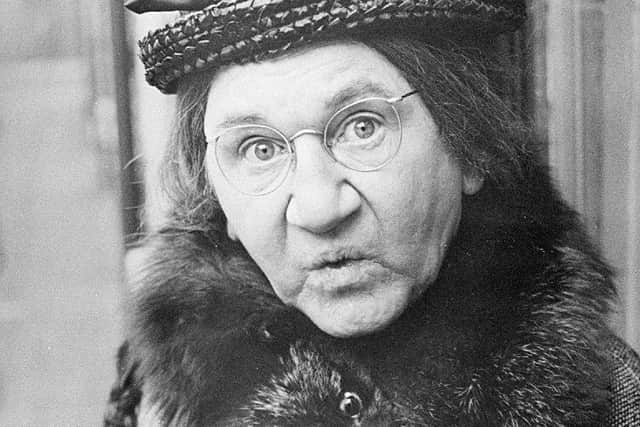
The Reverend M W Dewar, rector of St John's Parish, Helen's Bay, said: “He was a magnificent man who had an intense appreciation of the foibles of both sides of the religious fence and enabled us to laugh at bigotry.”
A 26-year-old factory worker, Mr Eddie Dickey of Bangor, commented: “It’s a real tragedy, I think Ulster can ill afford to lose men of the calibre of James Young who did so much to make both sides laugh at themselves.”
An 82-year-old grandmother from the Shankill Road, Mrs Agnes McFarland, said she remembered Jimmy young as “the wee boy who used to collect her rent every week long before he went on the stage”.
An Ulsterman who emigrated to Canada five years previously and arrived home on holidays the week before Young’s death telephoned the News Letter office to say how deeply he regretted his death.
“I saw him in Toronto about five weeks ago,” he said. “Though he made us laugh uproariously there were few dry eyes in the audience when he delivered his famous monologue about the nostalgia for his home felt by the wee homesick Belfast man who had settled down in Canada.”
Former Community Relations Minister, Mr David Bleakley, said: “James Young was a great and kindly Ulsterman. Time and again he raised us above our bitterness and by making us laugh together made us aware of how much we have in common.”
George Hewardine, who produced Youngs’ shows on television, told the News Letter: “His professionalism was mixed with sympathy, affection and understanding of the people from whom he drew his inspiration: the ordinary people, of Ulster.
“Those of us who worked with him owe him a debt of gratitude for the privilege of working with him and for making us laugh whenever we ran the risk of taking ourselves too, seriously.”
Famous figures from the theatrical, television, broadcasting and cabaret worlds paid their last respects to Young when he was cremated at Roselawn on Tuesday, July 9th, 1974.
Among them were Joe Tomelty, author of The McCooeys, in which Young had scored a big radio success. Others who played prominent parts in the series were also present at the funeral, including J G Devlin, John McBride and Mina Dornan. Other famous personalities among those who attended the funeral that the News Letter spotted included Sam Cree, Jean Lundy, Catherine Feeney, Harold Goldblatt, Tommy James, Walter Love, Joe McPartland and Bridie Gallagher.
The eulogy was delivered by Jack Hudson, Young’s long-time partner and friend, who said it was appropriate that on the most solemn and final occasion in the life of Jimmy Young he has, as usual, a capacity audience.
The News Letter noted: “The only ingredient missing was the sound of laughter, and that too was appropriate; not because of the nature of the day but because very little of the vast repertoire of words he used on stage were funny, unless delivered with that unmistakable voice, with the mischievous facial expression, with the eloquence of his gestures, and above all with the superb timing of his delivery.
“A true perfectionist of his art, his greatest fulfilment came with the waves of affectionate laughter during a comedy, or the utter silence during the beautifully judged dramatic pauses in a serious monologue.”
Mr Hudson said: “Whether he entertained in luxurious and fashionable cabaret clubs and well appointed theatres or small village bars and halls with minimal facilities he gave the same performance to create the illusion that he was just talking to you.
“He loved the magic of the theatre. And after two and a half hours of a solo performance he never allowed anyone to know what an effort it could be to stand and sign autographs. Whether in a beautifully bound autograph book or some grubby piece of paper from the hand of a small child, each one was important to him.
“Whenever it was remarked how tiresome it must be to keep signing autographs, he had a stock reply, 'I'll start worrying about that when they stop asking me.' Of course they never did stop.”
Hudson continued: “His most recent highlights came from his tour of North America. An ambition was fulfilled by appearing at the Mecca of entertainment, in Hollywood, California, where he held a sophisticated American audience spellbound. In Edmonton, Alberta, the Lieutenant Governor of the province presented him with an award to mark his achievements for Irish entertainment and community relations throughout the world, and the Mayor of Detroit in Michigan presented him with the key to his city.
“I was very proud, not only in seeing him honoured across the Atlantic, but in seeing what a good ambassador he was for this country which loved so well.”
Finally, in the days after Young's death a Sandy Row pensioner, Mr S Boyd, penned an appreciation in verse of Ulster's comedian entitled Young At Heart.
The poem read:
How true that old saying
About Mr James Young
This great Ulster comic
That gave us such fun
He was loved by us all
Both orange and green
The pride of the stages
The best Ulster ever seen.
Mr Boyd added: “I was reared beside him in the Ormeau Road district and knew him as a boy until he started work in an estate agent's office in Shaftesbury Square.
“He was liked by all Ulster people regardless of class or creed. I never went to any of his shows but we have many of his records in the home which the family always enjoy playing, especially the record of the mixed marriage - the name wee Rosie Brown whom he met in Bangor and its sad end. We all regret his sudden end. Gone but not forgotten.”