
Thomas Sinclair was a towering presence as both Presbyterian and Unionist
Thomas Sinclair was the most eminent Presbyterian layman of his generation; he was a man of strong and reforming social commitment; he was a businessman by profession; in politics, he was a Liberal; he was a political strategist and organiser; and he was a writer and wordsmith, being the man who framed the Ulster Covenant of September 1912.
Sinclair was born in Belfast on September 23 1838. Presbyterianism was central to Sinclair’s family background. Much of the family’s wealth was donated to the Church and to Presbyterian causes.
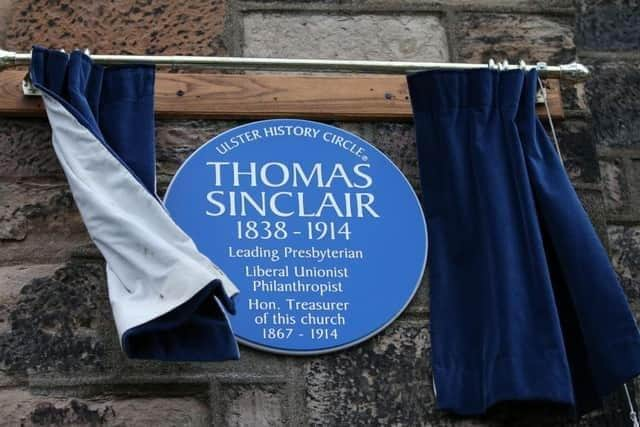

Sinclair was to become the most eminent Presbyterian layman of his time. From an early age he had taught in Sunday School; and at the age of 28 he was elected and ordained an elder in Duncairn congregation; and a year later he was appointed its clerk of Kirk Session.
Sinclair had been educated at the Royal Belfast Academical Institution and then at the Queen’s College, Belfast, now Queen’s University. He was a distinguished student, graduating with a first-class honours degree in mathematics, and with a gold medal, in 1856 and with a Master’s degree, and another gold medal, in 1859. Queen’s conferred an honorary doctorate on him in 1882.
Despite his distinguished academic record Sinclair chose to enter the family business – J & T Sinclair, Provision Merchants and Pork Curers – which had been founded by his father and his uncle. He became head of the firm on his father’s death, a position which he was to occupy for the rest of his life.
Sinclair promoted his religious and social views in the general assembly; and he supported, and sometimes led, the assembly in its opposition to Home Rule. He gave it practical support too: he conceived the idea of the Commutation and Sustentation Fund, persuaded the general assembly of its value, and set about organising it; all at a time when he was still in his early 30s. It remains to this day.
Sinclair’s Presbyterianism was central to his politics. We need to remember that in those days, in national politics, you could be attached to either the Conservative or the Liberal parties. Generally speaking, Irish Presbyterians, in common with Scottish Presbyterians and English non-conformists, were attached to the Liberal cause. Sinclair, as an active Liberal and a great admirer of W E Gladstone, welcomed and allied himself to Gladstone’s reforming measures in Ireland. He believed fervently in the disestablishment of the Church of Ireland, in land reform and in non-denominational education. Predictably, he welcomed disestablishment in 1869 and Gladstone’s two reforming land acts of 1870 and 1881.
The years 1868 to 1885, which corresponded with Sinclair’s active involvement in the affairs of the Ulster Liberal Party, marked the steady erosion of the Conservative Party’s long political domination in Ulster. These were years of advance for Ulster Liberals. While it would be wrong to suggest that the Liberal advance was due to Sinclair’s activities alone, Sinclair was recognised as a leader of Ulster Liberalism and a highly articulate critic of Conservatism.
However, Gladstone’s reported conversion to the cause of Home Rule stunned Ulster Liberals. They were comparatively slow to abandon Gladstone but when Gladstone’s espousal of Home Rule was placed beyond all reasonable doubt, they reformed themselves as Liberal Unionists: Liberals but not Home Rulers.
However, we should remember that Home Rule was not a proposal for independence but what we might today call devolution. In April 1886, at the time of the first Home Rule bill, Sinclair forcefully enunciated the Liberal Unionist viewpoint: ‘We shall show the world that come what may Ulster will never consent to yield up her citizenship, or be expelled from the imperial parliament to be degraded to a junior partnership in a subordinate colony.’
The 1892 Ulster Unionist Convention was Sinclair’s idea. It was to be a united and convincing demonstration against Home Rule. Sinclair translated the idea into a practical proposition, organised it and made one of the best speeches.
He was proud of his, and explained the policy of passive resistance with which Unionists intended to confront Gladstone’s prospective second Home Rule Bill should it become law.
However, Sinclair and the Liberal Unionists did not cease to be committed reformers. Sinclair and his friend, Thomas Andrews, were enthusiastic supporters of the report recommending state promotion of agriculture and industry. Both men were supportive of the efforts of Horace Plunkett and the Irish Agricultural Organisation Society, formed in Dublin in 1894, and they welcomed the establishment of the Department of Agriculture and Technical Instruction in 1889. They both supported the extension of democratic local government to Ireland and continued to be supportive of land reform.
Despite their willingness to cooperate with other parties and points of view, Sinclair and the Liberal Unionists were accused of selling out to the Conservatives and the Orange Order over Home Rule. Sinclair had to balance and combine civic, economic and ethnic arguments in his opposition to Home Rule. Civic, in that the Union offered all sections in Ireland a better opportunity for equality, freedom and diversity than a Home Rule Ireland dominated by one group; economic, in that industry and business, which as particularly strong in the north, would prosper better within the Union, and the Empire, than within a largely agricultural Home Rule Ireland; and ethnic, which recognized national groupings and argued for their right to retain their citizenship.
For a man of his years, Sinclair was remarkably active during the third Home Rule crisis. Despite having been ill in 1911 he was present but did not speak at the great Craigavon demonstration on Saturday September 23 1911. Thomas Andrews spoke for the Liberal Unionists.
Sinclair was also the moving and organising force behind the great Irish Presbyterian Anti-Home Rule Convention of February 1 1912. This again was a demonstration against Home Rule, bringing some 50,000 Presbyterian male voters to five venues in Belfast for afternoon and evening meetings to hear speeches, and to pass a resolution, against Home Rule.
Later that year, in May, Sinclair presented the case against Home Rule to Scottish Presbyterians in the Assembly Hall in Edinburgh. And, of course, in that year also Sinclair was to compose the wording of Ulster’s Solemn League and Covenant, drawing inspiration from the Scottish Covenants of the 17th century.
Thomas Sinclair died on February 14 1914. He was 75.