
Irish agitation perplexes people across the Kingdom (1811)
The continued agitation in Ireland was perplexing people in parts of Britain early in 1811.
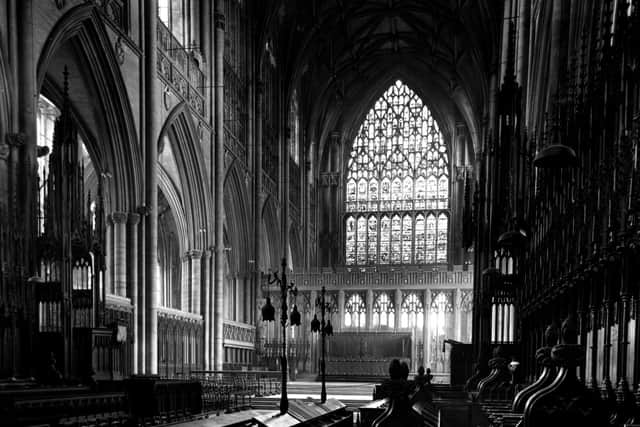
A report in the News Letter in February of that year covered the attempt by Trinity College don, the Reverend Francis Wrangham at the Cathedral Church in York to explain the Irish problem.
Wrangham described Ireland as “a country whose natives inherit, beyond almost all other men, the choicest blessing of Providence, exuberance of soil, vigour of frame, vividness of feeling and ardour of imagination”.
Dealing with the religious issue Wrangham concluded: “1f we cannot make them Protestants we may make them patriots by a type of early 19th century equality of citizenship.

“Let but science in its most useful form, toleration in its widest comprehension and kindness with its whole family of generous offices be employed as our missionaries and then, though we may continue for a while to worship at different altars, we shall in the spirit meet in the same temple.”
Wrangham recommended a “general and efficient” plan of conciliation.
On February 26 the News Letter noted: “The state of Ireland is the principal subject which engages the public attention in London at the present moment. It will speedily occupy the serious consideration of Parliament and we hope the discussions will lead to some salutary regulations.”
Catholic meetings were being held regularly throughout Ireland and the scale of the gatherings had begun to cause concern in London. There were fears that another rising was on the cards.
Later that month the authorities’ anxiety was manifested at a meeting in Capel Street, Dublin held to provide an opportunity for people to sign the latest parliamentary petitions requesting Catholic emancipation.
The meeting was about to start on February 20 - the News Letter carried the report three days later - when Alderman Darby announced that he had been ordered to disperse all such gatherings.
Lord French, who was in the chair, responded by warning the alderman that force would have to be used to clear the hall. Darby then withdrew declaring that the signing of a petition was not a problem. The incident, however, caused concern to the committee which demanded a meeting with the authorities.
The Catholic Committee held another meeting within days of the incident and rejected the imputation of disloyalty. Members were alarmed that the Capel Street incident marked a change in strategy by the authorities which would lead to a denial of the right to organise a parliamentary petition.
'A notorious robber' face execution at Dundalk
A correspondent from Kilkenny, on January 25, 1811, was quoted in a News Letter report saying that “this country is in a shocking state of disturbance; the whole country has been robbed of arms which the insurgents do in the middle of the day”.
The trouble was caused by the latest manifestation of agrarian unrest in the Caravats. leader of one band, a family group, was Michael Ryan,”who was known as Sclug, “a notorious robber”.
There was trouble in Belfast too in April. The News Letter reported that “a daring banditti of nocturnal robbers have infested our streets for several nights past”.
A gang of about a dozen, dressed as soldiers, had attacked two sailors at the bottom of James Street. At Hercules - Street, two gentlemen were attacked by another gang.
“These depredations call aloud for the immediate interference of the magistrates and the inhabitants and if some effectual measures are not quickly adopted our lives and properties will be in perpetual jeopardy,” warned the News Letter.
The paper suggested there was a need for a regular guard, a guard house or a jail.
“If our lives and properties remain in safety one night, it is merely because these blackguards chuse [sic] to forbear or to find it inconvenient to go upon the road. But there is no check, no interruption when they chuse to exercise their calling.”
Crimes, highway robbery in particular, were punished severely - when the culprits were caught.
On Friday, April 5, the newspaper reported that two highwaymen, namely, John McTagart and Pat Caullan faced execution at Dundalk.
While McTagart accepted his sentence quietly, Caullan was determined he wasn't going to go to the gallows without a fight; indeed, he was determined not to go at all and twice escaped from jail. The first time he used a pocket knife to cut through his chains but was captured before he could make good his escape. The second time he used a file, smuggled into the jail by his father. Again he was caught.
As might have been expected, the prison authorities were far from amused by the behaviour of their reluctant prisoner. They slapped him in heavier chains and to concentrate his mind brought forward the construction of the gallows outside his cell window.
Caullan must have had a premonition that his execution wasn't going to be a pleasant experience. It wasn't. The executioner bungled it, leaving the victim dangling to strangle slowly to death.
The News Letter reported: “After some further bungling by the executioner, they were launched into eternity.”
After an hour hanging from the gallows the two bodies were cut down and given to the friends of the deceased. Frederick Brown, a captain in the Dragoons, ended up in court to face a charge of tandem driving in “Colerain”.
Under a heading, Witchcraft, News letter editor, Alexander Mackay, included an extraordinary tale of ordinary countryfolk at Taunton. A labourer, Jacob Poole, in the edition of August 30, 1811, was reported as having brought a prosecution against a 77-year-old woman claiming she had bewitched his 12-year-old daughter.
According to the report, “the old hag” had forced the youngster to bring her money under a threat to make her “die by inches if she failed”.
Poole discovered the business when he went to the town druggist, Mr Brufard, who informed him his daughter had borrowed heavily against his name.
Mrs Poole and a number of friends descended on the old lady.
During the ensuing dialogue, Mrs Poole whipped out a pin and proceeded to scratch the old lady's arm three times from elbow to wrist - “this is considered to be a process of unfailing efficacy as an antidote to witchcraft”.
The old lady was subsequently fined a shilling and sentenced to six months hard labour in jail.