
Mourne trawlers played key role in search for missing Victor bomber


Sixty-five years ago this week a top secret British bomber on a routine test flight plunged into the Irish Sea, resulting in the loss of its four-strong RAF crew and a senior observer from Handley Page, the company which had built the 40-ton Mark 2 Victor aircraft.
The crash on 20 August 1959, involving a prototype of the UK’s latest and fastest military aircraft, was headline news, including locally in the News Letter, but after initial press interest had died down, the story, like the ill-fated four-jet Victor, disappeared ‘off the radar’.
Few if any members of the public ever knew about the massive operation that was mounted, at a cost of approx. £3m., to recover the missing aeroplane and to determine the cause of the catastrophe, which placed the whole future of the multi-million pound Victor programme in jeopardy.
Nor were they aware that nine fishing boats from Mourne, six from Kilkeel and three from Annalong, had played a vital role in not only helping to retrieve 70% of the bomber but also in ensuring the Mark 2 Victor would remain in service until the early 1990s.
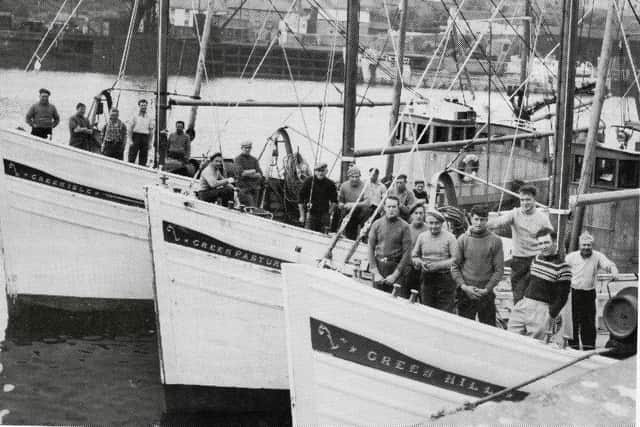
Under the control of HMS Harrier, the search off the Welsh coast involved some 1,500 men on board 27 trawlers and 12 Navy ships. It was described in contemporary official documents as “probably the greatest search operation of its type ever undertaken”.
It wasn’t until early 1960, some seven months after the crash, that a sizeable piece of the plane was recovered by a Welsh trawler. As a result all the boats, now including those from Mourne, were directed to an area measuring some 16 square miles.
The Kilkeel boats, which were engaged in the search from June/ July to November 1960, were Ambitious (skippered by Ernest McKee), Castle Dawn (Howard Forsyth), Melita (Louis Campbell), Ocean Gleaner (Bertie McBride), Shemeriah (David Wilson), and Unity (F. J. McKnight).
The Annalong trio, comprising Green Hill (Jack Chambers), Green Isle (Hayden Chambers) and Green Pastures (Victor Chambers), were involved between April and November 1960.
The trawlers cast special fine nets manufactured by Courtaulds, which used a tough new man-made yarn called Courlene. When the final ‘return to harbour – search complete’ signal went out on 19 November 1960, the trawlers, backed by a number of salvage vessels, had carried out more than 12,000 hauls and nearly 600,000 pieces of the missing bomber had been recovered.
Ambitious achieved the record for a single trawler’s recovery for any one month – 27,574 pieces of Victor wreckage. Green Pastures set the record for a single day, netting no fewer than 7,395 fragments on 30 June 1960.
The crew of Green Hill recovered the co-pilot’s watch from the seabed. This discovery was critical, as it pinpointed the exact time of impact from which a more accurate search area could be determined. Of all the thousands of items recovered, the watch was the only “human” evidence to survive the catastrophic crash. No human remains were ever found.
The total catch represented an amazing 70 per cent of the aircraft which had shattered on impact with the sea. It gave the Royal Aircraft Establishment at Farnborough, which pieced together a crude skeleton of the Victor bomber in a huge hangar, enough information to be ‘reasonably satisfied’ regarding the cause of the accident.
It was all down to human error: too much protective paint had been applied to the sleeve that secured the pitot tube, an instrument that measured the speed of the plane, causing it to shear off from the starboard wing during its routine high speed manoeuvres. As a result the plane went into a sudden dive which the pilots were unable to correct.
The story, which for many years was shrouded in official secrecy, was first made public in a meticulously researched book called ‘Operation Victor Search’, which was written by Douglas A Koster, Second Mate on the salvage vessel Twyford, and published by Terence Dalton Ltd in 1979.
A copy came into my possession, in my role as editor of the Mourne Observer newspaper, some 15 years later. Realising that as far as local readers were concerned it was potentially “the greatest maritime story never told,” I obtained permission to serialise the book in 1994, concluding with a reunion night in Kilkeel which brought together a number of the trawlermen who were involved in the operation.
The power of the local press notwithstanding, the story of the search remained largely untold outside the Mourne area. That was until July 2023, when, upon my prompting, a three-minute report was viewed many thousands of times on the BBC World News website followed by Radio Ulster coverage and again on the BBC Northern Ireland Newsline programme.
All the reports featured an interview with Annalong man Sam McKibbin, one of the last survivors of that “greatest maritime story never told”. The online coverage was drawn to the attention of Cheshire-born Elizabeth Morgan, daughter of pilot Raymond Morgan, which led to her paying a visit to Mourne in early June, including an emotional meeting with Sam in Annalong.
Extending her family’s sincere thanks to Sam and the trawlermen of Mourne for the hugely important role they had played some 65 years earlier, Elizabeth stressed that above all else five men had lost their lives and their names deserved to be remembered: Squadron Leader Raymond James Morgan, Squadron Leader Gerald Breakspere Stockman, Flight Lieutenant Ronald John Hannaford, DFC, Flight Lieutenant Lewis Nicholas Williams and Mr Robert Hugh Williams, Handley Page.