
News Letter editor grapples with judicial censure woes after failed Emmet’s rebellion (1803)

James Blair in October 1803 had to grapple with every editor’s nightmare – judicial censure.
At Downpatrick Commission, held to deal with supporters of Emmet’s Rebellion in the north, Judge Osborne complained that the Dublin Evening Post had produced “a gross misrepresentation” of a charge given at another hearing in Carrickfergus.
He demanded an explanation. Blair confessed that the Dublin Evening Post had lifted the material in dispute from the News Letter.
“The printer of the Belfast News Letter finding it incumbent on him to observe that any error alleged to have originated in the Dublin Evening Post as attributable to him, as the paper alluded to was copied from the Belfast paper.”
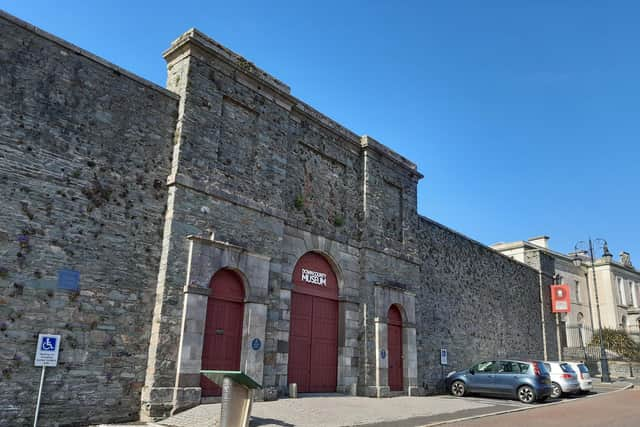

Blair said the News Letter was anxious to lay before the public “a faithful report” of the case involving the “learned judge buy may have failed in the attempt to do so”.
He revealed that the paper had brought a shorthand writer from Dublin to help produce an accurate record of the hearing.
The court cases at Downpatrick and Carrick demonstrated that the north had been far from tranquil during Emmet's Rebellion.
Among those charged with high treason was Thomas Russell who faced the court on October 12 (and was later executed and beheaded at Downpatrick on October 21, his remains were buried in the graveyard of St Margaret’s Church, Downpatrick, a grave paid for by his friend Mary Ann McCracken).

Russell, a Dublin Episcopalian, came north and became friendly with Presbyterian families including the McCrackens. He was close to Henry Joy and his sister Mary Ann. After the failure of the 1798 United Irishmen Rebellion he had fled to the continent hoping to launch another rising but was distrustful of the French.
The News Letter reported that Russell spoke from the dock for 20 minutes but “his thoughts were loose and ill constructed, at the same time expressed without embarrassment”.
Russell had spoken in favour of “ameliorating the condition of the lower classes – infatuated and inconsistent man”, the paper commented and continued thus: “Who could even for a moment conceive that the state of either the beggar or the gentleman could be ameliorated by the intimidation of French armies with; the most arrant tyrant at their head.”
Russell was found guilty – there was never any doubt that this would be the verdict.
The News Letter went on to establish that Russell had been central to the preparations in the north.
It accused him of inconsistency in attempting to bracket freedom with “French anarchy” and “French slavery”.
The News Letter asserted: “The tyger and the ape Voltaire conceived to be the compound of his countrymen’s character. These if Mr Russell’s project took effect would lord it over the unhappy land which gave himself birth cursing it with the ferocity of the one animal and the fantastical tricks of the other.”
On October 26, 1803, Bonaparte was reported to be in Boulogne.
“An attempt will be made in Ireland,” the News Letter report suggested.
The paper also noted that “there are a great many Irish traitors in Paris”. They were consulted as to the best means of attacking their country, “but though they are listened to on this head, they are generally hated and despised”.
The Society Tyrone Orange had met on July 12 at Ardboe Church where Coagh and Stewartstown districts had assembled. The resolution passed attacked “the hostile machinations of that renegade upstart Bonaparte and his plundering horde of slaves”.
The Orangemen pledged loyalty to the Protestant religion, the Constitution and “our amiable Sovereign”.
As the marching of French troops to the coast continued for the purpose of invading Great Britain, Italy declared war on Britain – a move which brought a venomous attack from the News Letter: “The hostility of this contemptible power would scarcely have desired notice but in as much as it must prove to Europe, if any proof were now wanting, that from the moment a power allies itself with France, from that moment it must cease to be ranked as an independent nation, and is doomed, dreadful doom indeed to follow the fortunes to submit to the dictates, and to bend beneath the iron yoke of its tyrannical master.”
The menacing Bonaparte brought a revival of the savage lampoonery which had been a feature of the late 18th century.
One correspondent to the News Letter in November 1803 referred to ‘Citizen Puff’ in a short piece datelined Dunkirk, Friday November 4, 1803, one o’clock, three minutes, 15 seconds am.
In a mock news report the writer informed readers that “Bonaparte is just arrived in a balloon” complete with wife in a cork vest for the assault on England. Much was made in this and subsequent contributions of the First Consul’s wife.
In December of that year another correspondent to the editor, James Blair, urged that Emmet’s dying dedication should be printed in every issue of the News Letter to remind readers of the French threat to freedom and religion. He described the passage as a “beacon” against French tyranny.
“If the French land in Ireland. O my countrymen meet them on the shore with a torch in one hand and a sword in the other,” Emmet was said to have advised.
A pastoral message to the “Lower Orders of Roman Catholics in Connaught” which appeared in the News Letter on Tuesday, October 18, 1803, urging them not to be seduced by French invasion “into the most fatal errors.”
The Church establishment hoped that “neither the seductive acts of domestic conspirators nor the allurements held out to you by our foreign enemies can again beguile you into the paths of guilt and misfortune”.
The letter said favourable reports had been received from parochial clergy which gave “the strongest grounds” for hope “that henceforth your pastors will not have cause to blush for the conduct of their flock, nor religion to weep over the errors of her children”.
It added: “What can, in this life, be dearer than constitutional freedom, security of life and property and the free exercise of religion.”
In a clear reference to Emmet’s Rebellion the pastoral remarked: “At home the remnant of an impotent faction has dared to raise its head and give us a cruel pledge of its murderous design, whilst from abroad our shores are menaced by a hostile nation and the tranquillity of 30 million people sacrificed to indulge the ambition or gratify the revenge of one man – misguided man!
“Who can be so infatuated as to imagine that the man who now rules France with a rod of iron, would become the assertor of true liberty in this country?”