
News Letter introduces the forerunner to Farming Life to it’s readers (1824)
While Alexander Mackay Jnr published the News Letter after 1821 his father Alexander Snr concentrated on other business activities including the publication of a weekly journal which could be seen as the forerunner of one of the company’s most successful supplements – namely Farming life.
On January 9, 1824 the News Letter carried the original prospectus for the Ulster Farmer and Mechanic (pictured).
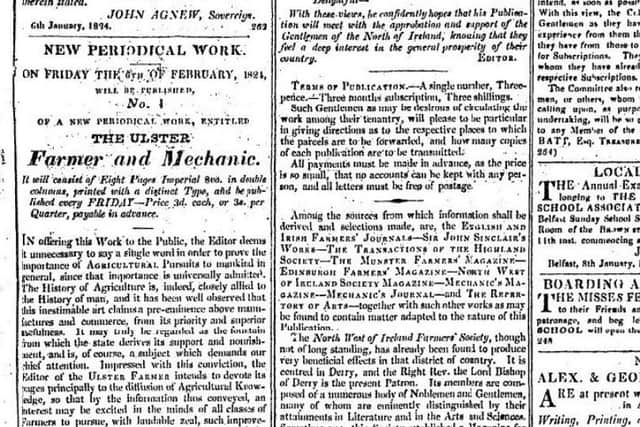

The new publication, a weekly, was the brainchild of Alexander Snr and another son, Robert A Mackay. They took an office at Rosemary Street near the Bible Repository.
The publication was intended to satisfy the fast growing demand for information about developments within the industry.
It may well be that the £5,000 loan which Alexander Snr had advertised for in the News Letter several months previously was intended to finance the new publication.
The Ulster Farmer and Mechanic posed little threat to the News Letter's position but the proposal .to launch another newspaper also announced in 1823 did.
The birth of the Northern Whig
In the News Letter on October 28 an advertisement announced the intended publication of the - Northern Whig in January 1824.
Behind the publication of the new weekly was a printer F D Dalzell who operated from premises in Corn Market.
The advertisement attributed the proposed development to “the rapid increase of knowledge chiefly by means of home education”.
The growth in commerce “assisted by enterprising individuals in the North of Ireland” had “created a reading population which no common stock of periodical publications can supply”.
The Northern Whig would consist of four pages totalling 32 columns “on a type so small yet perfectly distinct that it will contain considerably more matter than any other publication in Ireland”.
In column terms the Northern Whig was bigger than the News Letter which then consisted of 24 columns. The News Letter, however, was published twice weekly.
According to the advertisement in the News Letter the Northern Whig would contain sections dealing with politics, commerce, agriculture and “belles letters”.
The motto of the new publication would be “Pro Rege sape-pro patria semper”, “crown and country”.
Finlay added a footnote for the community - “into the ranks of its watchmen we cast ourselves, and shall not fail to sound the trumpet of alarm whenever we discover the hostile approach of its enemies.”
The publication of the Northern Whig in January 1824 gave Belfast four newspapers — the News Letter, the Belfast Commercial Chronicle, The Irishman and the Northern Whig.
The News Letter and the Chronicle tended to slot into the pro-establishment sector. Although the News Letter was regarded as Conservative it was non-partisan and backed a number of liberal causes including Catholic Emancipation.
It was also to the fore in supporting radical projects in commerce such as the Ulster Canal in the hope that prosperity would be expanded and work provided for those unemployed.
Stuart as editor gave the News Letter a new more positive identity and a more definite editorial policy.
The Irishman was used by its publisher John Lawless as a platform for his own ideas and interests and was more a political journal than a genuine newspaper.
Although it was. designed to plug the gap in radical political debate left by the destruction of the United Irish Society's Northern Star it lacked the consistent quality in content.
The Northern Whig was designed to combine a liberal approach to the issues of the day with extensive and accurate news coverage.
New Letter urges reduction Stamp Duty
The expansion of the newspaper industry coincided with complaints about the impact of stamp duty on publications. On September 16 the News Letter urged that stamp duty should be reduced because it had “a manifest tendency to diminish the circulation of that species of periodical work by coercing the publication to charge a higher price for the journal than otherwise would have demanded”.
Publications had to pay duty on advertisements which the News Letter claimed had cut the number of paid notices by 60 per cent.
A reduction in duty to l/6d, the News Letter contended would cut the price of most newspapers by one penny and would mean they “could be afforded on such reasonable terms that a multitude of individuals and families would become readers”.
Belfast in December 1824 boasted a population of 37,267 while Lisbum had grown to 4,684, Coleraine to 4,851, Newry to 10,019 and Londonderry to 9,413.
On animal and human health
The year 1824 also saw the establishment of Belfast's first veterinary hospital. A Dubliner Edward Wimbush on June 29 in the News Letter announced, he had opened a vets hospital and forge at 24 Chichester Street with extensive stalls. “Medicines would also be prepared on the premises,” noted the News Letter.
For humans with health problems Hodgson's on High Street offered a range of preparations from Butler's Medical Hall of Sackville Street, Dublin.
The products included Fluid of Sarsaparilla, super carbonated sodiac powder, acetated laudanum, quinine lozenges, concentrated essence of Jamaican ginger and essences of cinnamon, peppermint and fennel.
Row erupts over delay in mails
The Post Office in Belfast faced complaints from 1824 over; delay, in the delivery of the mails. A commission of inquiry was established to examine the complaints levelled against the office and the Postmaster, Tom Whinnery.
It was alleged that Whinnery delivered mails quickly for those merchants prepared to pay for the speedier service. There was a conviction that those merchants who paid the extra thereby obtained a head start on their competitors.
The Chamber of Commerce was quick to take up cudgels on behalf of the majority of the town’s merchants. One of the town's leading personalities, Thomas Verner, found himself in the middle of a row between the News Letter and the Northern Whig in June 1824. Verner was in the middle of a transfer from his post as collector of excise; he had also served with distinction as sovereign of Belfast. The Whig, however, attacked him alleging he had failed to send a message of welcome when George IV visited Ireland. The News Letter described Verner, who had served in Belfast for 23 years, a “sagacious in discovery and prompt in effecting as far as possible every object that could essentially benefit his fellow townsmen”. Verner’s removal from Belfast would be “deeply regretted and ever felt as a general loss,” added the News letter.
The Northern Whig had charged Verner with a dereliction of duty but the News Letter pointed out that this was inconsistent with the facts of the matter in question. Verner had called a town meeting to discuss a message to the king.
“Recalling to memory with grateful emotion the honourable testimony borne to the rectitude of his conduct by his fellow townsmen, Mr Verner may receive the unmerited and wanton censure of the Northern Whig with perfect indifference,” stated the News Letter.
'Notorious fact” of absentee landlords
Absentee landlords posed serious problems for the Irish economy during the 18th and early 19th centuries. The absentees who extracted rents from the island and; put little cash back in to improve their properties drained resources from the island, and contributed to the agrarian unrest. Tenants resented paying money to rent collectors and other middlemen.
The absentee problem was tackled by News Letter editor James Stuart on September 16,1825. Stuart said it was a “notorious fact” that much of the rental of Ireland was spent in foreign countries by absentee landlords, who made no attempt to encourage the island's tradesmen and farmers. The fact that they also gave little example in terms of land improvement was also resented.
Absenteeism, Stuart pointed out, ruined the link between landlords and tenants.
Absenteeism, however, was defended by an economist, J F McCullough, who argued that the landlords provided a market outside Ireland for products such as cloth.
The News Letter described this as a “manifestly absurd” supposition.
The paper suggested that if McCullough's views were carried to their logical conclusion "the most effectual mode of increasing the export trade of Ireland would be to expatriate all the landlords of the country”.