
News Letter reaches its first centenary since foundation (September 1837)

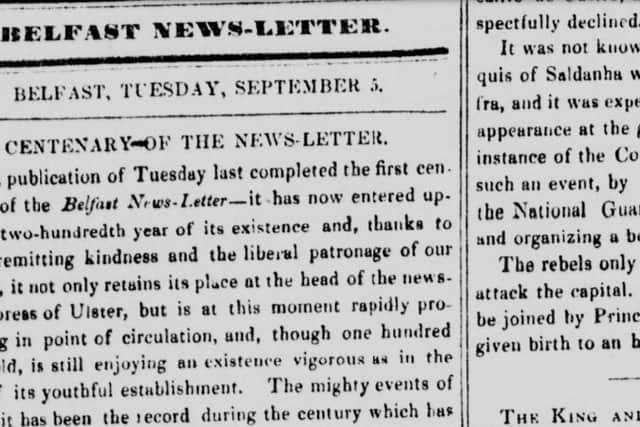
The News Letter reached the first centenary of its foundation on September 1, 1837 but the historic event was not marked in the newspaper’s columns until the following edition – September 5.
An editorial in that edition outlined the objectives of the newspaper's publisher, Alexander Mackay and its editor James McKnight: “Our aim has been to convey the strict truth on all sides of agitated questions without regard to the unintentional or unprincipled exaggeration of mere party, and we find that our labours have been appreciated with public approval.
“Our duty as public journalists we conceived to be to extenuate nothing, nor set down aught in malice towards any party in the state, and we believe that by this putting our readers in possession of unvarnished truth in respect to the occurrences of the day we are doing them a far more important service than if we should excite delusive hopes that cannot be realised, or kindle feelings of party animosity by distorted representations,” the editorial said.
By September 1837 Mackay then aged 74 was nearing the end of a long and distinguished career which had seen him twice assume the role of proprietor and publisher of the News Letter. He had been a j unior member of the Edinburgh consortium which had purchased the News Letter from Henry Joy in 1795. In 1804 he had purchased control. His plan to pass the newspaper onto his sons was ruined by the premature deaths of both leaving him to resume total control in 1829. Under the Mackay's a separate post of editor was created, the first incumbent being Dr James Stuart, journalist and historian of Armagh.

In 1837 the imprint signalled a new development at the News Letter with the ageing Mackay taking David Murray into virtual partnership. The imprint at the foot of the fourth page announced that the News Letter was published by Alexander Mackay from his home at 10 Mount Collyer Park and by David Murray “at their printing office in 10 Bridge Street”.
With the deaths of his two sons Mackay was left with a daughter in law and three grand daughters of his son Alexander who had been earmarked to own the News Letter after his father's death. \ As Alexander senior neared the end of his own career there was, therefore, a question mark against the succession and the very future of the News Letter. The imprint indicated that Mackay was endeavouring to run the newspaper from his home; clearly his health was poor and he was then housebound.
On May 29, 1838, McKnight published for the first time since 1795 the circulation figures for the News Letter which showed it was still Belfast's leading newspaper. The figures based on stamp duty calculations showed that the News Letter was then selling 1,260 copies on a twice weekly basis. It had a number of serious rivals - Francis Finlay's Northern Whig founded in 1824 sold 1,009 copies twice a week; the Commercial Chronicle 870 on a thrice weekly basis and a newcomer, the Ulster Times, which had been founded in 1826. The total circulation of newspapers in the province, therefore, amounted to 3946.
In 1795 Henry Joy, when he was advertising the sale of the News Letter, revealed that its circulation was 3,225 copies twice a week. In 1789 it had been selling at the rate of 2,100 copies per edition.
Between 1795 and 1838 newspaper sales showed relatively little sign of growth despite the improvements in education and the expansion of schools throughout the province. Newspapers were still comparatively expensive at this period which also saw an increase in news rooms such as the one which existed for merchants in the Commercial Buildings in Bridge Street. News rooms exerted an adverse impact on sales. Stamp duty was a device by which successive governments attempted to restrict the dissemination of newspapers; it kept cover prices high and also limited advertising revenue.
The News Letter by 1837 was also facing stiff competition for its share of the limited market; viability was, therefore, threatened and the newspaper could ill afford difficulties arising from inheritance.
The rivals were also eating into the News Letter's share of the advertising cake which it had controlled from its earliest days. Mackay had enlarged the newspaper and tidied up its appearance with new type but advertising did not show significant growth because of the competition and the economic slumps which hit Belfast from the start of the 19th century. The cotton industry, in particular, was largely wiped out creating much distress and destitute.
Coal discovered on the new road to Crumlin
The big news story in the News Letter on September 5, 1837 was the discovery of coal near Belfast. The newspaper reported: “During the last few days a discovery of considerable importance has been made in the neighbourhood of this town. In the course of the operations necessary for the completion of the new road to Crumlin, the workmen unexpectedly happened upon a stratum of coal at the junction of the old and new roads, about four miles and a half distant from Belfast.”
The News Letter reporter said he had seen two types of coal from the find - “the first was of a stony or slate formation, emitting scarcely any gas during the process of combustion, and affords therefore no ground for high anticipations so far as the stratum to which it belongs is in question; but the second, or lower stratum is of a totally different character.”
The News Letter said the second specimen had the appearance of “fine lead ore”. When exposed to fire it burned freely and emitted a large quantity of gas.
“From the situation in which this coal has been found it is conjectured that it may possibly be a continuation of the Coalisland stratum, but this is an assertion which it would be premature to entertain until the extent of the bed shall have been ascertained by experiment.
“The inquiry, however, is worth making since, in consequence of the recent destruction of the colliery at Workington, fuel is now not only scarce at our port but is sold at prices which, considering the season, may well be termed exorbitant. If it were possible to discover coal in our own vicinity, the benefit conferred upon the community would be immense, and on this account every indication of such a result should be carefully and perseveringly investigated.
“At present our expectations are not sanguine, but still no effort should be left untried in order in order to pursue to its termination an inquiry so vitally interesting to the inhabitants of Belfast.”
The involvement of clergy in politics also exercised McKnight in 1837. During a consideration of the proposal introduce secret ballots at elections McKnight expressed a fear that this might serve to increase the influence exerted by the priesthood in particular.
McKnight wrote: “Clergymen of all denominations have occasionally been too active in politics and have consequently in the estimation of impartiality diminished the reverence which would otherwise have been paid to their sacred character.”
Increased interest in the linen industry had prompted News Letter editor James McKnight to publish a supplement in March 1834 which had been prepared by William Andrews in Comber. Andrews produced guidelines for the cultivation of flax in an attempt to encourage more farmers to provide the raw material for the burgeoning Belfast mills.
Andrews advised: “The increasing wants of a world advancing in civilisation and wealth, cannot fail to reward all the industry and enterprise which may be brought to the improvement of a manufacture, which produces the most useful and durable, and the most beautiful fabrics.
“Ireland possesses many advantages and facilities for maintaining and advancing her superiority. lam not aware that we are now surpassed in any branch of this manufacture, fine cambric and lace excepted, by any country in the world. Even our damask now equals, if it does not surpass, that of Silesia, as will be seen by comparing the manufacture of my relation at Ardoyne, with the most perfect specimens that have ever been imported. But I must repeat the lamentation that we are forced to go to the continent for the material for our finest yarns though our own soil and climate are so well adapted for its production.”
Belfast by night during 1835 must have been difficult. A correspondent to the News Letter in February 1835 complained about “hordes of prowling ruffians” infesting the town.
The letter writer said he had been molested near the Poor House on Clifton Street by a gang of “three evil looking fellows”. He wrestled with then until one pulled a small dagger. The writer was saved by the appearance of another person who forced the thugs to run away.
The correspondent urged that a nightly patrol should be placed on the town's main streets to protect innocent people from ruffians.