
News Letter’s new owner promises to steer clear of ‘delusion of faction’ (1804)

The last News Letter to carry the imprint of James Blair appeared on Friday July 27, 1804. Thereafter from Tuesday, July 31 the responsibility for the running of the newspaper passed to Alexander Mackay who had been part of the consortium which acquired the Belfast paper in 1795.
With Mackay at the helm the News Letter moved ahead. He purchased new type and improved the overall presentation of the newspaper featuring a number of supplements dealing with news in depth.
The imprint at the foot of the last page informed readers that Mackay would print “Gentlemens leases and every other kind of printing work ... with neatness and elegance.”
The first appeared on Friday, August 31. An experiment of publishing the News Letter on a Monday instead of the usual Tuesday was dropped on February 15, 1805. The last News Letter to carry a Monday dateline appeared on February 11.
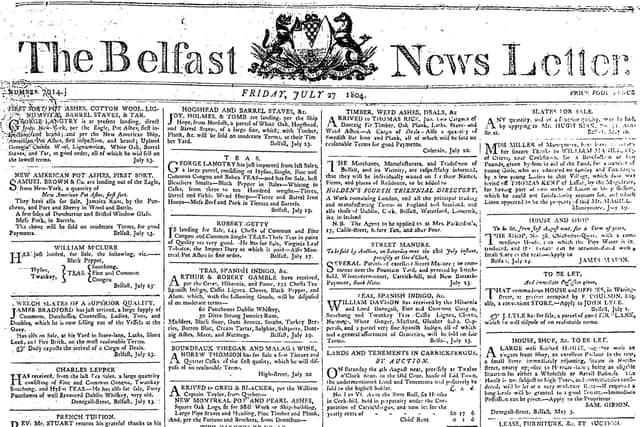

Mackay revealed that the experiment had been scrapped following complaints from a number of regular subscribers. The first Monday News Letter had appeared on February 4. Mackay announced the change of publication in the edition of January 29. The change had been made to suit the arrival of British mails.
Subscription rates were also increased to £1-12-6 for those who paid in advance in Belfast; £1-16-10 for advance in the country and £2-3-4 for those depending on credit.
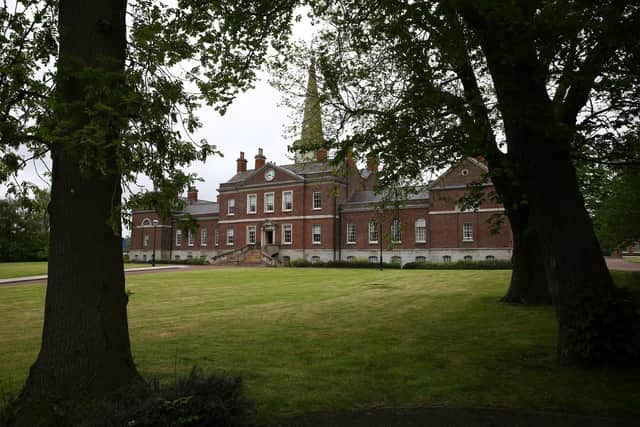
On April 30 there was another development at the company and a new enlarged newspaper emerged. Mackay moved from High Street to 11 Bridge Street but continued to print the newspaper at Joy’s Entry.
Mackay in a message to readers said the paper had seen a number of changes in proprietors and “much vicissitude in taste and in politics” but it had “continued to enjoy public favour”.
“If indeed in its maturity of years it can retain that character it so amply possessed in its juvenile vigour, its present editor will desire no more,” wrote Mackay.
He said the News Letter had, during its 67 years, steered clear from the “delusion of faction” and the “infamy of corruption”.
He pledged it would continue to plough this furrow “that it cannot pretend either to precise authenticity in its facts or perfect justice in its comment, it will seek for truth and carefully detect misrepresentation”.
He told readers that provincial newspapers detached as they were from the centre of affairs had to depend upon reports from other journals.
“But in its selection it can endeavour to disentangle contradiction, and, when it has no fact to dwell upon, it must rest satisfied with considering airy speculation of the day, avoiding embellishments of fiction,” Mackay commented
The News Letter would endeavour to be a “faithful register of the progressive march of this great and opulent Province”.
After a period of intense political activity Mackay said he was “happy that the delirium of the age is now nearly at an end”.
The News Letter would look forward to “a return of the sentiments of reason and of nature”.
It would hope for years of progressive improvement “chastened and corrected by a due regard to habit, to morality and to duty; it will humbly, though ardently, endeavour unbiased by power or party, to correct what is wrong and to record what is right”.
Mackay in April had indicated the existence of a specific ‘News Department’ which used a new type. The early supplements included a detailed account on October 19, 1804 of Wellesley's achievements in India and the endeavour of Nelson in Toulon against the French invasion preparations. The supplement had been flagged in the News Letter of Friday, October 12 and readers encouraged to obtain their copies.
The French threat remained in the forefront of peoples’ minds throughout 1804. On August 30 the newspaper had covered French activities at Boulogne under a heading “The Invasion” - which was sensational by 19th century standards.
Dromore poet Hafiz who had figured in News letter columns for many years penned an Ode to the French Flotilla - “O ill-starred fleet and must ye sail. Urged by demons that prevail. O'er subjugated France.
“Take my advice, boat, brig and ship. And let your anchors hold their grip. Tempt not Britannia's borders,” he wrote.
Belfast Charitable Society and the 'threat of beggars'
A black cart introduced by Belfast Charitable Society proved a formidable threat to the beggars who roamed the streets of Belfast.
The cart was mentioned in the News Letter of July 22, 1804 when a correspondent reported: “The very sight of it gave vigour to the infirm and the lame became so fleet that their most ardent pursuers were completely distanced.”
The following poem accompanied the report: “He that begs and runs away May hope to beg another day/But he that's by the black cart taken./Can never beg again.”
At a meeting of the society a badge system was introduced. The ‘badged’ poor could beg without fear on Tuesdays and Saturdays only. But they were not allowed to approach strangers in the streets. The residents of Belfast were urged to give alms only to the “badged” poor. “Foreign” beggars when spotted by residents were to be reported to magistrates “that they may be immediately committed to confinement and hard labour”.
Two years later on January 24, 1806 the society was providing proof of its success.
Under a heading “Longevity” the News Letter noted about a number of the residents of the poorhouse: “The great age they have attained is more convincing proof of the healthy situation of the house than any arguments we could offer, and demonstrates at the same time the care the managers bestow towards the cleanliness, regularity and general economy of the establishment.”
The report listed the oldest male and female residents - James McAlister was 89 while Jane Burns was 88.
A letter from the Reverend Mr Graves “who lived nearly a century” urged temperance in all things as a “source of health”.
He said: “Fast and take rest ye candidates for sleep. When from high food tormenting vigils keep. Fast and be fat. Starveling in a gown. Ye bloated fast I'll warrant it brings you down. Fast and fear not. You'll need no drop or pill. Hunger may starve, excess is sure to kill.”