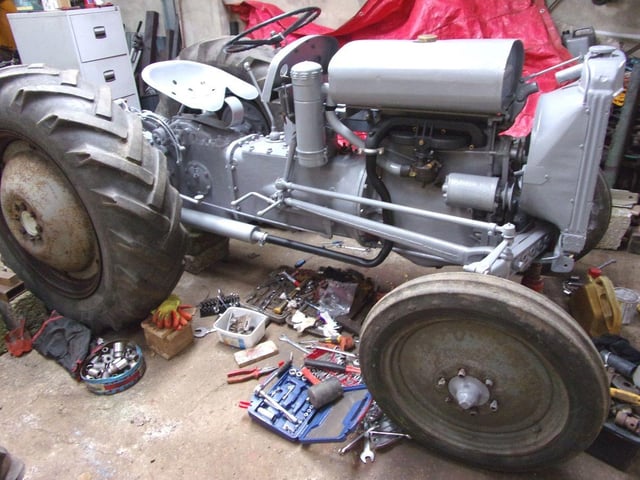
It’s been 35 years since I last undertook a full restoration of a vintage tractor and that was one of my all-time favourites my 1944 Ford-Ferguson. The Ford-Ferguson was the world’s first mass produced Ferguson System tractor introduced in June, 1939 and built by Henry Ford in the USA to a design by Harry Ferguson and his fellow Northern Ireland engineers.
The Ferguson TE20 was based on the Ford-Ferguson, Harry Ferguson had brought the blue prints of the improved Ford-Ferguson with him on his return to Northern Ireland having spent from 1940 to 1945 in the USA. The Ferguson Company owned the intellectual rights to the Ford-Ferguson tractor and not Ford so Harry Ferguson was able to base the new tractor on it.
The next time you see a little grey Fergie, the TE20 remember it was designed in Northern Ireland and came so close to being built in Northern Ireland as the Ferguson TE20 (Tractor for Europe 20HP) in August, 1945. Sadly because the government at Westminster refused to make the £3 million Pounds available to Stormont to equip a factory in Belfast that was not to be, something Harry Ferguson always personally regretted. In October, 1945 Harry Ferguson signed an agreement with Sir John Black of the Standard Motor Company to build the tractor for his Ferguson company. Harry Ferguson Limited would market, sell and maintain the tractor called the Ferguson TE20 (Tractor England 20HP) for European and world markets after Westminster did give a £3 million Pound grant. John Malet Chambers was the man Harry Ferguson tasked to work with the Standard Motor Company to put it into production.
After the deal was made with Sir John Black, the prototype Ferguson TE20 assembled in Belfast and all drawings and plans were shipped to Coventry. Harry Ferguson would purchase Abbotswood estate near Stow-on-the-Wold, Gloucester, England to be within driving distance of the Standard Motor Company factory. A total of five pre-production TE20s were used for testing and assembled during April – June, 1946. These later in 1946 being remanufactured with the production improvements and supplied to dealers for demonstration purposes as there was such high demand for the tractors.
The Ferguson TE20 had important improvements over the Ford-Ferguson that included a new overhead valve engine made by the Continental Motors Company in the USA, an extra forward gear to give four forward and 1 reverse gears, improved steering, brakes and extra mounting points beside the top link mounting pin.
1946 Ferguson TE20s are special because of the over half a million Ferguson TE20 tractors built from 1946 to 1956 only 315 were assembled in 1946 due to casting difficulties, material and component sourcing problems and training of staff by the Standard Motor Company of Coventry to build them.
Many of the early tractors were built then disassembled and rebuilt a number of times to learn those building them the correct methods. This was also for the benefit of visiting VIPs and the press to see tractors assembled in “staged” assembly as they didn’t have the parts to build more tractors.
The first tractors were built on tables before the production line was ready. Production got fully going in 1947 with over 20,000 built during the year. Early tractors used the American built Continental Z120 spark ignition engines running on petrol only, Standard’s own engine of a similar specification was introduced later in 1947 and both engined tractors built side-by-side until use of continental engines was discontinued in the UK.
I purchased the tractor on the 5th November, 2024 and discovered it was once owned by John Malet Chambers and featured on many of the early demonstrations and advertisements at the farm behind the Standard Motor Company.
The tractor was stored in a barn since 1985, the previous owner had bought it earlier in 2024 and regularly dismantles Ferguson tractors. He had removed a number of parts including the manifold, the tractor was that close to being scrapped not realising how special it is.
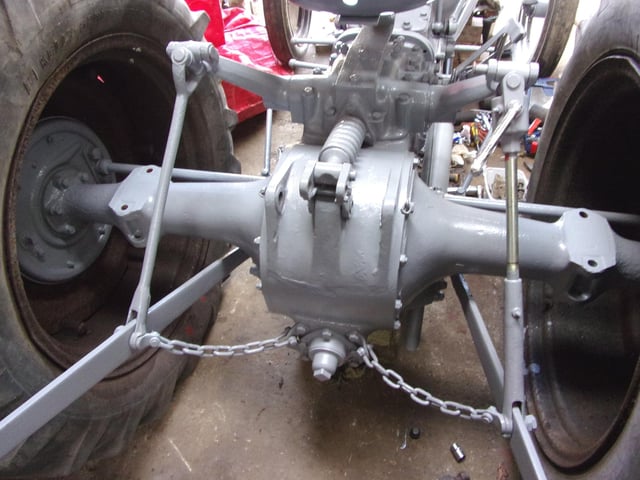
Early tractors appear to have been built with whatever parts could be sourced and this means each one is unique. The gearbox is cast Iron, which was quickly changed to Elektron, a magnesium alloy after the first 1,000 or so tractors. It has a casting date of 26th March, 1946. The fuel tank is hand fabricated. It has a long type air cleaner and an adjustable stay for the top of the radiator. The radius rods are welded up the sides.
Some of the parts are the same as fitted to the Ford-Ferguson tractors of that time, the two tractors being that similar. For example front axle parts.
Back last July I made an appeal for parts for the tractor as a full restoration got underway with the hope to have the tractor restored for the 80th anniversary of the first Ferguson TE20 tractor having its assembly completed on Saturday 6th July, 1946.
On the restoration my first task was to obtain a manifold and carburettor as these were missing. A temporary manifold, exhaust pipe and a cheap made in China carburettor was modified to fit and attached. The engine sump was removed and the internals of the engine checked over and cleaned to remove years of crud and dirt. A new oil filter fitted and the oil system primed over several days to ensure all surfaces had a coating of oil in preparation for the attempt of starting. A temporary fuel tank was fitted and filled with petrol. The distributor was overhauled and new bearings fitted. A distributor cap, plug wires and coil obtained and fitted. The ignition timed as best I could, guessing timing in respect to place of the pistons and point opening in the distributor. A new water pump was fitted and the radiator cleaned out and refitted. The starter was overhauled with new brushes. A seat was obtained and temporary mudguards fitted.
And I was so surprised or should I say shocked it started on the very first attempt in August, 2025.
Video of its first start.
Video of it starting and driving back and forward.
One thing I did notice on first start although you can only start in by using the gear lever moved to S for start the lever must be lifted to put it into starting gear but when moved back it can easily drop into reverse. This design defect was quickly addressed after several hundred tractors with a little plate to stop this happening.
With the tractor running a full strip down, clean and paint began. The tractor itself was not in bad mechanical shape, but needed work on the steering box, brakes and clutch. The three point hydraulic lift was very tight and the lift arms almost impossible to move so they had to be freed by disassembly and cleaning down. Pitting of the metal work can be seen but that will add character to the tractor. From early on in the restoration I decided it would be best to keep the tractor as original as possible. Sadly Ferguson TE20 serial number 1 that is on display at the Massey Ferguson Museum in France has received many new parts over the years and this has destroyed the authenticity and look of the tractor. I was determined that my tractor would not suffer the same fate.
As the engines fitted to the first TE20’s were made by the Continental Motor Company in the USA, a new petrol manifold was obtained from the USA. The correct carburettor obtained and fitted with the metal pipe from the carburettor to air filter modified to fit from a later tractor. A new exhaust pipe and silencer fitted and other small components obtained. The correct governor rod and spring located as these are once more different to Standard Motor Company engined tractors. Cleaning out the tank took a while with stones in it and shanking to dislodge the dirt and rust. I spent a couple of days welding and repairing the cowling around the radiator.
Getting parts was such a struggle as those who have the correct parts in England are not willing on so many occasions to send them to Northern Ireland because of the Irish Sea border. Or if they do placing for example an exorbitant £40 pound delivery charge on a £10 Pound part that they only charge a few pounds postage on for the rest of the UK to cover the red tape and customs work. I have noticed this trade divergence get even worse recently and companies that did supply parts to Northern Ireland from GB last year are now no longer willing to doing so. As a Unionist, Harry Ferguson would I am certain be ashamed that his beloved Northern Ireland and its people are being treated as second class in such a terrible manner with the UKs surrender of Northern Ireland to the EU that is costing everyone in Northern Ireland in the pocket.
Restoring an early tractor gives you a great inside to the many issues in assembling the early tractors and is probably why most 1946 tractors have been repaired in the working lives. The use of bolts being quickly changed to studs for example on the steering box, gearbox. My tractor had bits of differential gear lying in the gearbox as some of the gears were clearly not strong enough for a tractor (some would say they were made of chocolate as they were so weak). The Standard Motor Company had never built a tractor before and weak components was an initial serious problem. Costing the Ferguson Company vast sums in rectification costs that thankfully was quickly resolved and the tractors becoming known for their high quality and reliability.
The correct rear rims with the valve necks on the inside and riveted lugs were very hard to source but recently I finally obtained a set. Would like to get a closed in grip pattern set of 10 x 28 tyres to go with them.
As present I have just started on the bonnet which will need quite a bit of time and work.
The tractor will still take a few months of hard work to complete but as you can see in the pictures progress is being made.
Stevan Patterson Castlederg, County Tyrone.
5. Contributed
Back end of the tractor once again with unusual early tractor features Photo: Submitted