
Retro: Belfast-Cork ‘Enterprise’ train service inaugurated (1950)


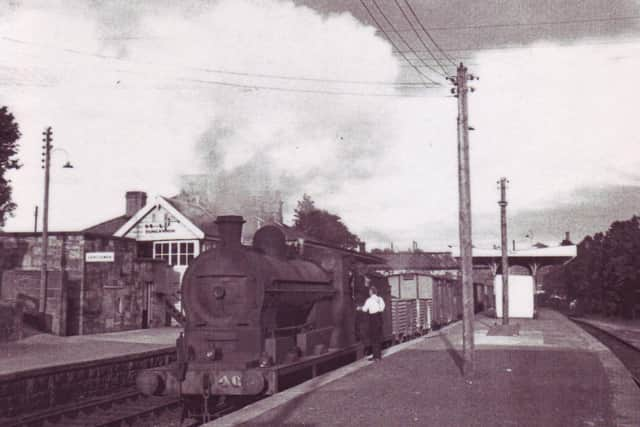
The “Enterprise” service between Belfast and Cork, organised by the Great Northern Railway and the Eire Transport Board was inaugurated during this week in 1950, reported the News Letter.
The newspaper's correspondent commented: “This the longest regular run In the history of railways in Ireland. It will provide connections for Ulster travellers with the Eire trans-Atlantic shipping and air lines.”
The trains were to run non-stop from Belfast to Dublin, where a stop about 45 minutes was made for Customs examination. Another short halt was made at Limerick Junction, where bus connection was provided for passengers to Shannon Airport.
At Cork, connections could be made to “Queenstown” (Cobh) by passengers embarking in trans-Atlantic liners.
Mr G B Howden, the general manager of the Great Northern Company and of the Eire Transport Board, told reporters on the train that, although the new service would be in greater demand during the summer months, the companies were “very gratified” with the initial support that it had received.
The correspondent who travelled noted: “About a dozen people travelled to Cork on the first trip. The service has been introduced purposely at that time so that they could have an opportunity for studying difficulties that might arise.”
SIX HOURS AND 40 MINUTES
The first Belfast to Cork train left Belfast on the morning of Monday, October 2, 1950, at 10.30am, arriving in Cork at 5.10pm.
Before its departure, the Belfast stationmaster, Mr R A Nelis, handed to Guard Samuel Mitchell a letter of greeting to the Cork stationmaster, Mr D J Kelly, in which he expressed the good wishes of the GNR in Belfast. Among those present at the departure were Sir George Clark, deputy chairman of the GNR.
A corresponding train which left Cork at 1-15pm carried similar greeting from Cork to Belfast.
The correspondent wrote: “Considerable interest was aroused South of the Border by the advent the train, and, at several points along the route, crowds turned out to watch it pass.
“At Inchicore locomotive works hundreds workmen lined the railway for about mile, cheering and waving a greeting. At Cork, too, large crowds awaited its arrival.”
Several GNR. officials, including Mr Howden, Mr H S Knott, traffic manager, Mr C Johnston, hotels and catering manager, and Mr A M Beaton, publicity superintendent, travelled on the train.
At Dublin they were joined by Eire Board officials, including Mr P J Floyd and Mr J T O’Farrell, directors.
CHANGES IN EIRE
The News Letter's correspondent wrote: “During the journey Mr Howden outlined to me changes in the running railways in Eire which in time will bring about a complete transformation of the existing system.
“The future policy of the Eire Board will be to provide shorter trains and more of them. Beginning next spring. It is intended gradually to replace steam locomotives on passenger services with diesel-electric locomotives and diesel rail cars.
“The Eire Board thus will be following the example of the GNR, who have been running a regular diesel car service between Belfast and Dublin since June and, about two weeks ago, introduced diesel cars on the Belfast-Derry route.
“Delivery of six diesel-electric locomotives, at a cost of £80,000 each, is expected by the board next spring, and of 20 diesel rail cars, costing £l8,000 each, in June.
“These will be used for main-line passenger traffic, and the change-over is to be extended to branch lines.
“Four diesel rail cars of a smaller type are already on order for the West Clare narrow gauge railway.
“It is probable, also, that all passenger services will eventually be operated by diesel locomotion, and that steam locomotion will be used only for goods traffic.”
A COMPARISON
Comparing the two systems of locomotion, Mr Howden said that whereas the coat of fuel for a steam locomotive was 3s per mile, diesel locomotive cost only 11½d per mile. On the other hand, the initial cost of diesel locomotives was five times great, and their average life about 20 years - “was much shorter”.