
The capture and death of notorious highwayman Dick Turpin (1739)

The capture of Dick Turpin, Britain’s most notorious highwayman was reported in depth in the News Letter during the months of March and April 1739.
In the News Letter edition from March 9, 1739, the paper published a letter from York, dated February 24 of that year, it related: “You have heard that a man has been committed to our castle for horsestealing, who, by means of a letter written by a prisoner here, which fell into honest hands, is supposed to be the notorious robber Turpin. And accordingly a person is coming down from London, in order to make a proper discovery whether it was he or not, it is this day verily believed that it is him; he has been examined this morning before two or three more justices, and confronted by his countrymen, who, they say, knows him very well, and affirms that he is Turpin; and he has been seen by abundance of gentlemen, as well as by many of the inferior sort, this afternoon, and several persons present at his examination, who are all of the opinion that he is the man.”
On March 13,1739, the News Letter reported how Turpin had “lurked” in the neighbourhood of Beverly in Yorkshire where he passed as John Palmer, a farmer's son from Spalding, Lincolnshire.
Turpin had been committed to the House of Correction at Beverly for robbing hen roosts and stealing poultry.
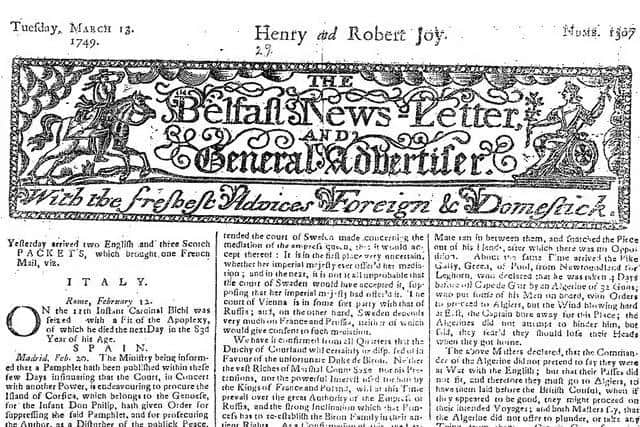

The magistrate handling the case sent to Spalding to seek corroboration of the Turpin tale but on finding none had charged the highwayman with stealing a horse and transferred him to a cell in the more secure York Castle.
During his detention Turpin had signed a letter to “one in Essex who married his sister”. The letter never reached its destination but by a remarkable turn of events Turpin's signature was recognised land his fate sealed.
The News Letter commented: “We, cannot help observing upon this occasion that each of the magistrates before mentioned have acted with great prudence and deserve the thanks of their country for bringing so notorious and dangerous a rogue to his due punishment.”
Turpin's trial at York was carried in the News Letter dated March 23,1739.
The News Letter reported the event in the following way: “Yesterday John Palmer, alias Richard Turpin was tried here, and convicted upon two separate indictments for horse stealing. The evidence was clear and full and the prisoner had nothing to say in his defence. He was proved by two witnesses – one from Essex – to be the notorious Richard Turpin (one of whom was Smith who taught him to write) and he himself owned his name to be, but said he was not the Richard Turpin he was taken for but another person of the same name.
“He said he had been a butcher in Lincolnshire and failing there returned to this county and took upon himself the name of Palmer, he did not apprehend any danger from the first accusation of shooting a farmer's cock and, therefore, tamely submitted to the constable’s authority; and after was charged with horse stealing but did not attempt to escape lest, if he did not succeed, an inquiry might be made after him and discovery made who he was.
“His necessity in gaol forced him to write a letter which he signed and which pulled off the mask and discovered him. Since he was suspected to be Turpin, the whole county have flocked here to see him and have been very liberal to him, insomuch that he has had wine constantly before him till his trial and it is said his gaoler made £100 by selling liquors to him and his visitors. Tho the fellow has made a great noise in the world, hell now die like a dog. A vast number of wagers have been lost on his account.”
A month later, on April 24, the News Letter included a report of Turpin’s execution at the York Tyburn, which was better known as Knavesmire in York, his execution place is often given just as the Tyburn which can of course be confused the other Tyburn in London, Middlesex.
It said that the notorious highwayman “behaved with the greatest assurance and boldness to the
very last”.
The News Letter said: “It was very remarkable that as he mounted the ladder his right leg trembled on which he stamped down on it with an air of boldness and, with undaunted courage, looked around him then speaking a few words to the Topsman, he threw himself off the ladder and expired in about five minutes.”
An epigram published with the execution report indicated the antagonism between the citizens of the North of England and those in the South.
It read:
Full oft the South has sneered at our Northern clime,
And horse stealing has been called a county crime.
But now no longer we will hear such jokes,
This rogue is theirs and we the honest folks.
Of knaves and fools we won't say we have neither,
But knave and fool are seldom found together.
Our purer Northern airs too sharp by half,
A Yorkshire Tike has bit the Essex calf.
This dull bred rogue has found it to his cost,
A fish out of elements is lost.
It was signed by a “gentleman from York”.
The day after his execution Turpin's body was buried in the graveyard of St George's Church, Fishergate, opposite what is now the Roman Catholic St George’s Church. On the Tuesday following the burial, the corpse was reportedly stolen by body-snatchers before being recovered, although some doubt persists as to the grave’s authenticity.