
The interesting life and time times of trade unionist Alexander Bowman

Former Mourne Observer editor Terence Bowman is the great grandson of pioneering Belfast trade unionist Alexander Bowman, who in 1885 made history by becoming the first working-class Irishman to seek a seat at Westminster.
To mark the approaching centenary of his death, Terence has compiled two ‘Retro’ features, the first of which, appearing today, traces Alexander’s roots to the townland of Derry in the heart of rural Co Down.
Despite my best efforts over several decades as a journalist and writer, Alexander Bowman remains a largely unsung hero of early labour politics and the trade union movement in late Victorian Belfast.
Just listing his other accomplishments – founding secretary of the Belfast Trades Council (1881); secretary of the Irish Protestant Home Rule Association (1887); one of the first Labour councillors elected to Belfast Corporation (1897); president of the Irish TUC at Sligo (1901), and, for the following 20 years, superintendent of the Falls Road Baths – should justify a Blue Plaque in his honour.
I will mark the centenary of his death, aged 70, on 3 November 1924, by detailing Alexander’s career in a second Retro feature.
Today, however, I will turn my attention to the place of his birth – Derry townland outside Dromara – and the difficult circumstances surrounding his childhood years which helped to forge the ‘People’s Champion’ of later life (that being the title of my Alexander Bowman biography, published by the Ulster Historical Foundation in 1997).
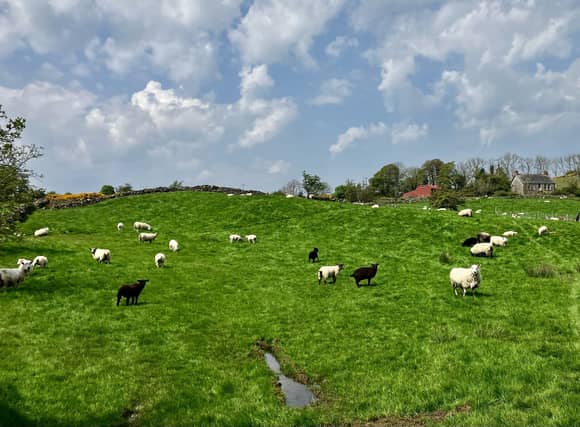
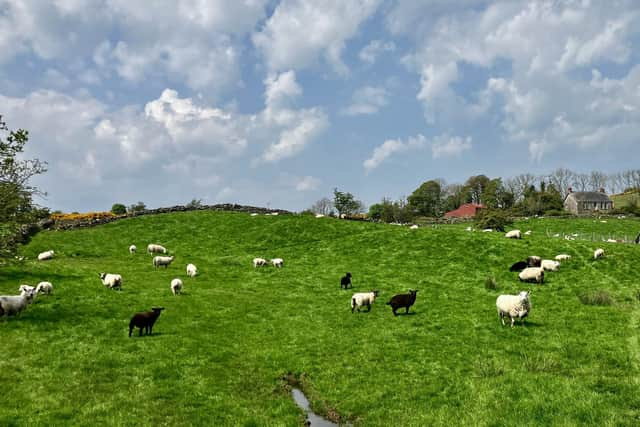
Despite visiting Dromara many times during my career at the Mourne Observer, I was well into my 30s before I discovered that my paternal roots lay in Derry. With easier access these days to contemporary documents and maps, I can pinpoint with certainty the spot in a picture-postcard field where my ancestor was born on 16 March 1854.
But, laying my cards on the table at the outset, Alexander’s surname wasn’t really Bowman and Alexander wasn’t the name recorded when he was baptised!
Derry comprises just under a square mile of often scenic but otherwise unremarkable countryside, straddling both sides of the main Ballynahinch Road outside Dromara. No signs herald its position as the county’s 311th largest townland (out of 1,285), so it’s a blink-and-you’ll-miss-it experience for most passers-by.
Turn the clock back to the mid-19th century, when rural Down was feeling the impact of the Irish Famine and a picture of often severe deprivation emerges.
Most families, with fathers and sons described as ‘farm workers’ or ‘farm labourers’, relied on the flax industry for their rent money.
Many clearly struggled, with wives and daughters often helping in the fields or at home.
According to the 1841 Census of Ireland, Derry’s 631 acres comprised 77 dwellings occupied by no fewer than 383 men, women and children.
A decade later the population had fallen to 319 and the inhabited properties to 68.
While the blood of many ancestors courses through my veins, it was at Derry that my Bowman surname and identity emerged. It’s a far from straightforward story, in essence involving four families, the Rogers, the McKeowns, the Swindles and, of course, the Bowmans, all residing in adjoining Derry holdings.
Back in the mid-1990s, when I began investigating Alexander’s early life, I was shocked to discover his father was identified on his 1880 marriage certificate as William McKeown.
Crucially, the officiating minister at Belfast’s Argyle Place Presbyterian Church added these lines:
“His mother was married first to a man called Bowman to whom she had a number of children. After his death she married McKeown to whom she had Alexander and some other children. He also died when his children were very young.
“These children began to be called Bowman, without any wish on the part of their mother that it should be so. Soon their own name was lost and remains lost.”
Alexander’s mother, born Eliza Rogers, had a son and two daughters by first husband John Bowman, with Derry identified as their home in birth records.
They had married at Loughaghery Presbyterian Church near Annahilt in 1844.
In November 1853, some two years after John’s death, Eliza married neighbouring farm worker William McKeown, who by then was growing flax on land previously rented by the Bowmans.
It was a mixed marriage, the McKeowns being Catholic.
The wedding at St Michael’s Church, Finnis, was followed by a civil ceremony in Lisburn.
Alexander was born the following year and given the baptismal name of Patrick, after his paternal grandfather.
However, there is no evidence this was ever used, even in childhood, or that he actually knew about it.
Whatever the case, by the time he was 10 and the family had moved to Belfast (following the death of William McKeown), Patrick McKeown had become Alexander Bowman.
I referred earlier to the Swindles of Derry – they too moved to Belfast in the 1860s, becoming Eliza and her family’s next-door neighbours at Tennent Street.
In 1872 daughter Mary married Alexander’s half-brother William (a ‘true’ Bowman from Eliza’s first marriage).
Alexander and his family very likely travelled light, transporting only basic possessions the 20 miles to Belfast.
But aged 10 Alexander was already wise beyond his years.
He carried in his head many tales of 1798 – no surprise, with much local involvement in the Rebellion and the Battle of Ballynahinch taking place just five miles from the townland that would become his childhood home.
Unsurprisingly, Alexander, with his ‘mixed’ background, had no time as an adult for political or religious intolerance.
This proud son of Derry, Dromara, would become a champion of the people wherever he lived and worked.
More about that in the second Retro feature in a fortnight’s time!