
The News Letter, Belfast and the 1906 San Francisco earthquake

The 1906 San Francisco earthquake struck the coast of Northern California at 5.12am Pacific Standard Time on Wednesday, April 18, 1906, some 120 years ago this week.
With an estimated moment magnitude of 7.9 and a maximum Mercalli intensity of XI (Extreme), it created high-intensity shaking from Eureka on the North Coast to the Salinas Valley, an agricultural region to the south of the San Francisco Bay Area.
Between 227,000 and 300,000 people were left homeless out of a population of about 410,000; half of those who evacuated fled across the bay to Oakland and Berkeley. Newspapers described Golden Gate Park, the Presidio, the Panhandle and the beaches between Ingleside and North Beach as covered with makeshift tents. More than two years later, many of these refugee camps were still in operation.
On Thursday, April 19, 1906 the News Letter devoted editorial space to the breaking news of the earthquake.
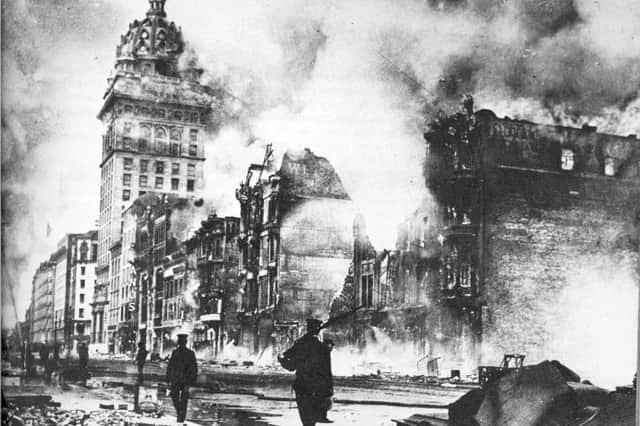

“Following the devastation wrought by the eruption of Mount Vesuvius comes the news of a most destructive earthquake at San Francisco. If the reports are accurate, a large part of the city bas been wrecked,” remarked the News Letter.
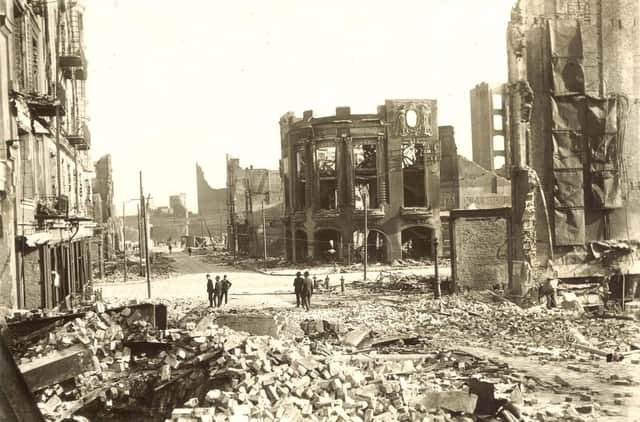
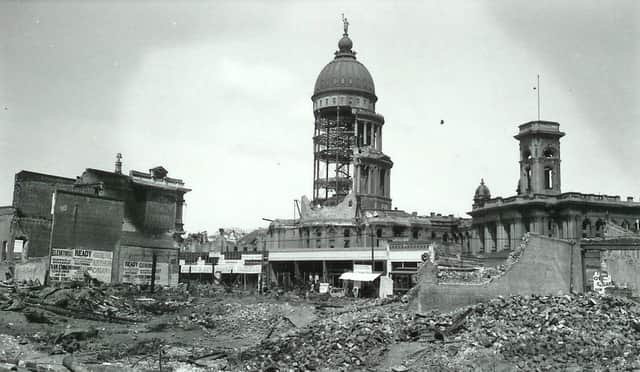
“The City Hall, which cost almost a million and a half sterling, and other public buildings are in ruins. The newspaper offices have been destroyed, and the city is at present in darkness and without telegraphic communication.
“The loss of life is said to exceed two thousand , while the damage is estimated at eight millions sterling. These are rough estimates, however, and we must wait for more precise information before we can know the full extent of the disaster.”
The News Letter added: “To add to the terrible situation created by the earthquake, fire broke out, and, as the water mains were burst, there was no water supply to extinguish. it. Buildings were blown up, in the hope of saving from the flames so much of the city as the earthquake has left standing.
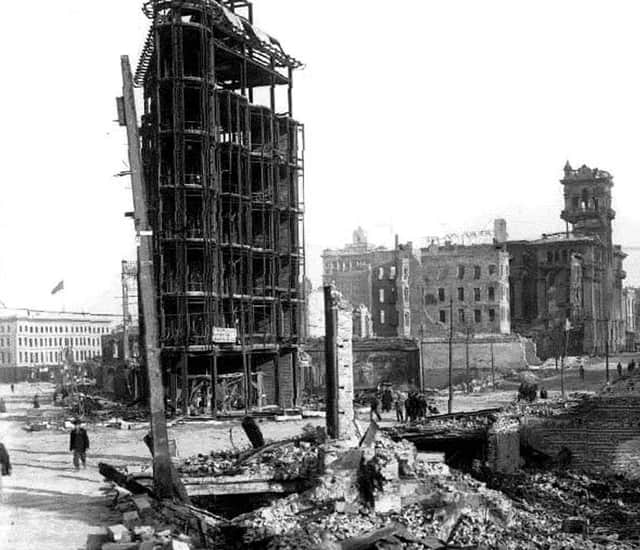
“The telegrams are coming chiefly from Kansas City and Sacramento. Some damage of the latter tow is also reported. The earthquake, though the worst in the history of the United States, is less disastrous than those which occurred in St Pierre and Martinique in 1902, which was a year of earthquakes, or those in Japan between 1885 and 1892.”
The News Letter's editorial concluded: “Throughout the world, but especially in the British Empire, sincere sympathy will be felt with the sufferers and with the people of the United States in the partial loss of one of their chief cities.”
SHOCKS RECORDED AT EDINBURGH
The seismograph at the Royal Observatory, Blackford Hall, Edinburgh, had produced “a splendid record” of the San Francisco earthquakes, reported the News Letter on Friday, April 20.
The roll showed that it had commenced at 1.22pm British Time “with very short preliminary tremors”, and that at 149pm the waves “began to increase in amplitude to a maximum at 1.53pm, gradually decreasing, till at 4.45pm the last faint traces were lost”.
The News Letter noted: “The earthquake began in San Francisco at 5.13am, and as the difference in time between there and Greenwich is 8 hours 8 minutes, it will be seen that the Edinburgh record begins almost precisely at the same moment, which in Belfast time was 12.58pm.
FELT IN ISLE OF WIGHT
The earthquake was also felt in the Isle of Wight. Professor John Milne, “the famous seismologist”, who maintained the seismological observation station at Newport, Isle of Wight, telegraphed on the night of the 18th: “Large, world-shaking earthquake recorded here 1.30pm today, English time. The last great San Francisco earthquake occurred 11th October, 1868, after which patent earthquake-proof houses were constructed, of which the Palace Hotel is San Francisco's most notable example. Fore and aft steel ties were run through the building to strengthen it. The causes are the sudden acceleration of great seismical activities always in operation in certain ports of the earth's crust. In 1899 these activities were pronounced off the Alaskan coast. Since then they gradually have become less frequent. Probably there is no connection with Vesuvius eruption, except that both are due to similar natural agencies. I cannot report further until I develop my photographic films tomorrow.”
Professor Milne, who after developing his seismo-photographic records of the earthquake, said the disturbance was caused by the production of, a large fault created by yielding rocky strata whilst undergoing a process of upheaval. Professor Milne predicted that there would be local shocks later on, “but probably much less severe”.