
Weather stories have always been popular (1738)

The weather forecasts which have become a familiar feature in modern newspapers are a relatively recent development.
Interest in climatic conditions was, nevertheless, a feature in the 18th century News Letters due to an extent to the paper’s role in providing commercial information and the hazards of travel at a time when communications were comparatively primitive.
The paper’s columns frequently report storm damage with ships being sunk and cargoes lost.
But a most remarkable weather report is found in the edition of March 2, 1738 when in Galway there happened the “greatest shower of hail” accompanied by the “greatest clap of thunder” that had been known there in the memory of man.

The News Letter correspondent said it “broke through the warden’s house and library into the church, it being the house of Divine service, struck a sergeant and three soldiers in church to the ground, demolished the Corporation seat or pew into small atoms, struck off the upper part of the church and Crown post, and cracked the rest of the steeple, melted part of the bell, blew off some part of the lead, but the ring of the bells received no damage”.
A month earlier on February 16, the News Letter had reported that 1,300 bodies had been found at Havre de Grace – “victims of the storms at sea”. A cargo valued at £2,000 - substantial in those days – had been lost on the Severn.
But the weather wasn't the only problem with which sailors, their passengers and cargoes had to contend with. Privateers and mutinous crews made travel by sea a hazardous business.
The dangers were graphically illustrated by a report from New England on January 9, 1738 which recounted an incident when “the crew mutinied, killed the captain and several passengers and threw the cabin boy overboard” but one of the crew informed of his comrades when they landed at Newport. They were arrested and jailed for their rebelliousness.
Another New England report in the same edition covered an attempt by Spanish pirates to seize a sloop from Boston in the Bay of Honduras. The pirates were repelled with a number of casualties.
News Letter reports indicate the extent of the rivalry between Britain and Spain for territorial advantage in the Americas.
But life at sea in general was both risky and harsh with discipline on vessels often being cruelly enforced.
In the January 9, 1738 edition the News Letter covered a hanging at Newgate of a sailor, James Buchanan, who murdered an officer in a bout of anger. Buchanan’s shipmates tried to rescue him from the gallows but the officers foiled their efforts. They could not, however, stop the sailors carrying off Buchanan’s lifeless body “with loud acclamations of joy”.
By way of explanation, the News Letter said: “The untimely fate of this unhappy man may serve as a caution to mankind not to let their passions gain the ascendancy of their reason, for at such times they are properly subjected to the state of madness.”
The News Letter described Buchanan as an “honest, industrious man, a valuable sailor and not subject to any vice, pretty rare among seafaring persons”.
But his temper had created problems for him. The News Letter left the reader to assume that Buchanan murdered the Mate Michael Smith because of the latter’s cruelty.
The correspondent said the incident “may also stand as a momento to the Petit-Officers on shipboard or elsewhere to be wary of the exercise of the power given to them, and always to remember that the people they command are men and that they themselves are no more, that by carrying too strict a hand they become odious and thereby lose the most valuable gem belonging to power, that of acquiring the love and esteem of all around them and becoming the delight of mankind”.
Conditions ashore often weren’t much better. The News Letter reported that “a madwoman in the French hospital broke her handfetters and bit the wrist of one of the servants in such a manner that he died two days after raving mad”.
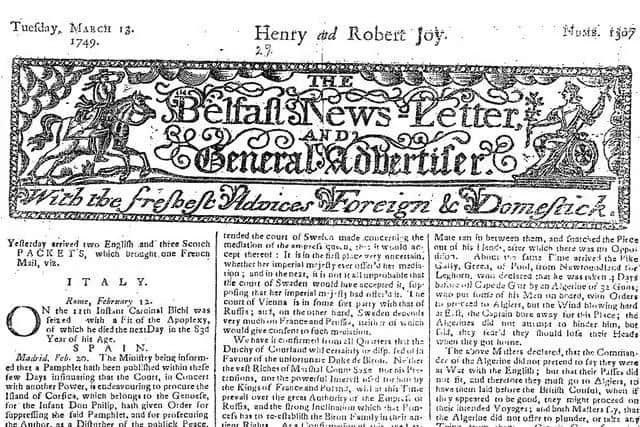
A message from the News Letter’s publisher Francis Joy on the front page just below the title on February 16, 1738, demonstrated the newspaper’s growing commercial success and marked an important development in the then fledgling enterprise.
Joy informed readers that he had “thought proper to print it on a larger character and to furnish for the future one whole sheet for the greater convenience of advertisements and satisfaction of his subscribers (to whom he acknowledges the biggest obligations) and will be continued as this day delivered at the usual time”.
The extra page certainly seemed to generate additional business. Advertising, according to a notice in the March 23 edition was charged at the rate of 2 shillings for the first insertion, of “moderate size” with no limitation mentioned on content, and 6d for repeat bookings – a significant charge in those days.
But Joy in another notice made it clear that news took priority.
He wrote: “Tis hoped that my good customers will not take it amiss that their advertisements were not inserted now nor formerly as there has been so much news and the Lords protest, but they shall be continued as opportunity offers, there being a whole large sheet furnished for that purpose.”
Wedding and death notices, an important service in today's provincial newspapers, had begun to appear a short time after the paper’s launch in September 1737. In February 1738 the marriage was announced of John Bateson near “Moyra in the County of Down” to Miss Cappage, a beautiful lady of fine accomplishments and “a large fortune”.