
Ulster’s rich tapestry of cultural diversity largely has its origins in the early 17th-century Plantation of Ulster with its influx of mainly Protestant English and Scottish settlers, even if some were only nominal Protestants.
Thus, the Plantation has proved to be one of the most politically significant mass migrations to have taken place in western Europe since medieval times.

James I (of England) and VI (of Scots) took a very close interest in the Plantation. This is evidenced by the great many commissions and surveys which were established prior to the establishment of the plantation and subsequently to monitor its progress.
He was also immensely pleased with the Plantation project which he regarded as one of his policy ‘masterpieces’.
In 1612 James told Sir Arthur Chichester, his Lord Deputy in Ireland between 1605 and 1615, that he esteemed ‘the settling of religion, the introduction [of] civility, order and government amongst a barbarous and unsubdued people to be acts of piety and glory, and worthy always of a Christian prince to endeavour’.
In 1603, even with end of the Nine Years’ War and the subjugation of Ulster, the last bastion of Gaelic power, Ireland remained a strategic problem, a point which had been dramatically underscored by the arrival of a Spanish army at Kinsale in 1601.
As the Venetian ambassador to London shrewdly observed, ‘Ireland is such that it would be better for the King if it did not exist and the sea alone rolled there’.
James’s advisors contended that if Ulster was planted ‘with good English and Scottish corn’ (or ‘colonies of civil people of England and Scotland’) the country would ‘ever after be happily settled’. It seemed a most attractive solution to an otherwise intractable problem.
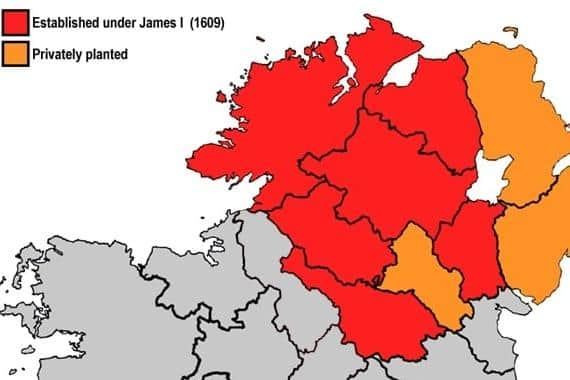
There were two plantations of Ulster: an unofficial, and almost exclusively Scots, plantation in counties Antrim and Down (and, to some extent, Monaghan) and an official plantation in the remaining six Ulster counties. Hugh Montgomery, laird of Braidstane in Ayrshire, and James Hamilton, an adventurer and a don at Trinity College, Dublin, spearheaded the unofficial plantation in north Down and the Ards peninsula.
The official plantation in counties Armagh, Cavan, Coleraine, Donegal, Fermanagh and Tyrone was facilitated by the so-called ‘Flight of the Earls’. The departure of Hugh O’Neill and Hugh O’Donnell, the Earls of Tyrone and Tyrconnell respectively, and some 90 of their followers, who sailed from Lough Swilly for the Continent on September 3 or 4 1607, created a power vacuum and allowed the Crown to charge the Earls with high treason in their absence and to declare their lands forfeit.
As early as September 17 1607 Chichester submitted to the English Privy Council proposals for the disposal of the fugitives’ lands. In March 1608 Chichester prepared ‘notes of remembrance’, which he further revised in October 1608, for a plantation in Ulster. In July 1608 a commission was established to survey the six Ulster counties which were to constitute the official plantation. In January 1609 a detailed plan for a plantation of the six Ulster counties, including the conditions to be observed by the planters, was completed.
The Scottish settlers came from Lanarkshire, Ayrshire, the Borders and the Lothians. King James thought that his fellow countrymen would be excellent material for the plantation because they ‘are a middle temper, between the English tender breeding and the Irish rude breeding and are a great deal more likely to adventure to plant Ulster than the English’.
However, because Scotland was incredibly poor compared to England and could not provide all the craftsmen, masons, carpenters and blacksmiths necessary to build new towns, new villages and fortifications, the Scottish settlers would need to be supplemented with English settlers. These came largely from Lancashire, Cheshire, East Anglia and Devon.
By January 1610 the English Privy Council succeeded in ‘persuading’ the immensely wealthy City of London to assume responsibility for the plantation of the city of Derry, the county of Coleraine and the barony of Loughsholin in Tyrone. This territory was subsequently renamed Co Londonderry.
Land was divided into ‘proportions’ of 2,000, 1,500, and 1,000 acres, with three categories of grantee. English and Scottish chief planters (undertakers) had the heaviest responsibilities as regards fortification and settlement.
Those who were granted 1,000 acres was required to build a walled enclosure called a ‘bawn’. Those who received 1,500 acres were required to build a stone house within the bawn, and those with 2,000 acres a castle. The bawn was intended to offer protection to the undertaker, his tenants and their animals in event of attack by the native Irish. Undertakers were to ensure that the homes of their British tenants were built close to the bawn.
Civil and military servants of the crown in Ireland (servitors) were allowed to have Irish tenants, but could have lower rents if they settled the required number of 24 adult English and Lowland Scots per 1,000 acres. Successful applicants for grants came from lists drawn up in London and Edinburgh. Local recipients (‘deserving Irish’) were to pay higher rents and to abandon Gaelic methods of tillage, harvesting, and threshing.
Twenty-eight baronies or ‘precincts’ were established, eight for English undertakers, eight for Scottish ones, and 12 for servitors and ‘deserving Irish’ jointly. Land was also set aside for the financial support of the Church of Ireland, Trinity College, Dublin, and the ‘Royal’ schools.
The English response to the challenge of the Plantation fell significantly short of government expectation. The Rev Andrew Stewart, the minister of Donaghadee from 1645 to 1671, observed that the English would not migrate ‘except to good land, such as they had known at home, or to good cities where they might trade, both of which in those days were scarce enough here’.
However, the Scots readily took up the slack and spilled over into areas designated for English settlement. Thus, Scots influence in the Plantation was much greater than intended.
Three factors account for the strongly Scottish character of the Plantation. First, the fact that Ulster is separated from Scotland by the narrow North Channel, which is at one point only 13 miles wide, meant that the Scots could easily transport men and livestock to Ulster. Geographical proximity also meant that the plantation could be constantly reinforced with new Scottish settlers.
Secondly, as James fully appreciated, impoverished but adventurous Scots could not resist the prospect of good land on agreeable terms.
Thirdly, the Scots came from a more primitive society than the English and could more readily adapt to conditions not radically different from those with which they were familiar in Scotland.
In modern Ulster the Scots presence is most strongly evident in Co Antrim, north Down, the Ards peninsula and fishing villages of the Kingdom of Mourne, parts of counties Londonderry and Tyrone and east Donegal. A strong Presbyterian tradition, Ulster-Scots speech and the presence of Scottish surnames are reliable indicators of areas of Scots settlement.
What of the native Irish? Contrary to popular perception, in The Catholics of Ulster (2001), Marianne Elliott has observed: ‘The ‘churls’ [the under-tenants who actually worked the land] may well have fared a good deal better under the new dispensation than under the Gaelic land system. But the elite did not and it is their voice we hear.’
By 1633 it has been estimated that there were between 40,000 and 50,000 British settlers in Ulster, of whom 13,000 were adult males capable of bearing arms. By then settlers were arriving on their own initiative, rather than being brought over from the undertaker’s home region.
The Ulster Plantation was also contemporaneous with the Plantation of Virginia, the Jamestown settlement being established in 1607. Hence Chichester’s celebrated promotional spiel: ‘I had rather labour with my hands in the plantation of Ulster than dance in that of Virginia’.
The Ulster Plantation proved to be the most significant and successful plantation in Irish history. Philip Robinson in his book ‘The Plantation of Ulster: British Settlement in an Irish Landscape’ (1984) has succinctly described its wide-ranging impact: ‘The Plantation brought innovation: a radical transformation of the lowland landscape had begun, even if influenced by pre-plantation precedent. Spread of a market-based rural economy resulted in a quite spectacular growth in urbanisation. Permanent dwellings of a more sophisticated construction became commonplace, and around the towns new field patterns emerged. The spread of hedged enclosure heralded innovations in agricultural methods, tools, livestock and systems of land tenure. In less tangible form, the settlers also brought with them a new language, new surnames, new religion and, of course, a change in politico-historical allegiance’.