
Ex-pastor ‘was trying to spread Gospel’ at hospital
A retired Baptist pastor has gone on trial accused of conducting an illegal protest inside the limits of a “safe access zone”.
It is the prosecution case that Clive Johnston either intended to influence, or was reckless as to whether any “protected person” attending the Causeway Hospital abortion services, would be influenced.
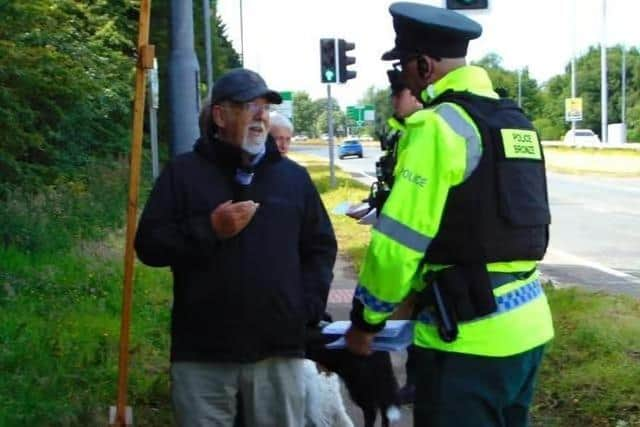

The 77-year-old maintained however, that although he had objections to the laws which extended abortion services to NI, he was not protesting outside the hospital on July 7 last year but rather giving a sermon and spreading the Gospel.
He told Coleraine Magistrates’ Court if it has come to a stage where spreading the “light of Jesus” is not allowed and is now illegal, “then in our country we have come to a very sad position”.
Mr Johnston, from the Melmount Road in Sion Mills and who is a former president of the Association of Baptist Churches in Ireland, faces two offences under the Abortion Services (Safe Access Zones) Act (Northern Ireland) 2003.
He is accused of doing an act in a safe access zone at the Causeway Hospital in Coleraine, “namely conducted a protest with the intent of, or being reckless as to whether, it had the effect of influencing a protected person whether directly or indirectly, in connection with the protected person attending the premises,” on July 7 last year.
The pensioner is further charged that on the same date he “failed to comply with a direction … to leave a safe access zone”.
Under the act, which received Royal Assent on February 6 2023, anti-abortion protests and other behaviours are prohibited within any safe access zone once it has been established, and this may be enforced by the PSNI.
Prosecuting counsel David McNeill and defence KC John Larkin told District Judge Peter King there was a large amount of agreement as regards what actually happened at the hospital that Sunday afternoon.
The first of two witnesses to be called, Michael Owen, told the court he was driving past the hospital when he saw what he believed to be a protest of around four or five people.
Believing it to be within the safe access zone (SAZ), he contacted police. Although he claimed the group had been carrying large placards, footage from the next witness’ body-worn camera suggested he was incorrect in that recollection.
The 15-minute video, recorded by a PSNI inspector, was played to the court and from the footage, it is possible to see Mr Johnston and around 10 other people, standing on the footpath outside the hospital.
As the senior officer approaches, the defendant can be seen holding a microphone as he recites the words of Bible passage John 3.16 and he waits until the retired pastor pauses before he speaks to him.
During the exchange, the inspector can be heard reading the exact wording of the legislation and the ruling of the Supreme Court as he tells the defendant and those gathered that “you are clearly within 100 metres of the entrance so you are in the safe access zone”.
“We are giving the word of God,” Mr Johnston tells the senior officer, “I want the government to know that there is a higher law.”
The pensioner is shown a map, illustrating the area of the SAZ and while the others all move away after the inspector warns failure to do so could result in prosecution, Mr Johnston remains where he is.
After being given a formal warning to leave, the inspector takes Mr Johnston’s details and after he is told if he doesn’t leave police can take appropriate action to remove him, the retired pastor picks up his large cross and walks away.
Under cross-examination from Mr Larkin, it emerged that the defendant and the officer had exchanged emails about what was going to happen on July 7.
The court heard that after the police received an email about an intended “gospel outreach event,” the inspector contacted Mr Johnston to warn him that any such action could be deemed an offence.
At the end of the prosecution case, the senior barrister lodged a “direction application,” arguing that his client should be acquitted as “there is a fundamental gap in the evidence” whether anyone was actually influenced by his actions.
Mr McNeill submitted however, that in order to prove guilt, it was not an element of the offence to prove that someone had actually been influenced but rather that a person’s actions could influence a protected person.
After Judge King refused the defence application, Mr Johnston was called to the witness box.
Mr Larkin asked how he came to be outside the hospital that day, and the defendant told him that as a “Bible-believing Christian, I believe in the sanctity of life and it is certainly evident that I am pro-life”.
He told the court that having been involved in protests before his retirement, “I would say that I had, without sounding too super-spiritual, a refreshed call from God to move away from protest”.
Having started a group called Run to the Cross in light of the change in the law, there was a decision to conduct religious services “outside places where abortions were performed”.
He told Mr Larkin there was a deliberate decision to hold a sermon on Sunday because it is a day of worship and also because he had been led to believe “no abortions are performed on the Lord’s day”.
Mr Johnston was adamant there was “absolutely not” anyone carrying placards and if there were, “they would not have been welcome”.
He was also adamant that it was not a protest but rather an effort to spread the gospel and “the riches of Christ”.
During Mr McNeill’s cross-examination, it emerged the retired pastor was wrong in that the hospital provides a ‘seven-day clinic’ and that at the time of the incident, one patient was ”receiving therapeutic after-care”.
The prosecutor suggested to Mr Johnston that by his behaviour, he had “hoped to influence people” but the defendant told him, “my hope is that the gospel of the Lord Jesus influences people, all people, not restrictive”.
While the pensioner conceded he believed the law regarding abortion services is a bad law, he refuted the suggestion that “you intend to break it”.
“I would say test it, not to break it,” Mr Johnston told the court. “I am still at this moment in time, in a state of disbelief that the preaching of God’s word can be construed as an offence … I think what I was doing was a higher calling.”
Having taken the witness through his interaction with the PSNI officer, Mr McNeill put to Mr Johnston that after the officer gave him a clear direction to move along as he was potentially breaking the law, “was it a deliberate decision not to move”.
Although the retired pastor admitted it had been, he told the prosecutor “of course I didn’t realise at that time, that the prosecution would actually summons me,” highlighting that all he was doing was “preaching the gospel”.
Both sides are set to lodge skeleton arguments over the legislation and how the various articles of the European Convention on Human Rights applies.
Those arguments will be heard on March 31.