
IRA man's widow wins 'health and safety' legal battle over his murder
The widow of an IRA man murdered after being branded a British state informer has won High Court permission to challenge a decision not to charge any corporate organisation with health and safety offences.
Mary Braniff was granted leave to seek a judicial review of the Public Prosecution Service’s alleged failure to properly consider potential criminal liability cases against the security forces over the management of state agents.
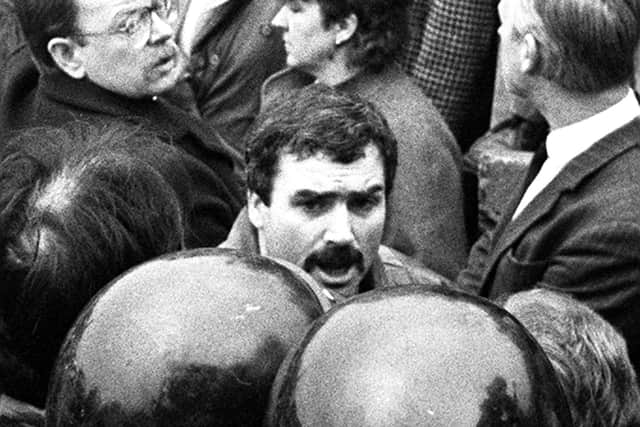

Her husband, 22-year-old Antony Braniff, was shot dead by the Provisionals in September 1981 on suspicion of working for the RUC’s Special Branch.
His killing formed part of the Operation Kenova investigation into the activities of IRA executioner and British Army spy codenamed Stakeknife, widely accepted to have been west Belfast man Freddie Scappaticci.
Scappaticci, who died in March 2023, was linked to more than a dozen murders while a member of the paramilitary organisation’s internal security unit (ISU).
Known as the “nutting squad”, the ISU was set up to interrogate, torture and kill those accused of being security force informers.
Mr Braniff, a father-of-three from the Ardoyne area of the city, was among those murdered by the unit.
According to Operation Kenova’s findings, Stakeknife probably cost more lives than he saved while working as a British spy at the heart of the republican movement.
The investigation team referred files on a number of former IRA members and soldiers to the Public Prosecution Service (PPS) in connection with the murders of Mr Braniff and others.
But in February 2024 the prosecuting authority concluded there was insufficient evidence for a reasonable prospect of securing any convictions.
A month later the PPS also declined a request by Mrs Braniff’s representatives to consider charging any individual or corporate body with health and safety breaches based on the Operation Kenova report.
Her lawyers challenged both decisions, claiming they were irrational and failed to properly consider the offence of misconduct in public office.
Based on newly discovered military records, it was alleged that an intelligence oversight body known as the Tasking and Co-Ordinating Group (TCG) received information that the IRA was holding Mr Braniff in the Divis area of Belfast and had sentenced him to death.
The documents indicated that the TCG, involving elements of the RUC Special Branch, MI5 and the British Army’s Force Research Unit, was told he would be executed that night.
But the response of deploying military and police to the general Divis area did not prevent his murder.
Mrs Braniff’s legal team argued that Operation Kenova files passed to the PPS disclosed evidence of possible health and safety offences, along with a failure to consider other possible forms of corporate liability for misconduct in public office in connection with the RUC, Military Intelligence or Security Services.
Senior judges heard how a decision was taken not to prosecute two specific suspects identified as being potentially involved in Mr Braniff’s killing: a retired British soldier who worked within the Force Research Unit; and an IRA member at that time.
Individual reports on up to seven others murdered by the IRA unit on suspicion of being informers were also introduced in support of the challenge. Counsel for Mrs Braniff claimed they showed the security forces recognised that the activities of agents not just limited to Stakeknife put victims in danger.
Resisting the legal action, the PPS insisted its decision-making process was procedurally fair and involved no public law failures.
Based on the Government’s proposed new Troubles legacy laws, which will involve a Commission investigating conflict-era killings, the benefit of the legal challenge was also challenged.
Lawyers representing the prosecuting authority contended that if the legislation is enacted police would be prohibited from probing any of the cases.
Ruling on the case, Lady Chief Justice Dame Siobhan Keegan said Operation Kenova had exposed “a shocking picture (about) the actions and management of state agents in Northern Ireland including Stakeknife in the context of many murders and other serious crimes”.
She rejected the challenge to the PPS decision not to prosecute either of the identified suspects after finding that its process and assessment of the evidence was reasonable and “entirely lawful”.
However, the court held Mrs Braniff had established an arguable case on the alleged failure to properly consider any prosecution for health and safety breaches.
Citing Home Office guidelines on the management of agents, Dame Siobhan pointed to Operation Kenova’s conclusions that they were not properly applied by the RUC.
“The argument is advanced that given there was a departure from the guidelines and the serious criminality which ensued that some individual or corporate responsibility flows in relation to the handling of the agent codenamed Stakeknife,” the Lady Chief Justice said.
She confirmed: “We grant leave on whether any individual or corporate entity should be prosecuted for health and safety offences which may arise from the management of state agents.”
The case will now proceed to a full hearing sometime later this year.
Welcoming the ruling, Mrs Braniff’s solicitor Kevin Winters said: “It is an important decision for all Kenova-linked cases, and it has possible implications for many other conflict-related sectors.”