
Jeffrey Donaldson showed no emotion as unanimous guilty verdicts were read out
Sir Jeffrey Donaldson stood with his hands joined while the verdicts in one of the highest-profile trials in Northern Ireland's legal history were delivered.
As the foreperson of the jury said "guilty" 18 times, the man who had once been the leader of unionism showed no emotion.
He was similarly undemonstrative when the court was told he would be placed on the sex offenders register or when he was remanded into custody and led from the court.
The heavily fortified stone court building in Newry had provided an imposing backdrop to the trial which had dominated news headlines for weeks.
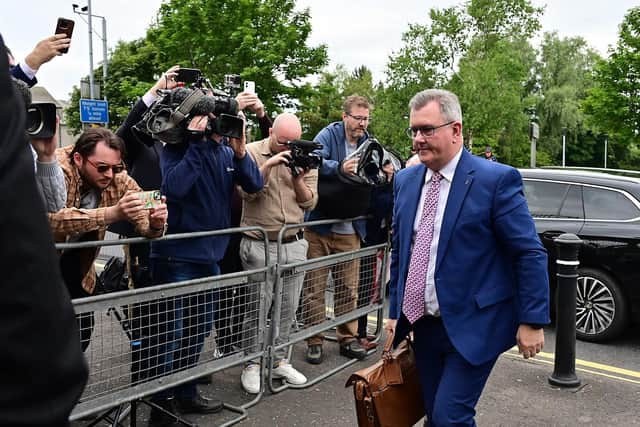
For 20 days Donaldson, once the DUP leader, arrived in a black car after 9am to be met by his solicitor, John McBurney , and walked quickly past the waiting cameras, through the security barrier and on his way towards Courtroom One.
The court complex in the city, built in 1843, has been the location for countless trials but had never witnessed anything on this scale.
Police, anxious to avoid the scenes of chaos which accompanied Donaldson's first court appearance in 2024, erected metal barriers outside the building to contain the media and keep a clear route of entry and exit.
The barriers were removed at the conclusion of court proceedings each day and erected again early the following morning.
Police officers remained on duty outside the court throughout the trial while civilian security staff searched those seeking to enter the building.
Occasionally, curious members of the public would gather on the road outside to get a fleeting glimpse of the former DUP leader before he was driven away each evening.
Media from across the UK, Ireland and beyond came to the building, which occasionally showed its age.
No thought had seemingly been given to the fact that the journalists would require access to plug sockets to report on the trial proceedings and an extension lead was hurriedly sourced.

On more than one occasion journalists were asked to type more quietly within the courtroom.
It had been expected that the process of agreeing a jury would be lengthy, but the five women and seven men were selected and sworn in under an hour on the first morning of proceedings.
Ten journalists crammed into the small wooden press bench in Court One each day while many more watched proceedings remotely downstairs in Court Five, which was transformed into a media overflow room for the duration of the trial.
By the end of the case, court staff were on first name terms with the media.
Donaldson, once known for his presence on the green benches at Westminster, watched proceedings from the small dock at the rear of the wood-panelled courtroom.
Dressed every day in a suit and tie, he entered the courtroom to be frisked before entering the dock where he sat between two custody officers.
Often during the evidence he would take notes.
Occasionally he could be seen shaking his head and often sat impassively with his arms folded.
On more than one occasion he could be seen asking to speak to his solicitor while evidence was being delivered.
He became more animated when he was called to give evidence in his own defence.
Facing the jury in the small witness box, he fought back tears as he was questioned by his own barrister Kieran Vaughan KC and was engaged in tense exchanges with prosecuting barrister Rosemary Walsh KC as he frequently spoke over her when repeating his denials of the claims of abuse against him.
At one point Judge Paul Ramsey reminded him to wait until the question was finished before he answered.
The trial began during a heatwave.
On the first day the judge excused counsel from wearing their traditional wigs.
The stifling heat soon passed but the habit remained and the whole trial passed unusually with judge and barristers bare-headed.
The trial centred around the claims of two women who said they were abused by the ex-MP as children.
The jury often heard graphic details of the allegations.
The trial was the most high profile since the passing in 2023 of new laws at Stormont around sex offences cases.
Following those guidelines, members of the public were barred from the court and white paper covered the glass door to prevent any view of the proceedings from outside.
Complainants A and B both gave evidence to the trial though neither was in the courtroom.
They delivered their testimony and were cross-examined via a video link from another room.
Judge Ramsey kept proceedings moving along at a brisk pace, adjudicating the occasional legal dispute between counsel and ensuring the trial concluded close to within his initial estimate of four weeks.
There was a brief moment of levity when the judge at one point called for evidence to proceed before realising he had forgotten to bring the jury into the courtroom.
Due to the stop-start nature of any criminal trial, barristers and jury can find themselves moving in and out of the courtroom multiple times each day.
At one point, as he briefly left the court, Judge Ramsey compared the process to hydration breaks at the World Cup.
As he delivered his closing remarks before the jury was sent out to consider its verdicts, the judge referred to the media attention which the case had attracted.
He urged the jury to block out the "noise surrounding this case" before it reached a decision.
Judge Ramsey said: "I understand 'trial of the facts' is the most googled term in Northern Ireland last month. I can't think why."
Following 17 days of hearings, the jury was sent out to consider its verdict shortly after lunch on Thursday June 18 .
The judge told jurors to consider each charge separately and to deliver their verdicts based on the evidence.
Some of the waiting media and court staff considered the possibility that the verdicts could come on the same day.
Instead, following three hours of deliberations, the jury was sent home.
Everyone returned on Friday.
Journalists shared bags of sweets as the waiting continued and it eventually became clear that the trial would stretch into a fifth week.
The jury deliberations continued into a third day.
Shortly after lunchtime on Monday the unanimous verdicts were announced.
The judge concluded proceedings by saying: "Take Mr Donaldson down."