
PSNI legally entitled to review into activities of 'Glenanne Gang' High Court judge rules
Police are legally entitled to carry out a major review into the activities of a loyalist terrorist unit behind nearly 130 murders, a High Court judge ruled today.

Mr Justice McLaughlin also held that the PSNI can publish a report on findings reached in the Operation Denton process.
He rejected claims by the families of two men potentially implicated in the Dublin and Monaghan bombings that the Chief Constable has no legal power to establish a non-criminal probe.
“The investigation, prevention and detection of crime are core and essential policing purposes,” the judge said.
“The work described within the terms of reference and commissioned by the Chief Constable falls clearly and obviously within the scope of his powers.”
Proceedings centred on the Operation Denton review into 98 separate terrorist incidents during the mid 1970s.
The attacks - 88 in Northern Ireland and 10 in the Republic of Ireland - involved a total of 127 murders attributed to the so-called Glenanne Gang.
Based in the Mid Ulster area, the terror unit is believed to have comprised UVF paramilitaries along with some corrupt RUC officers and locally-recruited UDR soldiers.
It has been widely blamed for the May 1974 Dublin and Monaghan atrocity when 33 people, including a pregnant woman, were killed and almost 300 others injured in coordinated explosions.
In December last year a summary issued by the Operation Denton review team found evidence of collusion between loyalist terrorists and some police officers and members of the military at the time.
However, no intelligence pointing to any state cooperation in specific UVF attacks was identified.
A challenge to the legal status of Operation Denton was mounted by the family of murdered loyalist William Marchant.
They also disputed the right to publish a final report containing any findings of individual culpability.
Concerns were raised that Marchant could be linked to the Dublin and Monaghan attacks through jigsaw identification.
Widely reported to have been a leading loyalist figure, he was shot dead by the IRA on Belfast’s Shankill Road in April 1987.
A second man granted anonymity also sought to judicially review police chiefs over the Operation Denton process.
Part of the case related to a briefing given to campaign groups and some of those bereaved in the Dublin and Monaghan massacres.
Names of suspected bombers were reportedly disclosed at that meeting in Dublin in October 2025.
The Marchant family’s legal team insist any such disclosures represent a breach of human rights laws.
But the first stage in the challenge related to the legality of the entire police review.
Counsel for the family contending there is no statutory power under the Police (Northern Ireland) Act 2000 to conduct a non-criminal investigation into historic events.
It was further claimed that the PSNI does not have a jurisdictional remit in connection with incidents in the Republic of Ireland.
However, Mr Justice McClaughlin emphatically rejected all grounds of challenge.
Establishing the review was in line with clearly established policing objectives of preventing and detecting crime, he held.
“The manner in which police choose to achieve these objectives in any particular case is for police to decide and for which they have the broadest possible margin of discretion,” the judge said.
“The appalling murders and atrocities which have been accepted within the remit (of the review) were all serious criminal offences.”
Dismissing claims there is no legitimate purpose in investigating a deceased person over the Dublin and Monaghan bombings, he ruled: “Police may legitimately review or investigate the full background and circumstances of the offences in order to determine whether any other perpetrators were involved.”
Multiple other terrorist incidents are under consideration which may ultimately implicate those who are still alive, he stressed.
According to the judge, police also have a right to examine crimes carried out in the Republic as part of the process as it could unearth related offending committed in Northern Ireland.
“Notwithstanding the fact that bombs were planted and exploded in Ireland, offences of conspiracy to murder outside the jurisdiction may still be committed and prosecuted in Northern Ireland,” he said.
“A review which may lead to evidence of such an offence is therefore plainly within the powers of a constable in Northern Ireland.”
Finding that the Chief Constable has the legal power to publish the Operation Denton report, the judge highlighted the need to carry out any potential privacy or defamation checks first.
But he confirmed: “In this case, the publication of the report will clearly further the policing purpose of preventing and detecting crime and also promoting public confidence in policing.”
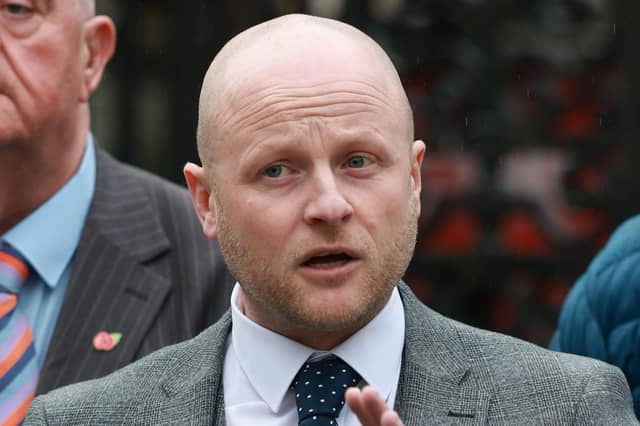
Speaking later on behalf of the Marchant family, loyalist activist Jamie Bryson insisted their case remains focused on what is in the report.
“This preliminary ground of challenge was an overall structural one,” Mr Bryson said.
“The main focus of the Marchant family has always been and remains on the contentious briefing delivered in Dublin and the content of any final report.”