
Sean Brown inquiry: Government delays decision on appealing verdict over public probe into Troubles murder of GAA official


The government has delayed a decision on whether to appeal the Belfast courts over an order to hold an inquiry into a loyalist murder.
The Northern Ireland Office has moved to secure the option of challenging a court ruling that found it was acting unlawfully in failing to order a public inquiry into the 1997 murder of the GAA official Sean Brown.
The demand by a High Court judge, upheld unanimously in the Northern Ireland Appeal Court, has led to fresh fears of an imbalance in how the past is investigated. The courts also ordered a public inquiry into Pat Finucane.
Such probes typically cost tens of millions, making less money available for the hundreds of victims of terror, most of whom were murdered by republicans.
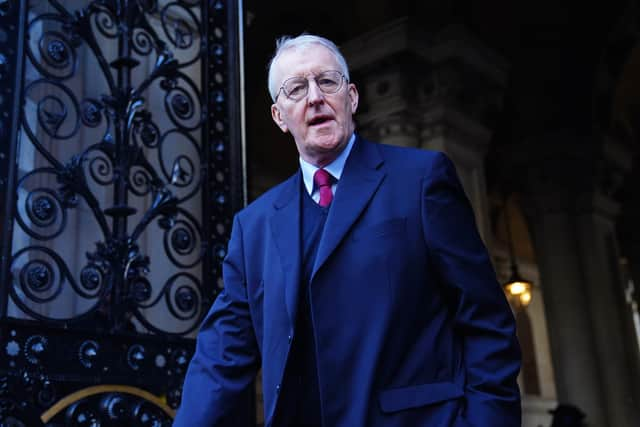
Northern Ireland Secretary Hilary Benn had been so concerned by the original order that he asked the NI appeal to look at it promptly. It did, but over-rode such concerns and upheld the demand.
Mr Benn has sought leave for an appeal over the Sean Brown case.
He has not confirmed he ultimately intends to take the case to the UK Supreme Court, but has applied for “protective leave” to appeal to Britain’s highest court if he believes that course of action to be “necessary”. The deadline for an application is this week.
First Minister Michelle O’Neill has branded the government’s move “cruel and inhumane”.
Mr Benn has also applied to the Court of Appeal in Belfast for further time to consider its judgment in the Brown case.
He has indicated the outcome of that application, and what transpires during any subsequent extension, will determine his decision making in respect of a Supreme Court challenge.
Mr Brown, 61, the chairman of Bellaghy Wolfe Tones GAA club in Co Londonderry, was ambushed, kidnapped and murdered by loyalist paramilitaries as he locked the gates of the club in May 1997. No-one has ever been convicted of his killing.
At the start of April, three judges at the Court of Appeal in Belfast said the government’s failure to order a public inquiry into the murder “cannot stand” and gave Mr Benn four weeks to “reflect upon the judgment”.
Mr Benn has now asked the judges for more time to consider their ruling.
He had brought the case to the Court of Appeal to challenge an earlier ruling by a High Court judge that he must set up a public inquiry into the killing.
The Northern Ireland secretary contends the case involves a key constitutional principle of who should order public inquiries, the government or the judiciary.
Mr Benn argues the GAA official’s murder could instead be dealt with by a new Troubles investigatory body, the Independent Commission for Reconciliation and Information Recovery.
Last year, a coroner halted an inquest into the killing, expressing concern that his ability to examine the case had been “compromised” by the extent of confidential state material being excluded from the proceedings on national security grounds.
Preliminary inquest proceedings had already heard that in excess of 25 people had been linked by intelligence to the murder, including several state agents.
It had also been alleged in court that surveillance of a suspect in the murder was temporarily stopped on the evening of the killing, only to resume again the following morning.