
Alan McQuillan OBE: Tributes to astrophysicist who laid foundation for ‘UK’s FBI’ - National Crime Agency - and could have been PSNI Chief Constable


Tributes have been paid to Alan McQuillan OBE - an astrophysicist who 'accidentally' became a police officer and went on to lay the foundations for ‘the UK’s FBI’ – the National Crime Agency.
Former PSNI Deputy Chief Constable Alan McQuillan OBE passed away peacefully, aged 70, after a four-year battle with prostate cancer, leaving his wife Heather, daughter Jane, and son Andrew.
"Despite graduating as an astrophysicist with no policing career plans, a series of events and his overwhelming care for others took him into policing," Andrew said.
"Alan cared deeply about protecting and helping every community across Northern Ireland, even when this meant personal sacrifices."
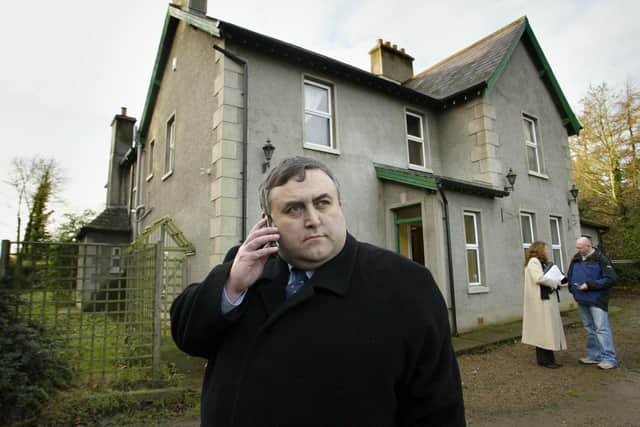
He told the News Letter: "He never meant to join the police but did so to give his friend moral support. He went into the accelerated promotion scheme examinations and - sod's law - he got in and his friend did not."
His new career led to numerous sacrifices, including having his parents’ home with no notice.
"His work in setting up and running the Assets Recovery Agency (ARA) - which evolved into the National Crime Agency (NCA) - hammered major blows to paramilitaries and organised crime across Northern Ireland, the rest of United Kingdom and internationally.
"His actions stopped hundreds of millions of pounds from being used to harm and murder people by criminals and terrorists."
His son added that the ARA was closed down "due to a deal between the Tony Blair administration to pacify republicans".
It was reformed as the Serious Organised Crime Agency - the key change being it was now "without a Northern Ireland focus".
Alan was the SOCA UK Director, based in London, until he retired in 2008.
However his work with ARA and SOCA led to "attempted attacks” on his house and his life by loyalists.
Andrew added: "In his role as a senior police officer, he was unafraid to take hard decisions to achieve peace for everyone, even when the consequence would be as significant as collapsing the government."
He noted that his father authorised the PSNI raid against an IRA spy-ring at Stormont in 2002 – known as 'Stormontgate' - and was the Gold Commander overseeing it on the day.
Roy McComb, an ex-head of PSNI Organised Crime Branch and former deputy director of the NCA, said Alan was an inspirational leader.
"I always found him to be a thoroughly decent and impressive leader," he said. "He carried his rank comfortably, but he was quick to support people that worked for him, very engaging, very plain spoken. There were no airs and graces about him."
"He was also a very gifted thinker."
Roy recalled briefing on a very difficult investigation against loyalists, noting his ability to grasp the detail and impact of a planned operation "was very, very sharp".
"He was a leader who was respected by those who were working underneath him, a man of high intellect, high capability and very high integrity... very much trusted by those he led."
Alan’s greatest achievement, he said, was providing key leadership at the time of very significant policing challenges that coincided with Sinn Fein finally deciding to join the Policing Board. "And he did it in a very calm, measured way."
He was ACC when the PSNI - not the Security Service - still had primary responsibility on national security issues, and at the time of the IRA break-in at Castlereagh police station and Northern Bank Robbery.
He could have been the first Chief Constable appointed to lead the PSNI, Roy said - but the Policing Board had other ideas.
"Alan was the Chief Constable we could have had. But Hugh Orde was always going to be the shoo-in because the Policing Board wanted to bring in an external candidate for the changeover from the RUC to PSNI."
Paying tribute UUP MLA Jon Burrows – a former senior officer in the PSNI – said the news was "very sad". He described Alan as “A towering intellect, a brilliant communicator and a fearless public servant". Northern Editor for RTE news, Vincent Kearney added: ‘Sorry to learn of the death of good friend Alan McQuillan, former PSNI ACC. ‘With a degree in astrophysics he was always very down to earth, great company and sharp as a tack. A critic of the darker side of policing, including recently revealed illegal surveillance of journalists."
Alan’s funeral is at St Columba's Church, Knock Rd, Belfast, on Monday 20 October at 11am.
ALAN MCQUILLAN: A STELLAR CAREER
Born in February 1955 Alan was married with two children - one a lawyer and the other running his own business.
Graduating with a BSC (Hons) in Astrophysics from QUB in 1976, he attained an MBA from Ulster University in 1984.
Joining the RUC in 1976 as the first graduate entrant, the accelerated promotion scheme saw him rise quickly to superintendent in 1990.
Leaving the RUC in 1995, he became ACC in Gwent Constabulary in Wales before returning in 1997 at the same rank. By the early noughties he was operational police commander in Belfast.
He was Acting Deputy Chief Constable in PSNI until 2003 when joined the newly formed Assets Recovery Agency, which he helped establish and develop right across the UK. In 2007 he was appointed as Director to manage its merger with the Serious and Organised Crime Agency for which he became the UK Director based in London, retiring in 2008. SOCA was later superseded by the National Crime Agency.
He worked on a voluntary basis with a number of third sector organisations took consultancy assignments for the EU, the UK Foreign Office and IMF.
Chairman of the Assembly Secretariat Audit and Risk Committee from 2009 to 2011, he went on to be an independent management and security consultant, running a company with his son, Crowded Space Drones which has worked for the MoD, BBC, ITV and Sky, Arsenal and Wimbledon.