
Charity CARE claims it is 'astounding' PSNI raided 27 brothels containing sex trafficking victims without any customers being charged
A public affairs charity claims it is "astounding" that the PSNI raided 27 brothels containing trafficked women but that not one person on the premises was convicted of paying for sex.
The PSNI responded that its works "tirelessly to tackle sexual exploitation, and to identify and safeguard victims" and pointed to four arrests this week.
In 2014 Assembly backed a private members bill from DUP MLA Lord Morrow backed by public affairs charity CARE to make buying sex an offence.
However the charity now claims NI authorities are failing women through a "soft touch" approach to enforcing the law.
It noted that Belfast man Ronnie McCaughey, 70, was recently handed a conditional discharge for several charges of buying sex.
Tim Cairns, CARE’s policy lead on commercial sexual exploitation, said many countries are now adopting "the Nordic model", which aims to tackle 'the demand side' of sex trafficking by targeting men who pay to use trafficked women.
He said: “In 2022, the PSNI raided 27 brothels across NI where women trafficked were being exploited, yet not one person found on the premises during raids was convicted of a crime. This is astounding and by no means a one-off.
"Last summer, six women were identified as having been trafficked to Belfast from Romania for prostitution. Men who exploited these women by paying for sex were not convicted either.”


He is concerned the pattern will be repeated
He noted police arrested four suspected pimps in anti-trafficking raids in Omagh and Ballymena this week but is concerned that their customers will "also evade justice".
"Freedom of information data obtained by CARE shows that men who visit brothels, and aid crime, only received cautions or community resolutions".
"In other countries, purchase of sex convictions are obtained through routine evidence-gathering techniques."
He said convictions in Sweden rose from 10 in its first year to 326 in its eleventh year.
"If the PSNI and DPP are serious about ending exploitation, they must enforce the law," he added.
The PSNI did not challenge his claims.
PSNI RESPONSE
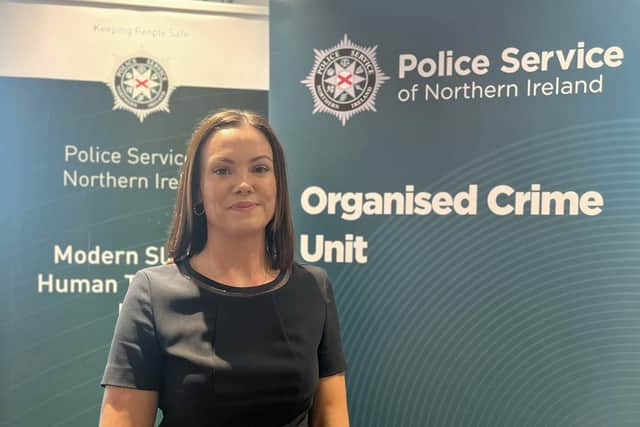
Detective Inspector Rachel Miskelly, responded: “Detectives in our Modern Slavery and Human Trafficking Unit work tirelessly to tackle sexual exploitation, and to identify and safeguard victims.
"Our ongoing commitment has been demonstrated most recently by searches and subsequent arrests in Ballymena and Omagh, as part of an ongoing operation to target human trafficking. Importantly, from this, we have already identified and offered safeguarding to one female victim.
“We will continue to prioritise our resources to safeguard victims, supporting them through stressful and traumatic experiences, which often continue beyond the criminal justice process.
“Our focus is to identify and safeguard victims who have been exploited, and to identify and gather evidence against members of organised crime groups who make their money from exploiting vulnerable individuals."
The huge challenge, which I’m keen to stress, is that sexual exploitation is often an unseen crime.
"Some vulnerable victims, under coercive control, may be afraid to speak out. While others, groomed and manipulated into having sex for money, may not think of themselves as victims."
She appealed for victims and the public to report human trafficking on 999 in an emergency or 101 in a non-emergency.
PPS RESPOND TO CLAIMS
A spokeswoman for the Public Prosecution Service said that in all cases of Paying for Sexual Services, prosecutors “carefully consider all cases reported by police” under Article 64A of the Sexual Offences (NI) Order 2008.
She added: “All decisions taken in relation to this legislation are taken in line with the PPS Code for Prosecutors and in line with our duty to prosecute where the Test for Prosecution is met.
“Where the Test for Prosecution is met, we will robustly prosecute a case at the height of the available evidence. We strongly refute any suggestion to the contrary. Such commentary has the capacity to seriously undermine the confidence of victims in reporting such offences to police and in supporting prosecutions. Sentencing is always a matter for the Judge in each individual case.”
She added that the investigation of paying for sexual services is a matter for police and that “if a file is submitted to the PPS, it is considered carefully in line with the Test for Prosecution and Code for Prosecutors”.
However the PSNI confirmed it does not pass files to the PPS for prosecution when cases are resolved with cautions or community resolutions.
HOW THE SWEDISH POLICE DO IT
In January the News Letter reported that officers from Stockholm police visited the PSNI in 2018 to give a presentation on how they secure convictions of sex buyers without using wiretap evidence or intrusive surveillance; Swedish police said they simply arrest buyers outside brothels advertised online, after which the buyers usually come clean.
Swedish police told the PSNI they take the suspect’s mobile phones to confirm evidence of communication with the seller. The PSNI told the News Letter they did not adopt this approach but did not give any explanation for their decision.
NUMBER OF PSNI ARRESTS VS COMMUNITY RESOLUTIONS
The News Letter also reported in January that Freedom of information data found police failing to explain how 46 out of the 75 arrests for the offence were disposed of from 2018 to 2023.
At that time only one arrest was recorded as leading to a conviction; 24 resulted in cautions, and four led to community resolutions.
For the other 46 arrests the PSNI said suspects “may have been dealt with by other methods without having been arrested”, and that not all community resolutions are recorded.
WHO BACKED AND OPPOSED THE SEX BUYER LAW IN NORTHERN IRELAND?
In 2014 the proposed sex buyer offence was opposed by Amnesty International, several Alliance MLAs and then Justice Minister David Ford, as well as several sex workers with links to the Irish sex trade.
Those who told MLAs they backed the law included trafficking survivor 'Anna' as well as Women’s Aid, the Human Rights Commission and the Irish Congress of Trade Unions.
The Belfast Health and Social Care Trust also gave positive feedback on the proposal, while the PSNI initially opposed the law but later gave it qualified backing.
:: See the full testimony of experts who gave evidence to MLAs for and against the sex buyer law here.